The $100 Billion Bet that a Postindustrial US City can Reinvent Itself as a High-Tech Hub
发表于 |
Image
|
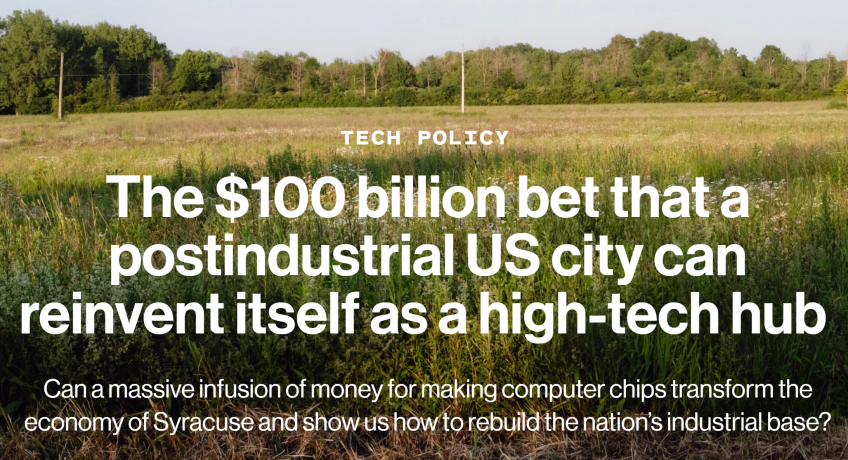
For now, the thousand acres that may well portend a more prosperous future for Syracuse, New York, and the surrounding towns are just a nondescript expanse of scrub, overgrown grass, and trees. But on a day in late April, a small drilling rig sits at the edge of the fields, taking soil samples. It’s the first sign of construction on what could become the largest semiconductor manufacturing facility in the United States.
Spring has finally come to upstate New York after a long, gray winter. A small tent is set up. A gaggle of local politicians mill around, including the county executive and the supervisor of the town of Clay, some 15 miles north of Syracuse, where the site is located. There are a couple of local news reporters. If you look closely, the large power lines that help make this land so valuable are visible just beyond a line of trees.
Then an oversize black SUV with the suits drives up, and out steps $100 billion.
The CHIPS and Science Act, passed last year with bipartisan congressional support, was widely viewed by industry leaders and politicians as a way to secure supply chains, bolster R&D spending, and make the United States competitive again in semiconductor chip manufacturing. But it also intends, at least according to the Biden administration, to create good jobs and, ultimately, widen economic prosperity.
Now Syracuse is about to become an economic test of whether, over the next several decades, the aggressive government policies—and the massive corporate investments they spur—can both boost the country’s manufacturing prowess and revitalize regions like upstate New York. It all begins with an astonishingly expensive and complex kind of factory called a chip fab.
Micron, a maker of memory chips based in Boise, Idaho, announced last fall that it plans to build up to four of these fabs, each costing roughly $25 billion, at the Clay site over the next 20 years. And on this April day, standing under the tent, CEO Sanjay Mehrotra conjures a vision for what the $100 billion investment will mean: “Imagine this site, which has nothing on it today, will have four major buildings 20 years from now. And each of these buildings will be the size of 10 football fields, so a total of 40 football fields worth of clean-room space.” The fabs will create 50,000 jobs in the region over time, including 9,000 at Micron, he has pledged—“so this is really going to be a major transformation for the community.”
....
Robert Simpson, president of the CenterState Corporation for Economic Opportunity and a close collaborator with Younis in recruiting Micron, puts the challenge this way: “Economic growth is no guarantee of a greater measure of shared prosperity. You can grow without improving the quality of life for a lot of people in the region. However, economic growth is a necessary precondition for a greater level of shared prosperity. You need growth—otherwise you’re just redistributing income and wealth from one place to the next. And that gets people understandably upset and nervous.”
The massive Micron investment, says Simpson, “gives us a chance to do something we have wanted to do for a long time, but we didn’t have the tools to do: bridge the socioeconomic divides that have held our region back.”
It’s a lofty goal that will no doubt be challenged over the coming years. There will be inevitable fights over housing and where and how to invest the hundreds of millions earmarked for community development. There will certainly continue to be skeptics, especially given the state’s hugely generous incentives and the number of years it will take to get the fabs fully up and running.
Transforming a city and its economy is not easy work. It comes with enormous risks. But in many ways, Syracuse has no choice. The great experiment unfolding there is one that the city—indeed, the country—badly needs to succeed.

其他
媒体报道