

S4,E21 - NY SMART I-CorridorPosted on November 11, 2026 |
Image
|
This is Talk CNY, a semi-monthly podcast by CenterState CEO, recording in the production studio at CenterState's INSPYRE Innovation Hub. CenterState CEO is Central New York's premier leadership and economic development organization. Join us as we meet the people and explore the projects driving the regional economy forward. This is Talk CNY, presented by NBT Bank.
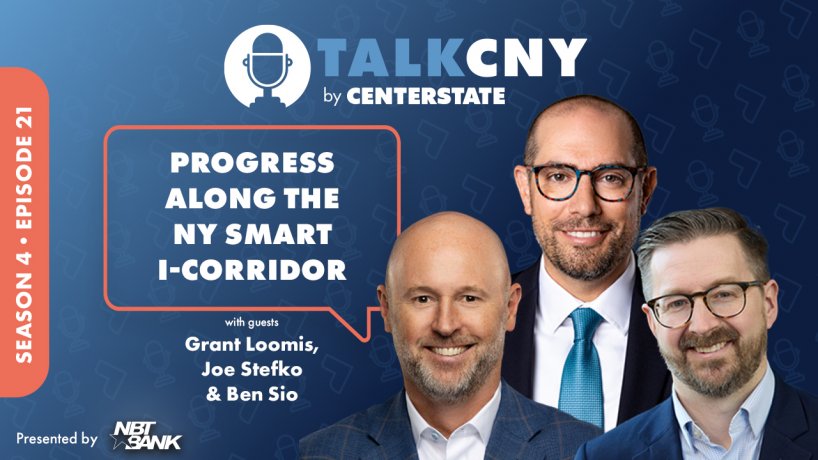
I'm Katie Zilcosky, Director of Communications at CenterState CEO and your host for Talk CNY. We are catching up on all of the latest progress across the New York Smart I-Corridor. On this episode of Talk CNY, we speak with Grant Loomis, President and CEO of the Buffalo Niagara Partnership, Joe Stefko, President and CEO at OneROC, and Ben Sio, President of CenterState CEO.
Thank you all so much for being here today. It's great to have you on the podcast.
Thanks for having us.
All right. So we are now about two years into the Federal Tech Hub's designation. What would you say, working on everything now, is the biggest difference from the announcement of the designation two years ago across the corridor?
Oh, I'm happy to start off. I think in 2024 we had an announcement, a plan and a designation, and now in 2026, we're building track record and that really feels like the headline difference for me. We've moved from proving that we could work as one corridor to actually starting to operate as one in this space. And I think when the designation first landed, the real question, one of the real questions was whether these three separate communities that have collaborated over the years, but maybe haven't really traditionally worked together at this level of sustained intentionality could actually operate as one. It feels like two years in, that question has been answered. To my way of thinking, the biggest change isn't really just one project, it's that the corridor now has this shared working identity with shared infrastructure and shared programs. I also think that it's impacted how the outside world sees us and sees Upstate to a degree.
I mean our federal partners certainly, but also industry and even other parts of the country are increasingly recognizing and talking about the SmartEye corridor as more of an integrated and collaborative ecosystem. I think that shift in perception has been hard won, but it's certainly really valuable to this work.
I think the other piece of this that is meaningfully different between now and 2024 is that the projects are just that much more real. 2024, Micron had been announced, obviously, and we were working on the environmental and the permitting process, but they hadn't broken ground. And I think there was still the question mark we got from a lot of partners, not just in Central New York, but across the corridor, is this really going to happen? Is it going to happen on time? How does that timeline match up with the work that you're doing as part of the Tech Hub? The reality is now the Micron project is underway. It broke ground earlier this year. The Edwards Vacuum Project had their grand opening last week, Joe, or the week before, but very recently. So people are beginning to see a lot of these kind of cornerstone real projects, the demand drivers for the work that we're doing turn into reality.
I think our timing was impeccable because we were able to get ahead of all of that and begin our work and start ramping up operations so that now when those companies, Edwards, Micron and others have the demands that they will have, we're going to be ready for it. So to me, that's the biggest change we've seen in the past two years.
Yeah, it's just much more concrete for everybody. I mean, there are direct ways today where companies and other organizations can plug in in meaningful ways that just simply didn't exist two years ago as we were getting off the ground and running. I mean, today businesses are actively getting assistance preparing for supply chain opportunities. Employers are directly engaged in shaping what training programs look like. For example, companies are working with our universities across the corridor on expanding and developing their technology. So there are just very tangible concrete ways that stakeholders across the corridor can plug in today. And that's just the reality of how far we've come in the journey so far.
And do you see that those stakeholders are developing more of an understanding of this vision of the New York Smart I-Corridor. That they're starting to understand what the goals are and how they can slot in, like you mentioned, more concrete ways or even just more engagement from them believing that they can be a part of it?
I can take that one first. I've been really surprised, honestly, in the two years that we've been doing this, the level of penetration that the Smart I-Corridor name and the Tech Hub name has locally, but globally also. There's a lot of times we've gotten inbound from trade delegations, from partners in foreign countries, and also from companies down the street from us that we may not engage with as much as we want to that said, "Hey, I've heard about the Smart I-Corridor," or, "I know you're a designated Tech Hub. I really want to engage with you because you're a designated Tech Hub and because you're part of this Smart I-Corridor." There has been an immense amount of just brand recognition we've received by being designated a Tech Hub. And I think that's a piece of the fact that this is a real thing designated by the EDA, Economic Development Administration, and it connects directly to this other project that people have heard about with Micron and Edwards Vacuum.
But I also think they connected to the collaboration that's ongoing. We've talked about this a lot on previous podcasts with you, but they see the ability to come into a place and engage with one brand and one group of partners that are all coordinated working together. And I can tell you that just the inbound we receive from folks on that has increased. And it's not just random inbound, it's actual valuable inbound from people that are making real decisions about where to locate in the United States or just how to better understand how to locate in the United States. Having that stamp of approval from being a tech hub has paid off in spades, in my opinion.
Yeah, I agree with that. I mean, awareness has grown a lot, but there's still work to do. I think the awareness has really been driven largely by the federal prioritization of this space, of this industry and sector. Certainly, in our part of the world, Micron's investment, the Tech Hub designation, the media coverage that's resulted, semiconductors have really gone from more industry jargon to something that people across our business and civic communities are regularly talking about. I would say five, six years ago, I don't think that was as true. So I think most people know now that the chips are coming, but the opportunity for us is to continue to advance awareness and understanding about, first of all, the sheer scale of the opportunity in front of us and maybe more importantly, what that means for them in terms of jobs and suppliers and career pathways.
So closing that awareness gap, continuing to close that awareness gap, I think is a next job that's really, really important for all of us.
I think another element of this when I consider bridging the awareness gap is continuing to emphasize how this is bigger than one fab. I mean, we've got a massive demand driver in Onondaga County and, frankly, other fabs across New York State, they're going to ripple across the state and create economic opportunity for us. But this is bigger than a single big plant when in fact it's a whole ecosystem, equipment makers, materials, optics and photonics, which are certainly a big part of Rochester's legacy and expertise, sensing software, all of the small and mid-sized suppliers that can feed into it. So for me, the bottom line is people increasingly are aware of the headline around opportunity. Our job now is to help them see themselves in that story.
Yeah, and I can share something fairly specific, which I think highlights that more people are growing more familiar with what we're doing every day, yet they're still somewhat surprised or taken aback by the potential of all this. The partnership just did a benchmark study where we compared our MSA against 12 other MSAs across the country. One of the things that we looked at was job growth in very specific industries, and one of those industries was semiconductor. The Buffalo MSA came out at the top of that list in terms of job growth in the semiconductor industry against those 12 other metros. And every time that I've shared that data point with an audience, most of the audience sort of does an eyebrow raise, which I don't think that they were expecting that to necessarily play out that way. So I think that just highlights the fact that people are becoming more aware of what we're doing and they're becoming more exposed to the major economic opportunity that this presents for all of our regions and New York State in general, really.
Now I know that whether it be awareness or actually getting people into workforce pipelines or the supply chain or engaging the vast research landscape, collaboration has been at the core of all of this work across the three metros here. But I'm wondering, aside from just the semiconductor ecosystem, building that up, by building greater ties between the areas, how has that helped other things that maybe people don't align with the New York Smart I-Corridor, but just kind of building new connections, stronger ties to each other as regions?
Yeah, I think the most valuable byproduct of this work has just been trust. Once our market's committed to and learned to work together on the Tech Hub, other collaborations came faster and easier, even around some amorphous things that, hey, we had an idea and one of us has an idea and brings it to the table, and we noodle it collectively. And also to think about what we've already explored together already, whether it's looking at our respective small business ecosystems and seeing if there's a play for us there jointly, joint advocacy, to really just sharing and learning from one another about what's worked and I think as importantly, what hasn't worked in our respective markets. So I think the Tech Hub consortium, particularly for our three organizations, has really given our markets a framework to build stronger relationships across Rochester, Buffalo and Syracuse, which as you said, can really carry over into all other sorts of work.
Yeah. I mean, I really sort of see this as a point of no return from the standpoint of there's... I feel comfortable speaking -
In a good way,
That's a good thing. It's a good thing. From the point of I feel comfortable speaking for Joe and Ben in this regard in that there's no going back in terms of how we approach economic development across the super region moving forward. The days where we are conditioned to compete against each other, I think are over largely because we have demonstrated that we are so much stronger when we're operating together. And yes, Buffalo's competition is not Syracuse or Rochester. We have different zip codes, we have different area codes, that's it. Our competition is other communities across the country, and we can compete at a much higher level when we are working together. I think there is a growing awareness that that new day is here and that parochial way of thinking that really I think has characterized the last several decades as something that we have definitely parked in the rear view.
We all, I think coming into this kind of felt like our communities had different zip codes, but really weren't that different. And the dynamics on the ground, yeah, we all have our interesting things happening on the ground on a regular basis, but this has proven to me, I think to Joe and Grant also that our economic futures are more intertwined than they've ever been. I think that's a great thing. To me, having the Tech Hub collaboration and this kind of structure for us to work together also gives us a structure for us to root for each other. So we celebrate expansions and groundbreakings in Buffalo and we celebrate them in Rochester and Ithaca and across the corridor because to me that is strengthening all of us. I think now Buffalo, Rochester and Ithaca see themselves more in the Micron Project, which in the long run for all of our communities is the right move and the important move. If we're going to bring all of the economic impact of these projects down to market in Upstate New York, we've got to have all of us rowing in the same direction. So it's given us that structure to collaborate where I think that feeling was already always there, but now we have a mechanism by which to exercise it, a muscle memory, as you might say.
Well, we will get into the specifics of some of the progress on some of the New York Smart I-Corridor initiatives in just a moment, but first we are going to take a quick break for a word from our presenting sponsor, NBT Bank.
At NBT Bank, we know that this day starts with this one. This day starts with this one because no matter how unforgettable the extraordinary days are, there's a lot of every day that leads up to them. You can count on NBT Bank to help you get started. NBT Bank, it starts here.
Welcome back to Talk CNY, presented by NBT Bank. I'm Katie Zilcosky, Director of Communications at CenterState CEO and your host for Talk CNY. I'm joined on this episode by Ben Sio, Grant Loomis, and Joe Stefko. Thank you all for joining me to talk about Tech Hubs.
Thanks for having us back.
So Tech Hubs consists of three main components: the SCAN component, the STEP UP component, and the C3 component. So I want to run through those real quickly to get an update on the work that's been done across the region on those three major initiatives. I want to start first with SCAN, which is the supply chain component. What has been going on in the last year? Are you seeing an increase in interest from folks wanting to be a part of the supply chain now that, like you mentioned in the first half of the show, shovels are in the ground and projects are really moving forward in earnest?
Yeah, absolutely. So SCAN stands for Supply Chain Activation Network. Katie, we love our acronyms, as we said. I think it's important to just remember when we talk about SCAN that when we were pitching the federal government on the concept of this Tech Hub, obviously the historic investment that Micron was making in Central New York was really the catalyst for all of this. But there's a whole other piece to this, which I think sometimes gets lost a little bit in the sauce, which is that the data told us that there were dozens and dozens and dozens of legacy manufacturers in all three metros that had the ability, sometimes with a little bit of a technical assistance, to pivot ever so slightly to become viable suppliers to the semiconductor supply chain. And that really represents a historic economic opportunity above and beyond the Micron investment for our region.
So it really sort of underscores the importance of this particular project. So SCAN is all around helping businesses figure out how they can pivot or if they already produce something that a semiconductor manufacturer needs, how do they get started on a potential journey to become a supplier or a customer? What are the requirements that are necessary? SCAN helps them understand those requirements and connect with the right level of support so that they can be a viable supplier. We get a lot of questions around we already make this or we already provide this service. SCAN is about helping people understand where they could fit and what would a customer require of them, and then doing that work so that ahead of time, whether it's new certifications or increasing their cybersecurity defense system or making some physical changes to their operations to increase their facility improvements or whatever it might be, so that when the opportunity does arise, they've done that homework and they're ready to step into line.
So it's really about being able for that company to understand what it needs to do to meet customer expectations and SCAN helps identify what they're currently missing and then connect that company with the assistance to address it.
And have you seen, would you say in the last year, more interest from folks who can make that pivot that maybe before this was still confusing, the terminology still wasn't familiar with them, but now that this has been more in our region for a longer period of time, that awareness gap is being bridged, like you mentioned, that you see more people willing to take that step to ask that question, "Hey, how do I fit into this?"
Without a doubt, and I think especially as we said at the beginning around Edwards and Micron itself breaking ground or opening their doors, depending on the situation, I think all of that fuels interest in other companies saying, "Okay, this really is real, and I think that there's a play for me here." We have discretionary dollars that are a part of all of these component projects, and SCAN awards something that we call ignition grants. We've awarded approximately $350,000 so far across 14 companies. There's another 19 companies that are in the pipeline to receive funding. And this funding, these ignition grants support the things that I talked about earlier, the certifications that a company might need or other operational improvements so they can really do all of that prep work now with this proper support because we know that work takes time, and we want them to be ready to take advantage of these opportunities when they arise hopefully here in the short term.
Now, an important part of this ecosystem too is having a really strong regional workforce for all the jobs and opportunities that are coming our way through the semiconductor ecosystem. So that is our STEP UP initiative. Can you give me a little bit of an overview of what STEP UP's all about and what gaps we've seen bridged in the time that the Tech Hub designation has been active?
Katie, you alluded to this, I think in a lot of ways talent is that all of these component projects are really important. At the end of the day, talent is maybe the most important deciding factor to ensure that not only do we optimize the opportunity that's in front of us, but to ensure that the benefits really stay here in our community. So STEP UP is our workforce component project. It is about making sure that fundamentally that the jobs that this industry creates are filled by people who are already here. And as Grant said, we've got acronyms riddled throughout this initiative. This is the Semiconductor Talent and Employer Partnership in Upstate New York, so STEP UP. The simplest way to describe it is it serves as a unified front door for employers to access talent pipelines across the corridor. It is employer informed, importantly, and really helps to coordinate investments in training infrastructure, wraparound supports and access to careers both in the middle skill technician space, but also in the construction trades, which of course are really important for us making sure that we have the horsepower to actually build out the facilities that these activities will take place in.
You asked about some of the gaps that we've really tried to target through STEP UP over the first couple of years of this work. I would say three of them rise to the top of my list. The first is around fragmentation. I think before this work began, employers really had to deal with more of a disconnected ecosystem across dozens of training providers, institutions of higher education, different programs. STEP UP is intended to give them more of a single coordinated doorway in with training then tied to what employers are telling us that they need. Related to that, I think making sure that training is matched to real jobs, both existing jobs, but jobs that we know are starting to emerge with the growth that we're going to see in the coming years. And part of that involves focusing on identifying and then investing to fill those curriculum or programmatic gaps while at the same time scaling what's already working.
Then the third area, the third gap that really focus on trying to fill is, we talked a little about this earlier in the conversation, awareness. Awareness of the opportunities, awareness of what this career pathway looks like, and making sure that those of all ages across our corridor fully understand not just what these opportunities can present, but how they as individuals, as families can access them.
So we've got supply chain. We've got workforce. The last pillar is research and development, and that's the C3 initiative. Can you talk a little bit about why having a strong research arm is so important to a complete ecosystem and what progress has been made on the C3 front in the last year?
C3, as we've talked about it in the past with you, Katie, really focused on helping existing firms that we're engaging with throughout the corridor innovate and develop new products that lead to direct commercialization opportunities. And this is also the mechanism that we got our colleges and universities engaged from a research and development perspective. So obviously as part of the STEP UP work, deep engagement with our talent generating entities across the corridor as part of C3. Similarly, this is more focused, as we've discussed with you in the past, on our higher-tier research institutions. So Syracuse University, Cornell University, RIT, U of R, University of Buffalo, going down the list of those institutions that were part of this entire effort when we originally established this. Specifically, it's meant to give a front door for these companies to engage with any of these institutions in ways that help those companies, those existing companies advance their own work in the space.
So it's parallel to the work of SCAN. SCAN is about helping companies begin to understand their role in that ecosystem and make advancements as a supplier. This is about helping companies, and it could be the same companies in some instances, actually innovate within that space so that they can become more competitive as a supplier or as an OEM in the microelectronic space. Very importantly, we did this in a very intentional way to be additive to the work that New York creates is doing in Albany around R&D. This is not meant to create new R&D fabrication facilities like they have in Albany. This is meant to really come home to companies on the ground here, and it's been super successful. The cool thing about this program is they've gone through two rounds of investments since we talked to you last. First round was just getting thing going, but the last round that they announced back in October, they announced 21 projects, $3 million worth of investment just in Central New York alone with companies like Flox, which was a GENIUS New York company, BQP, which is a quantum company located in the INSPYRE Innovation Hub, Saab and TTM.
So we've got Flox, which is a startup company out of Sweden, and you've got Saab and TTM, very established defense contractors that are in the Central New York area. And this is across the corridor. I'm just talking about Central New York companies here. Interestingly, we've seen opportunities for different companies at different sizes to engage directly with our research institutions throughout this program, and we intentionally designed it so that any company could come in and engage in that way. So we're super excited about it. Still early days in terms of new patents and new licensing activity being generated out of, but these guys are doing a great job in really getting these projects moving forward and pairing each of these individual companies directly with a research entity or research institute at one of the colleges and universities. So again, beginning to hit their stride, really beginning to connect the dots in terms of getting good company engagement, and we're super excited about where it's going.
So a lot of work's been done, but I'm sure there's a lot of work still to be done as well. As we wind down 2026, what are some of your goals for 2027 ,when it comes to the New York Smart I-Corridor?
I'll start on that. I think 2027 is really the year that we go from building these programs, activating these programs, to really showing more tangible results. It's the year we, in a lot of ways, I think, make the corridor and the collaboration permanent. The first two years, even though we've certainly activated these programs over the last 24 months, I think in a lot of ways it was about standing up the work. But as Ben just mentioned, through the last two rounds of what we've seen in the C3 application process, we're seeing more company awareness, which begets more company engagement, which begets more investment in those companies, technical assistance and support to those supply chain companies, and translating what we're hearing from employers into what our workforce training providers are doing. So I think we're seeing a more rapid maturation of these component projects. So the next year is really about proving that impact at scale.
And I think also importantly, making sure that the collaboration lasts beyond this single grant. We've spent a lot of time over the last 12 months in particular talking about these other various tentacles that this collaborative framework could create for our respective communities. And I think we'll see more of those come to fruition in 27.
Yeah, for me, we work hard as a group to not talk about what this means for any particular metro and frame it as a regional play, but I'm going to deviate from that ever so slightly with the best of intentions to say that for me, it's important that over the next year, Buffalo leans in more into the opportunity that all of this presents. I think being the farthest from the Micron construction geographically, I think it is a little harder for people in our community to start to knit all the pieces of this together. We've made progress, but there's more to do, and so I'm excited about having the collective of the Buffalo Niagara economy really understand the play here and the excitement that is going to be derived from all of our efforts.
I guess I'll finish this up here. To me, it's outcomes, outcomes, outcomes. We're a couple years in, we started this up. Last time we talked to you about this, there was the apprehension of when you start a new program, are there going to be people that demand the program that we're offering? Are the people that are going to be interested? I think we've proven that there is interest and there is demand and that companies want to engage here, but they engage with the expectation that there are new opportunities for them, that they are going to be able to grasp something new for their business and grow and receive investment. And take that next step. And now it's become incumbent on us as organizations in the space to help companies succeed in that, which to me is really exciting. Now we know there's demand, there's interest. Now it's making sure that companies thrive in the best way possible from all of this and benefit in the best way possible and make use of the different programs.
We have companies that come in the door through C3, through STEP UP, and making sure those companies make use of SCAN and the other project we have available is also I think a real important thing for us to be digging into deeply this year. But for us this year, it's continuing to do whatever we said we're going to do, continuing to drive companies through, provide visibility on those companies that are going through these programs, and hopefully begin to make some really good connections between those companies and the suppliers that eventually will begin to need their services.
Well, it has been great to catch up with you all. Always a pleasure to have you on. Thank you, Ben, Grant, and Joe.
Talk CNY, presented by NBT Bank, is recorded in the production studio at Center State's INSPYRE Innovation Hub. Talk CNY is available on all major podcast platforms or centerstateceo.com. Additional content and clips can be seen across CenterState CEO's social media channels. For new episode reminders, be sure to subscribe in your favorite podcast listening app and don't forget to leave a quick review or five-star rating. Thanks for listening to Talk CNY, presented by NBT Bank.
Other
| S3,E4 - Hope Knight | February 26, 2025 | |
| S3,E3 - Nora Spillane | February 12, 2025 | |
| S3,E2 - Melanie Littlejohn | January 29, 2025 | |
| S3,E1 - Rob Simpson | January 15, 2025 | |
| S2,E24 - Kevin Schwab | December 18, 2024 | |
| S2,E23 - 2024 Highlights | December 4, 2024 | |
| S2,E22 - Tony Baird | November 20, 2024 | |
| S2,E21 - John Liddy | November 6, 2024 | |
| S2,E20 - Rob Simpson | October 16, 2024 | |
| S2,E19 - Dr. Juhanna Rogers | October 2, 2024 | |
| S2,E18 - Tylah Worrell | September 18, 2024 | |
| S2,E16 - Ben Sio, Dottie Gallagher, Joe Stefko: Part 2 | August 21, 2024 | |
| S2,E15 - Ben Sio, Dottie Gallagher, Joe Stefko: Part 1 | August 7, 2024 | |
| S2,E14 - Rob Simpson | July 24, 2024 | |
| S2,E13 - Dave Kavney | July 10, 2024 | |
| S2,E12 - Ebony Farrow | June 26, 2024 | |
| S2,E11 - Aimee Durfee | June 12, 2024 | |
| S2,E10 - Kristi Eck | May 22, 2024 | |
| S2,E9 - Nora Spillane | May 8, 2024 | |
| S2,E8 - Housing Taskforce | April 24, 2024 |