Deep Dive: Understanding Employment in Syracuse
发表于 |
Image
|
CenterState CEO’s Aimee Durfee sat down with our Communications & Grants Specialist Maximilian Eyle to discuss the evolving nature of employment and the steps being taken to make careers more accessible for CNY residents.
Aimee Durfee moved to Central New York two years ago from the San Francisco Bay Area, where she worked at Jewish Vocational Service, overseeing 15 different job training programs. Now she serves as CenterState CEO’s Director of Workforce Innovation, helping to connect untapped talent to career pathways among CNY residents and businesses. Durfee’s career spans more than 20 years of anti-poverty, workforce development, and asset building work. She also has a background as an attorney, specializing in employment law. The Gifford Foundation has worked closely with Durfee as one of the funders behind CenterState CEO’s Work Train initiative.
How can employers attract and retain candidates? How is The Great Resignation affecting Syracuse? What strategies are being used to help get people back to work? Her efforts with such initiatives as Syracuse Build, Work Train, and Syracuse Surge reveal important lessons about how employment standards are evolving and how we can best adapt.
Max: Let’s start with the basics – what exactly does CenterState CEO do?
Aimee: CenterState CEO is an economic development strategist, business leadership organization and chamber of commerce for CNY. We are focused on bringing economic development to the region but in a way where everyone can benefit from that growth and prosperity. Work Train is a program of CenterState CEO; as a workforce intermediary we are supported by the Work Train Funder Collaborative, of which the Gifford Foundation is a member. From 2014 through 2020, Work Train helped roughly 1000 individuals secure employment. Although we had to pause some of our programming during the first part of the pandemic, we expect that an additional 700 people will have received professional training through our partner programs in 2021 and 2022.
Through Work Train, CenterState CEO brings together employers who are looking for workers, training providers and community organizations, and we connect with job seekers and workers to understand their challenges. We design and fund programs that address gaps in the system. We are looking for opportunities for connect people to careers and good wage employment, and we are looking to diversify industries that are traditionally white and male.
Most of all, we help people identify their untapped talent. We know there are people in the community who have skills that could be used in a career that they might not know about, and employers don’t know how to connect with them. Our programs help build on those skills and bridge these gaps.
Max: Can you give an example of some of the programs you have launched?
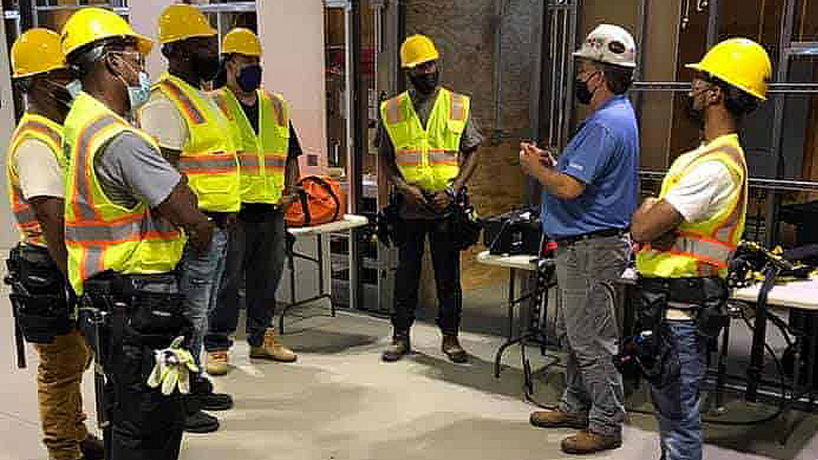
Aimee: Syracuse Build is a great example of this. This Mayoral initiative focused on the construction industry was incubated with our team’s support. Now the initiative is led by a highly talented Director and Manager and is housed at CNY Works.
Syracuse Build helps people access opportunities to get into construction, and is a place where employers and unions can find a pool of interested and qualified individuals.
We are also incubating workforce programs with partners as part of the Mayor’s Syracuse Surge strategy, which is related to coding and high-tech manufacturing. There’s also a program for digital customer service/call center work, as well as manufacturing training programs. For both initiatives, we raise funds and then target that support to specific projects.
Max: Are there many opportunities for employment here in Syracuse? If so, what are the main barriers that prevent people from accessing those jobs?
Aimee: There are significant job opportunities for people in Central New York. The question is whether opportunities are at a wage level that can sustain a family, whether people can find childcare so they can actually go to the job, and whether they have adequate transportation to get to the workplace.
What we’ve found is that a lot of employment opportunities are outside of Syracuse, and some are not on a bus line or shifts are not aligned with bus schedules. Additionally, we know that child care is hard to access at hours that align with all shifts.
There are a lot of challenges when you’re talking about people in poverty trying to get access to employment. Applying to a job is just one layer of it. We are working with employers on things like, ‘how long does it take to fill out your application? Can you fill out your application on a phone? Do you say in your job announcement what time and where the job is?’ If the employer says, ‘we are on a bus line, this is what time the shift starts, and this is what the job is,’ then people are more likely to apply.
The other piece is turnover: when people get into a job and then it isn’t what they thought it was, it’s too far away, or it’s not a high quality job, or their childcare stops functioning, or they can’t maintain a car because they aren’t getting paid enough to afford gas – all this stuff is ‘outside of the job’ but it heavily impacts how people can access those jobs.
There’s also bias and discrimination at different points in the process. Employers need to look at their hiring pools, who is getting hired and who is advancing. Are their job requirements related to the skills required for the job? Is the work environment welcoming and diverse?
If you’re talking about people getting out of poverty, you’ve got to advance. You have to have the ability to save. You have to have health insurance. And these are also aspects of a job that attracts talent. So that’s the question with many of these jobs – do they have any of those things that both support workers and make an employer more attractive in a competitive employment marketplace?
Read the full interview on The Gifford Foundation's website, here.
其他
媒体报道