

S4,E8 - Joe NehmePosted on April 22, 2026 |
Image
|
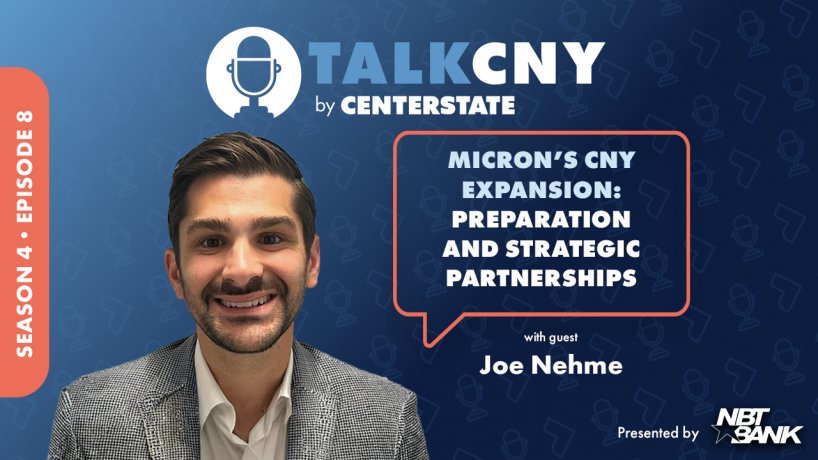
This is Talk CNY, a semi-monthly podcast by CenterState CEO. We're an independent nonprofit committed to creating inclusive, equitable, and sustainable economic growth in Central New York. Join us as we meet the people and explore the projects driving the regional economy forward. This is Talk CNY, presented by NBT Bank. I'm Katie Zilcosky, Director of Communications at CenterState CEO and your host for Talk CNY. CenterState CEO is hosting Micron Technologies Executive Vice President for Global Operations, Manish Bhatia, for its 2026 Annual Meeting. Batia's visit to Syracuse comes as Micron works to prep its site in Clay for its first fab and continues to lay roots in the Central New York community. There are a lot of moving pieces to the Micron project, and we know that it can be difficult to stay on top of it all. So on this episode of Talk CNY, presented by NBT Bank, we're joined by Micron Technologies Senior Manager for External Affairs, Joe Nehme, to discuss what Micron has in the works and what to expect in the future.
Joe, thanks so much for joining us today.
Thanks for having me.
So 2026 has been a big year for Micron so far in the community. We celebrated the groundbreaking at the site in Clay in January. Most recently, Micron was here for the inaugural Central New York community week. So I know there's been a lot of work that's been going on behind the scenes, but we're really starting to see stuff in the community that other members of the public can see as well and celebrate with us. So what's that been like to finally see those two things come together and see them play out in Central New York?
Yeah. I mean, I've been at this for a long time. I have worked for the company for about three years now and had been working on this idea of a semiconductor manufacturer in Central New York for longer. I know the tremendous amount of work that has been put into this project over the past several years and even prior to the selection, but the people don't see that. And so to be able to finally be on the other side of groundbreaking has been tremendously exciting. I give a lot of talks like this and they're certainly more exciting and easier to do when we are on the other side of groundbreaking. And like anything this big, this high profile, there are ebbs and flows. And I'm a highly emotional person, so it's easy to get caught up in those ebbs and flows, but I try to focus on just small progress each and every day, little wins each and every day.
And when you're at that for an extended period of time and you take a moment to stop and look back, you realize you've come a long way.
Oh
Yeah. But when it comes to this project, we have so, so much work to do. And so you can't stop for too long, you got to keep going. But it's been an exciting couple of months for people to start seeing the fruition of what we've been working on.
Speaking of what you guys have been working on, there is work happening right now in Clay, New York at the Micron site. So can you tell me a little bit about what's happened so far and then what are the next steps to getting the fabs built?
Sure. So first milestone this year was to ensure that we were able to clear trees by the March 31st deadline. We were able to do that with several weeks in advance, approximately 330 acres of trees that we cleared. And the folks and the team up there did a tremendous amount of work. So now we're really onto the next phase, which includes site establishment and groundwork. So perimeter fence, stormwater, retention ponds, grubbing, leveling, mass excavation, really with preparing for a concrete pour by the end of the year. 2026 is that horizontal work that we're focused on. And then in 2027 is when we start to go vertical. And that's really when you're going to start to see thousands and thousands of construction workers on site and really the project come to life out of the ground.
That's really exciting. I mean, and I was at the construction careers information session, one of them last week, and they were giving some statistics about what just even one of these fobs is going to look like. I mean, it's huge. I mean, they're giving these kind of crazy statistics about how much rebar and concrete is going to be used. How do you help people conceptualize what's going into that space and how big this really is?
Yeah, it's massive. Each fab is about 600,000 square feet of clean room space, and we're building four of them. So 2.4 million square feet of clean room space, and that's approximately the size of 40 US football fields. There's also support buildings that go around it, so it's actually bigger than that. Another way to help kind of conceptualize it is when all four fabs are complete and you walk from one end of the facility to another, it's about 1.1 miles. And then the other, one of my other favorite statistics is that 70 tons of steel per fab, and that's about the same amount of steel that was used to produce the Golden Gate Bridge. So about four Golden Gate Bridges. So it's a massive project and scale. And I think you mentioned the construction career fairs that we were able to do several cohorts that we went and talked to at CNY Works, ON-RAMP, OCM BOCES.
I think people think a lot about the fab itself and the jobs coming from the fab. But before a single wafer goes out the door, we're going to need thousands of construction workers. And it provides a great pathway for people locally to get into the trades and to help us build this thing. And there's so much incentive for us to pull from the talent here locally, which makes those programs that are getting people into the trades in partnership with the building trades unions to ensure that we have enough people here to build these fabs. A lot of the work is typical work you'll see at a construction site, but obviously there's many things about fabs that are highly specialized and specific and requires a certain type of skill. And that's why it's going to be really important that these thousands of construction jobs maybe not be direct Micron jobs, but it's really important that we're working with the ecosystem to help build those pathways and those pipelines.
We have a tremendous base of programming here, and it's about scaling and replicating that.
I was going to say, I mean, Micron, CenterState CEO, all of our really great regional partners have been working to put this pipeline together. And like you said, these are opportunities for folks who might not work in the fab, but will have a great career, both if they get to work on the site and otherwise after. So was that really a priority for Micron when getting this project off the ground and even getting started to build this talent pipeline well before you guys broke ground? I mean, we talked a little bit about the work beforehand. This was some of that work beforehand.
Yeah. Really from day one and credit to CenterState CEO and the team here who has been a tremendous partner, not only with the fab work, with the jobs that will come from the fab, but also the construction work. And from the very beginning, one of the first things we did is establish the Future Ready Workforce Innovation Consortium. It's a tongue twister, but it's really important because as I just mentioned, one of the draws to Central New York is our tremendous education and workforce ecosystem. And so we don't have to come in here and reinvent the wheel. We need to really engage and work on scaling and replicating the programs that exist here today. And I think Micron is one of the leaders in the nation, not only in the semiconductor industry, but of all corporate America, really our workforce strategy, really thinking about it from cradle to career.
Obviously, childcare is a big priority for us, so we're obviously going to have a childcare facility on site. We've made some investments in YMCA here locally to help scale childcare programs and the tremendous amount of benefits that we provide to our employees. I'm actually expecting another child this summer.
Congratulations...
...and the support that Micron provides to new parents is tremendous. And then obviously looking at the K through 12 space, we do a tremendous amount of, we call it signature programs, but things like CHIP camp, careers in a high-tech world, going tech. And the goal there is to start reaching it at a young age in the middle schools and in the high schools to get kids excited about careers in semiconductors. And then obviously, teacher development is really important. We have a partnership with the New York State Teachers Union and the American Federation of Teachers to start working with teachers directly, not so we can design the curriculum, but that they can design that curriculum, bringing it back to the schools.
And then obviously the technician work that we've done at Onandaga Community College, our partnership with Syracuse University, of training, transitioning veterans. I mean, I could go on and on and on about the workforce priorities, but that was something that we started from day one. Well before, and we're going to continue to do that.
I know the Future Ready Workforce Innovation Consortium, FRWIC, another...
FRWIC, correct, yes.
Great acronym.
It has over one hundred partners in it. What's it like working with so many people, bringing everyone together in that space to find a solution to building that talent pipeline?
Our partners are the experts.
They know where the people are, they know how to structure the programs, they're credible messengers. So again, it's about equipping them with the things that we need, and then they can go deploy that. I think we were able at an event that we had last week, a teacher, Ryan Terpening is what they call him, Ryan Terpening, but he's the P-TECH coordinator at Corcoran High School. And P-TECH is essentially a program for high school students that allows them to start taking college credits, particularly community college credits in high school. And we worked with Corcoran to design a semiconductor specific P-TECH program. And the goal is obviously to replicate that in other part other schools, but to hear Ryan talk about the possibilities that students start to see in themselves when they can start getting hands-on experience and learning about these careers. So it's a dual benefit for us, right?
It's a benefit from Micron because we're training people to work in the industry. We hope they work at Micron, but certainly they can go anywhere. And it's a benefit to Central New York because we want to make sure that people in Central New York have opportunities on these jobs. I mean, that's really important to the company. It's really important to me as someone who's from the region, but we can't do that alone. We need those partners. We need intermediaries like Center State CEO to helping us be that umbrella organization to help us do that. And again, it spans everything from construction careers to technicians, both of which we're going to have thousands of technician jobs, thousands of construction jobs. None of those require a four-year degree. So talking about building good middle class wealth. If people can have the option to do that, but we also need the engineers and the scientists and the Ph.D.'s as well.
So we've got a big task to be able to fill our workforce, but we have the partners here in Central New York that can help us pull it off.
Well, we will have much more coming up, but first we're going to take a quick break for a word from our presenting sponsor, NBT Bank.
At NBT Bank, we know that this day starts with this one. This day starts with this one, because no matter how unforgettable the extraordinary days are, there's a lot of every day that leads up to them. You can count on NBT Bank to help you get started. NBT Bank, it starts here.
Welcome back to Talk CNY, presented by NBT Bank. I'm Katie Zilcosky, Director of Communications at CenterState CEO and your host for Talk CNY. On this episode, we are joined by Micron's Joe Nehme. Joe, we are so happy to have you here. Thank you for being here.
Thanks. Happy to be here.
So we talked, we mentioned it at the start of the program that recently Micron had its first Central New York community week, which was filled with a lot of events, but kicked off at the end of March with an announcement from Micron of $35 million in community investments through the Green CHIPS Community Investment Fund. Can you walk us through what those investments are and why they are important to Central New York and Micron's future?
Yeah. So taking a look backward first, we have a very strong, robust commitment to a community investment framework, $500 million Green CHIPS Community Investment Fund, half of which will be funded by Micron. And so I think when we're really looking at the investments that the company is looking to make as it relates to the investment fund, we really want to make sure that the benefits of the project are reaching everyone and that ensuring that our investment is going to have widespread impact across the community. So that includes investing in things like workforce and education, but it also includes investing in the things around the needs for people looking for jobs and looking for employment. So really proud of the investments that we announced and really covering a wide range of areas. So you mentioned a $30 million commitment to the Central New York Housing Fund, a really innovative approach by the State of New York, local finance in financial institutions.
And I know CenterState CEO is sort of the brainchild behind a lot of that work. And so really ensuring that we're expanding the housing supply, that's going to be important to the region. It's going to be important to our employees.
And investment in transportation, really excited about this one to be able to create a new express line from the downtown hub here for Centro straight up to the site, giving people the opportunity to, if they don't have a vehicle, that they could utilize the bus service, but also helping kind of reduce traffic up in Clay and ensuring that we don't have ... Limiting the car traffic where we can as it associates to that. So really, really excited about that investment. A partnership with Jefferson Community College in the North Country, specifically tied to training, transitioning Fort Drum veterans and families. So, I think the number is something like hundreds of veterans matriculate, leave Fort Drum per month.
Oh, wow.
A lot of times those veterans pick up and they go to other parts of the country. We want to keep them here and provide opportunities and pathways for them to come work at the fab. Investment in Peace Inc., a childcare investment, which it's the early childhood pathways program that Peace Inc. has launched, but essentially it focuses on expanding the number of childcare providers, particularly home care and things like that. So partnering with them to expand that program. An investment with SUNY Oswego, there's not really a better SUNY school, really a better school in the state that trains educators. There was an article recently that OCC, despite the big investment we had, they're struggling to find educators that are going to come and do this. And so we're partnering with SUNY Oswego to enhance STEM educators and CTE educators and ensuring they have the tools that are aligned with the things that we need today.
And then finally an investment with OCM BOCES on their adult program to get more people in the construction trade. So again, looking at all of those different areas, how can we as Micron support the region, but also selfishly, it does provide a benefit to us. We want people to have access to these jobs, and I think our investments touch a lot of different areas, and there's going to be more to come.
I want to kind of take a step back a little bit because these investments don't come out of nowhere. There was a really large community engagement process that took place before that are guiding these investments now. Can you speak a little bit to the community priorities document and how that's guiding what people are seeing in the announcements now?
Yeah. Very early on, along with the state of New York, we established a community engagement committee led by Melanie Littlejohn and Tim Pennix. And the goal there really was, we wanted to hear from members of the community that have a lot of experience here. What are the key areas that we Micron in New York State should be looking at when we make these investments? I think the community engagement committee did months worth of outreach. I think the engagement numbers were something like 12,000 Central New Yorkers were engaged, over 300 organizations, 50 focus groups, if you will, meetings that sort of informed what ultimately became the Community Priorities document. And again, that document, I think what is in it necessarily isn't a surprise to people, but it's a reinforcement of the things that matter. Education, workforce, housing, and making sure you're really intentional about those investments and making sure people across the community, whether it's in rural Oswego County or the City of Syracuse are having access.
So that's really important. We're going to continue to engage the community engagement committee moving forward. They're a tremendous asset. Each and every one of the members of the committee brings a whole lot of experience and years and years and years worth of hard work, groundwork here in Central New York that could provide a benefit to us in the state. So we're going to continue to find new ways to help engage them, but we're honored that they've dedicated so much of their time to support the work that we're doing.
Now, the Green CHIPS Community Investment Fund, it is, like you said, a commitment from Micron and the state to match funds and $500 million end up with $500 million worth of investment in Central New York. I mean, how significant is that for a public and private partnership of this scale for a community like Central New York or even just when you zoom out nationally across the country?
I don't know of anyone in the country that has an agreement, a commitment that Micron has. I think there's a double-edged sword with that because the needs of this community well outstripped $500 million. And I think a lot of people feel that they might be on the outside looking in and the investments can only go so far. But with that being said, it's a tremendous amount of money, and we feel that we can really make targeted investments. And the goal really is to folks, what are the things, again, that are going to make sure that the benefits of the project are widespread? And that's kind of what we're looking at as we look at these investments and then encouraging others in the private sector to come join us. Our private sector, philanthropic organizations, foundations, come join us in these investments, find areas that are aligned with the community priorities document that you care about, and then come and talk.
And I think the Central New York Housing Fund is a really good example of that, right? It's the state of New York, it's Micron, but it's also, I think, a dozen local private financial institutions that have some skin in the game. And I hope that as we start to do more of it, you'll start to see more organizations, whether they're local, statewide, or national, come and join us in that effort.
Now, Community Week also consisted of volunteering events, STEM events for students. You had us talk about Micron's role in the memory ecosystem and AI's demand at INSPYRE Innovation Hub. It was a very busy week for you all, but it brought a lot of Micron representatives to the area that maybe hadn't been to Central New York before. So what was it like for you who you're a Central New York native to kind of bring all your colleagues to the community and say, "This is the place that we've kind of placed our bets on. This is where we're going to build."
Yeah. Well, first they said, "Wow, it's cold." But no, I think ... Yeah.
You said, "It will get warmer. The weather gets better. I promise."
Trust me, our summers are beautiful. But no, I think from the very beginning, even prior to me joining Micron and the Micron executives and the Micron team would come to Central New York, they would always comment about how hungry we are, how scrappy we are, how a type of investment like this brings everyone to the table in figuring out a way they can support. And so I think we've always showed out when, whether it's top executives or rank and file throughout the company come, the excitement and the hunger that we have here for an investment like this to make it successful, I think is really important. I think the other thing I want to point out is it's not only ... Sometimes I feel that a lot of people in the community think I'm the only one that works here for Micron. And really right across the street from where we are today, we opened our office in downtown Syracuse back in October and we got about a team of about 25 people here that it's just an amazing team that pours each and every ounce of their effort into this project every day.
And so to have an opportunity, not only for people outside the region from Micron come here, but also the people locally that are working here also introduced themselves to the community
It was great. And it's a collection of people, right? We have people that are working in the office that are from the region, but moved away and have moved back here for the role. We have people that are actually Micron veterans, have worked at Micron for many years that are from the region and decided they want to move back and support this project. And then you have Micron people from other locations that are bringing their expertise that are moving here, both from within the country and outside the country. So it's a great group and events like Community Week are an opportunity for the community to see us showing up, but it's also an opportunity for us to continue to introduce ourselves to the community. So definitely want to continue to show who we are and show up and the project elicits a lot of opinions and I feel each and every one of them, but at the end of the day, there are people here that are working really hard to make it possible and it's good for people to see that.
Did you have a favorite part of Community Week going through kind of all those events day in and day out?
The two events that we did were Astronaut Jeanette Epps were really, really ... I mean, for kids from Central New York to have the opportunity to hear from someone who's as accomplished and successful as she is, that grew up right here in Syracuse, come back and talk to them about the possibilities, that's what it's all about. It's about giving people that people ... Growing up, I think sometimes you take paths of things that you're familiar with. And so if people can be familiar with someone from their community reaching as high as levels as Astronaut Epps has done.
Out of space.
Literally outer space.
Yeah, that was really a cool thing to see the kids react to that.
We of course will be hearing much more from Micron. Throughout 2026, we were lucky enough to have Executive Vice President of Global Operations, Manish Batia speak at CenterState's 2026 Annual Meeting. What do you hope people took away from Manish's message at the annual meeting?
Yeah. I think obviously Manish being the Head of Global Operations is in charge of both our manufacturing footprint, but also building the fabs and obviously taking away that AI has unleashed an insatiable demand for memory. And we as America's only memory manufacturer are well positioned to meet that, but also sort of the stakes of this moment. And we're in a global competition and in order to maintain market share, the scale and the speed in which we need to innovate is tremendous. 1500 processes to make a chip, each of those processes need to be executed with precision or else the whole process falls apart. Our fabs are outfitted where every 18 months a new technology is filtered in. So the scale and the speed in which innovation is needed, we need to execute on that, but we also need a partner in Central New York that's going to help us execute on that.
So I think the message taking away today from Manish is, look, we got a lot that we need to do to make sure we're ahead of our competitors, but we need the community's help in doing that. And that's going to take us all acting in unison. We have a motto at Micron. We're 50,000 employees all working together to solve a singular problem. And I think in this instance, we want Central New York to be part of that mission. And I think we're ready and prepared for the moment, but it's going to take a lot of work and a lot of partnership. And the speed in which we do that is so great that the stakes are pretty high.
Well, Joe, we look forward to working with you into the future to find that success. And thank you so much for stopping by today.
Thanks, Katie.
Center State CEO's podcast, Talk CNY, presented by NBT Bank is available on all major podcast platforms or centerstateceo.com. Additional content and clips can be seen across Centerstate CEO's social media channels. For new episode reminders, be sure to subscribe in your favorite podcast listening app. And don't forget to leave a quick review or a five-star rating. Thanks for listening to Talk CNY presented by NBT Bank.
Other
| S3,E3 - Nora Spillane | February 12, 2025 | |
| S3,E2 - Melanie Littlejohn | January 29, 2025 | |
| S3,E1 - Rob Simpson | January 15, 2025 | |
| S2,E24 - Kevin Schwab | December 18, 2024 | |
| S2,E23 - 2024 Highlights | December 4, 2024 | |
| S2,E22 - Tony Baird | November 20, 2024 | |
| S2,E21 - John Liddy | November 6, 2024 | |
| S2,E20 - Rob Simpson | October 16, 2024 | |
| S2,E19 - Dr. Juhanna Rogers | October 2, 2024 | |
| S2,E18 - Tylah Worrell | September 18, 2024 | |
| S2,E16 - Ben Sio, Dottie Gallagher, Joe Stefko: Part 2 | August 21, 2024 | |
| S2,E15 - Ben Sio, Dottie Gallagher, Joe Stefko: Part 1 | August 7, 2024 | |
| S2,E14 - Rob Simpson | July 24, 2024 | |
| S2,E13 - Dave Kavney | July 10, 2024 | |
| S2,E12 - Ebony Farrow | June 26, 2024 | |
| S2,E11 - Aimee Durfee | June 12, 2024 | |
| S2,E10 - Kristi Eck | May 22, 2024 | |
| S2,E9 - Nora Spillane | May 8, 2024 | |
| S2,E8 - Housing Taskforce | April 24, 2024 | |
| S2,E7 - Rob Simpson | April 10, 2024 |