

S4,E18 - Craig MarcinkowskiPosted on September 23, 2026 |
Image
|
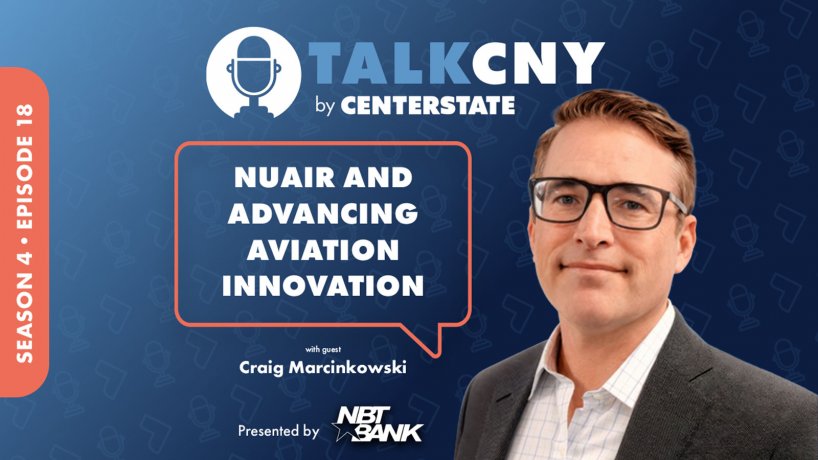
This is Talk CNY, a semi-monthly podcast by CenterState CEO, recording in the production studio at CenterState's Inspire Innovation Hub. CenterState CEO is Central New York's premier leadership and economic development organization. Join us as we meet the people and explore the projects driving the regional economy forward. This is Talk CNY, presented by NBT Bank. I'm Katie Zilcosky, Director of Communications at CenterState CEO and your host for Talk CNY. NUAIR was founded in 2012 to help establish world-class uncrewed aerial systems infrastructure in central New York. Now it oversees 1900 square miles of beyond visual line of sight airspace, and it holds the first and only FAA letter of acceptance to a public- private organization for its proprietary airspace surveillance technology stack. On this episode of Talk CNY, presented by NBT Bank, we're joined by NUAIR president and CEO Craig Marcinkowski to discuss what's next for the organization and for the UAS ecosystem in our region.
Well, Craig, thank you so much for joining us here today.
Great to be here. Thank you for having me. I've heard Talk CNY many times, so I'm excited to be here.
We're excited to have you. So you were named president of NUAIR a few months back. Congratulations.
Thank you.
So how has it been the first few months on the job? What have you learned? What's been exciting to you?
I've been involved with NUAIR kind of from its get go, but it's been really humbling to be in this role now for the past four months. What surprised me, the depth of our staff. When I was involved with NUAIR before, it was a little bit of a smaller organization. The team is absolutely incredible, and it's been really eye-opening to see all the progress that's been made locally. If you look at a group like SUNY Upstate, for example, doing medical deliveries, they're one of the top, I think they are the top medical delivery provider in the country. And that's happening right here in our ecosystem and in our corridor here in a bunch of other operations happening with public safety and others. But those are really pleasant surprises to me to dig in and see how much progress we've made on real-world applications. It's not just testing; there's real-world applications happening here.
Now, before we get too far into the conversation, I do kind of want to level set for everyone who's listening or watching who might not know what NUAIR is. So how do you describe NUAIR to folks who haven't heard of it before or aren't totally clear on the organization's mission?
Yeah, no, that's awesome. NUAIR has been around for over a decade now, a not-for-profit New York State company, but the mission has always been to help integrate and accelerate the integration of uncrewed unmanned systems into the national airspace system. And that history goes back to when the region received the FAA test site designation, and then we've continued to do much more expansion of work there as we've gotten additional incredible funding from the state of New York to support the integration of uncrewed systems.
Now you mentioned when we were talking about taking on the role that you've been involved with NUAIR for more than a decade now. So tell me a little bit more about how you got involved in the uncrewed systems industry. What was your path to working with drones and in the AAM space?
Sure. We've got a great heritage of companies here locally. I was fortunate to work at SRC at the time when the FAA test site proposal was being put together, and I was supporting Bob Alger, who was a great advocate in the early industry here locally. And there was a number of companies that worked on that. Saab, Lockheed Martin and SRC collaborated with CenterState CEO in Oneida County as well to put that test site application in and we won. So that was kind of my entry in and I was working at...
First step.
Yeah, and I was working at SRC on the radar side of things, just beginning to get into drone-tracking radars and other things that SRC is world class at. And then while I was at SRC, I was fortunate to get to found a company called Gryphon Sensors, where we developed a set of sensors from the ground up to detect and track drones in this commercial space, based on a lot of work we were doing with NASA and the FAA at the time.
And that then led to, we were fortunate, Griffin, to help CenterState CEO in the region author the Upstate Revitalization Initiative, uncrewed systems portion of that. And that's really where we really dove in and we were fortunate enough as a region to win one of the three URI awards. And that led to a much larger amount of funding for NUAIR to implement this 50-mile beyond visual line of sight corridor; funding for GENIUS New York was in there as well. So that was really a big, I think, inflection point for the region, getting that type of funding from the governor to make this one of the global leadership centers for uncrewed systems.
What about you? What makes you excited about uncrewed systems? Why is this a field you want to work in, and think people should be interested in?
It was really interesting. It happened just kind of naturally with the work I was doing at SRC, but then when we started working with NASA.
They were doing the leading research on UTM back in 2014, 15. We were going out to NASA Ames in San Francisco area regularly for roundtables, helping define what a UTM architecture would look like, just being in industry roundtables and collaboration. When you start looking at the use cases, whether it's public safety, a lot of the work that, for example, Upstate's doing medical deliveries when you start talking about critical medicines, blood work, even organ transplants, Upstate's not doing that yet, but they probably will someday. I wouldn't put it past Steve Robertson's team. They're amazing. You can really see the utility for how it can help society. And I was always deep on the tech side as an engineer and looking at these advanced systems to see the low-altitude airspace. And there's also an element with a lot of the surveillance and tracking that we have here that's so advanced that also provides you a level of security, national security.
Counter UAS is also a big topic that you hear either domestically or from a military standpoint, and being able to see the airspace so you can fly safely, but so you can also protect any critical infrastructure or anything that's important to you from a national standpoint here. I love that angle to it as well.
NUAIR has undoubtedly played a huge role in helping to advance Central New York's UAS ecosystem. In your opinion, what has been some of the greatest accomplishments of the organization over the years?
That's awesome for you to say that NUAIR's been such a huge contributor, but even just winding it back to when we won the test site and some of the other things that happened, it's really been an ecosystem play. We wouldn't have gotten here without those companies that I mentioned earlier that really pitched in and helped make that happen. The incredible investment from the state, Oneida County with the test site and it's really been a collaboration of that corridor between Central New York and Mohawk Valley, especially as we put the upstate revitalization initiative plan in. The 174th wing, they've been such a huge piece of this as well, them doing some of the first Beyond Visual Line of Sight flying in the US. And then Jason Terreri at the airport as well, he's been an amazing collaborating partner for what he's been doing with AAM. So I think the biggest accomplishments have been that group coming together, coming up with just getting the test site was big, but then coming up with a cohesive regional plan that brought everyone together, focused around Beyond Visual Line of Sight. And now you can see the real-world applications that are happening. You can see the commercialization that's happening. You mentioned as we were talking earlier before the show, the 1900 square miles of beyond visual line of sight airspace that we've now gotten the letter of acceptance from the FAA for. That didn't just happen. That took 10-plus years of testing, validation, investment from the state for us to be able to do that. SRC radars, the investment they made in part of the technology stack that we're utilizing and you start putting all that together, and then you can see that headline a year ago that we have this amazing 1900 square miles.
A lot came together to be able to claim that and now be able to take that and commercialize that around the country, which is quite amazing.
I think collaboration, I mean talking to anyone from any industry in Central New York seems to be something that we're pretty good at here. It's something that it's one of our assets, but the UAS industry in Central New York has a lot of assets. So what are some of the things that draw companies here that make Central New York one of the places to start and grow a UAS business?
I love that question. You could start with the talent. We talked about maybe the aerospace defense industry and aviation. There's a long heritage and history here. There's been entrepreneurial startup spirit looking back to a company like Sensis who Saab acquired a lot of that group. Mark Viggiano, one of them.
He's been a leader in GENIUS New York here as well. He's done so much for the ecosystem, but he built up that air traffic business, which is really, really entrepreneurial and you could see other companies and things happening on a similar bent there. I think those are really big accomplishments, being able to move out of just defense work and being able to expand into aviation and then the new entrance space of aviation, which is UAS traffic management, some of the low altitude counter UAS, companies like Hidden Level that have now spun out of SRC and other examples there. I think GENIUS New York is also another great asset. It's really gotten global brand recognition now. We're in cohort 10.
It's one of my favorite things I get to do is getting to be a judge and mentor for some of those teams. For those listeners who don't know, GENIUS New York is an unmanned systems incubator and business competition and largest in the world now; it came out of part of that funding from the upstate revitalization initiative. So that funding from the state funded a 50-mile beyond visual line of sight drone corridor, which is what's turned into that 1900 square miles that we've talked about that's now commercialized. GENIUS New York came out of that and a bunch of other research testing and other things. So I mean putting those together, I think this collective ecosystem I think is the biggest accomplishment for the region and NUAIR's been, we feel fortunate to get to be a steward within that to help pull that together and drive a regional strategy with CenterState CEO and others.
I mean this has been over a decade of collaboration and work from private, public, nonprofit entities, but I still think some folks don't really quite grasp the whole breadth and depth of this ecosystem. And aviation is a complex industry, so who can blame them? But for people who aren't living and breathing it every day, what impact does it have to have a really strong UAS ecosystem here in Central New York?
Yeah, I mean I think it was identified during Upstate Revitalization Initiative. There was a core area that we wanted to build a regional strategy around. And if you look at the assets between Oneida County and Central New York, what they've done with the test site in Griffiss Air Force Base and that park out there is incredible. The amount of, and you have AFRL and everything on that one end of the corridor, and then we've got a lot of the aviation defense industry here between Lockheed, Saab, SRC, Hidden Level, and then NUAIR powering a lot of that. You put that together, it's a place where, and you look at the global recognition, the amount of applications that we get for Genius New York and others now that people recognize globally. If I want to be in this industry, that may be a place I want to at least go to validate my technology, or I may want to go there and set up operations and set up a company.
CenterState CEO is great and we're hosting a company next week who's looking and evaluating the region to say, "Hey, where do I want to set up my U.S. operations?" Especially even with administratively, with some of the things that are happening in the drone industry, there's a push, especially in some defense realms that things need to be made here in the U.S. So there already was a pull here with the ecosystem we've built for companies to want to come here, but now there's even more of a headwind for companies to do business in the U.S. So I think those together have really made this place stand out nationally for aviation.
Have you seen the community, I mean in your tenure in this industry and in this ecosystem kind of come to understand the reputation a little bit more?
Yeah, I think I give CenterState a lot of credit and others. I think we've done a very good job of getting the word out. And NUAIR, once again, we're not-for-profit. We're focused on a lot of tech innovation and other things, but we're also focused on workforce development and working within the community. We've hosted a number of Syracuse City School workforce development, getting them introduced aviation. We've done things out of BOCES as well. I think we're hosting Liverpool High School in a couple of weeks. We've done three Micron chips camps as well where we're bringing kids in. So that's a big piece for us as well to get the word out. Local news has done a great job as well. Jeff Kulikowsky is one that always comes to mind. He's always checking on the state of what's happening. He has us on regularly and getting the word out locally to how leading and amazing some of the work we're doing in a globally, very fast-growing industry.
It's going to be interesting to see what happens over the next decade. It's going to be very exciting, but what we've positioned the region to do here is going to be really exciting. It is funny at times. I'll be out nationally and people know about us, and still there's people here locally who don't really fully get what we're doing. But I think shows like this right now, what's been happening on the news and just continuing to get the word out there, there's a lot of good efforts even at the state fair, a lot of things happening with drones to educate people. I think there's just a continual need for that. I think we're doing as well as any region that's trying to lead in drones right now, but it still takes time to get everybody up to speed on that. There's still sometimes concerns of privacy and some of those other things. I think those are going away much more. And I think people are really beginning to focus on the utility, especially around things like public safety and how you can use drones as a first responder and that it can really impact lives.
We will have much more with Craig coming up, but we are going to take a quick break for a word from our presenting sponsor, NBT Bank.
I would recommend NBT Bank to any business. My name is Chris Polimino, and I'm the president of Atlas Fence. Chris had decided to purchase Atlas Fence from the previous owner. He had previous connections at NBT Bank. NBT Bank provided me equipment financing, doubling our entire production workforce. It's important to me as a business owner that the decisions of our banking relationship are made locally.
Welcome back. This is Talk CNY, presented by NBT Bank. I'm Katie Zilcosky, Director of Communications at CenterState CEO, and your host for Talk CNY. I'm joined today by Craig Marcinkowski. Craig, thank you so much for being here.
Great to be here.
It's been fun talking about NUAIR, its history a little bit, but I kind of want to bring us up to the present. I mean the UAS market and federal regulations, it's all changing so rapidly. How is NUAIR balancing the speed of this sector right now?
Yeah, we've been very fortunate, I think as a region that we've been, I would say on the front end of things, especially around enabling beyond visual line of sight flight and the low altitude surveillance picture there. So with our region making a clear bet and investment in that area back in 2016 with the Upstate Revitalization Initiative, that was around the time where the drone space was just starting to pick up from a NASA UAS traffic management side. And from the FAA side, they were starting to come out with something called Part 107, which was the early rulemaking around piloting drones, simple things around can you fly over people, not fly over people? Can you fly at night? Can't you fly at night? What weight can it be? Some of those things. It had nothing to do with flying beyond visual line of sight. Where we fast forward to today, we're on the precipice of Part 108 rule coming out, and that is the rule around beyond visual line of sight flying.
So from a NUAIR regional perspective, we've positioned ourselves, you could say, Hey, maybe we were a little ahead of the game, but from the game now, we're in a very good position. And from one of the areas that we focus on quite a bit at NUAIR is on the regulatory side. So we're part of the Commercial Drone Alliance, which is a group down in D.C. that does a lot of rulemaking shaping with the FAA. I was actually fortunate to be a Commercial Drone Alliance founding board member back in 2017, I think. And Lisa Ellman and team there are doing a great job. We're very plugged in with them. And then any other appropriate FAA groups that we can collaborate with, we're part of that from a rulemaking perspective. So I don't want to get cocky like, oh, we've got all the rules figured out.
They're dynamic. They're changing. A lot of them are consensus-based, so we're trying to have a seat at the table. We think we're in a good position, and we want to understand what's going to be best regionally. Our heritage, our DNA is really around aviation and safety. We're really a group that a lot of the founding leaders within NUAIR were pilots. And I like that heritage going back to understanding aviation and safety because we're talking about integrating drones with traditional air traffic management. So we're coming from this aviation safety beachhead. We're pushing innovation, especially to do that integration at scale for beyond visual line of sight flying. And then with the not-for-profit charter and everything, NUAIR fills a really unique spot in the whole ecosystem. And I think that's appreciated by others when if they're going to be trusting you for a surveillance picture or feed, how reliable is it?
How trusted is it? Is it grounded in aviation? I think those are all things that we bring to the table, and we're going to continue to make sure that's part of our DNA going forward.
And I know you work a lot with the region's uncrewed systems companies. So what is it like working alongside other companies who are figuring this out as it goes too?
So the majority of my career has been coming from industry, so I feel quite at home , nd I've worked with a number of the local companies here and even some of them here in the tech garden from an advisory standpoint from Genius New York. So it's been great. And I think one of the things that I'm trying to focus on is to continue to help NUAIR be in our not-for-profit unique role to be a unifier if we can, to bring and drive collaboration as much as possible, to pull an industry as much as we can. For example, we've got a lot of these genius companies here in this amazing INSPYRE (Innovation) Hub and they can use some help and collaboration from maybe these larger well-funded and very experienced aerospace defense companies. So that's where I try to fit as much as I can because I did spend most of my time on the industry side and I think that gives me a little unique vantage point here now leading NUAIR.
Now I know a lot of the companies here have, especially genius teams, I can speak from that. They work together. They find different ways to collaborate. What has your experience been like, not only during your time at NUAIR so far, but just in the industry seeing regional companies work together and collaborate, help each other out to fill the gaps to create a new innovative product?
Yeah. NASA back when they started the UTM Initiative 2014, 15, Dr. PK Parimal Kopardekar, he actually was very helpful in helping us shape our regional strategy. He came out here multiple times from San Francisco for meetings in Albany. He was a keynote speaker for CenterState at one of the annual meetings. He was phenomenal and his whole mantra was around collaboration and the NASA architecture was put together in a way to foster collaboration. The test site here won multiple contracts with NASA where we're bringing in multiple companies to work and test their systems in tandem. And I think the way the ecosystem's been built here, once again, when the test site started, you had multiple regions together. Oneida County really helped get the test site going with local companies here and CenterState CEO. So if you look at the heritage there, it was all built around companies collaborating together.
And now the way GENIUS is constructed and getting to be on the judging and selection committees there, we're pretty thoughtful, not perfect, but we're thoughtful and we've gotten better every year on how do we even select a cohort? It used to be six teams; now it's five, that maybe they're complementary. Maybe we don't want to have five companies that are all exactly in the same space and uber competitive with each other. We want them working together and collaborating together. I think it's working.
Yeah, I think so too. A lot of the teams that we talk to say one of the best parts on their exit interviews or reflections, they always say that the collaboration and the cross-pollination between teams is one of the biggest values of the program.
That's good to hear. Kara Jones did a great job, just got a great new role at SUNY Oswego, which is I think a nice kudos to what's happening here. People are doing great things and graduating into growing roles. And Craig Witmer's here now, and I'm excited for what's going to happen with GENIUS there. And kudos to the team that every year I think they bring in the teams, they bring in the advisors, the judges, and they say, "What can we do better?" And we've done that every year, and I think it's gotten better every year.
So zooming out a little bit, back to the market, the regulations, what has changed over the years in the UAS space for good? What has made innovation more possible? What has made going to market easier? And on the flip side of that, what have some of the challenges been that still persist?
Yeah, I like that a lot. Go back 10 years, when the UTM initiatives were happening. It was good research. NASA was driving that. It was more of a regional play. There were the test sites. We made a state investment. There wasn't a lot of federal funding, and you can see now federal funding is starting to move more into the drone space, which I think is a very good sign. Part 107 was coming out at the time, which is around piloting. Now we've got rules that are coming out around beyond visual line of sight flying. And for our listeners there, why does that matter? What's the distinction? For a lot of these commercial applications to scale and for companies to say, "Hey, this is going to be economically feasible. I'm going to be able to deploy a system I need." Typically, you need to fly beyond visual line of sight if you're going to deliver packages, if you're going to do medical deliveries, if you're going to do drone as a first responder, beyond visual line of sight flying is kind of a key.
They're calling it unlock. This can be an industry unlock. I've heard that a lot of times, but I do think it's an important inflection point here. So when you look at what's happened over that last decade with regulation, investment and use cases, it's going to be a really exciting next few years. I think with Part 108 coming out, our region's positioned well. And then when you're looking out on the horizon, there's also advanced air mobility where we're talking more about these larger craft, whether they're your air taxis or your cargo delivery with a much larger craft, that's come online here as well over the next five years. So you're going to see quite a bit more drone operations, but you're also going to see larger aircraft in the airspace. And for an organization like NUAIR in our ecosystem here, where we're trying to coordinate and look at that low-altitude airspace, we do a lot of things locally here.
There's drone companies, other things, but I think that's a core regional strength that we're world leading in, being able to coordinate all of that activity, you have to be quite advanced in what that low altitude airspace is to be able to deconflict that. And I think the investments the state's made there for us to become leading in that is going to really help the whole industry.
And so what are the things we're still working on here? What are the things that will make it easier to achieve some of those goals in the future?
Yeah. We're tirelessly. It feels like you always have to keep flying, you have to keep testing, you have to keep collecting data. And the way it's been with the FAA has been, a lot of it's been waiver-based up to date. So you got to be beyond visual line of site waiver and use a safety case and you collect data and you do some things. We're in the process of getting a higher and heavier waiver right now, which allows us to fly at much higher heights with heavier aircraft within our corridor. And there's a bunch of great use cases and there's companies already reaching out to us saying, Hey, once you guys are set there, we want to come out to Central New York and Oneida County and be able to fly and operate there. So those are things coming down the line right now.
So I think continuing to execute on our plan, collect the data, prove where we are and basically expand operations geographically. We mentioned 1900 square miles. We're working to expand that. We're going higher and heavier. And then you're going to see much higher density of operations happening obviously once approval's happening and once we've validated that we can expand into some of those areas.
Now looking back, I mean, we mentioned that NUAIR has this history about over a decade of experience in this industry, but the organization was originally formed with the intention to establish the infrastructure, to kind of get us going, to really invest in our strengths and give us a solid foundation to take these next steps that we're talking about right now. So for you, what do the next 10 years look like?
So when we started Test Site 2012, Upstate Revitalization Initiative win in 2015, 2016, we wanted New York State to be a global leader. We are today. I mean, 10 years from now, I think you're going to have infrastructure like we have here in every major city, but I see us being able to expand that rapidly, even in the next couple of years. And then there's the whole advanced air mobility space. People are like, oh, am I going to be. My kids are always asking, are we going to have a flying car? Probably. Or at least we're going to go in flying taxis.
Within the next 10 years, absolutely. I think that's probably closer to five as well. We've been fortunate to partner with the Port Authority of New York and New Jersey on the EIPP program with Jason at the airport as well. That was one of eight in the country electric mobility EVTOL programs. So we have priority from the FAA to test and validate that. There's operations happening here at the Syracuse Airport you may see in a couple of years where there's cargo delivery, and then there's going to be urban air taxi work happening down in New York City, and there's some other pieces in the rest of the Northeast as well. So we're focused there. It's a pilot program, but it's also the federal government saying, "Hey, this is going to be a priority going forward. We picked some regions to begin testing. We're going to give priority resources from the FAA to test and validate this." So you can see where that will go from there.
Craig, this has been such a great conversation. I really appreciate your time. Thanks for being on.
Oh, thank you.
Talk CNY, presented by NBT Bank, is recorded in the production studio at CenterState's INSPYRE Innovation Hub. Talk CNY is available on all major podcast platforms or centerstateceo.com. Additional content and clips can be seen across CenterState CEO's social media channels. For new episode reminders, be sure to subscribe in your favorite podcast listening app and don't forget to leave a quick review or five-star rating. Thanks for listening to Talk CNY, presented by NBT Bank.
Other
| S3,E21 - Sara Broadwell, Rachel Pierce | October 29, 2025 | |
| S3,E20 - Rob Simpson | October 15, 2025 | |
| S3,E19 - Dan Straub and Erin Noto | October 1, 2025 | |
| S3,E18 - What to Know Before INSPYRE Innovation Hub's Grand Opening | September 17, 2025 | |
| S3,E17 - Ben Sio, Dottie Gallagher, Joe Stefko | September 3, 2025 | |
| S3,E16 - Emilija Postolovska | August 19, 2025 | |
| S3,E15 - Dr. Carlene Lacey | August 6, 2025 | |
| S3,E14 - Corporate Leadership Takeover | July 23, 2025 | |
| S3,E13 - David Kavney | July 9, 2025 | |
| S3,E12 - Jess Abbott and Jared Shepard | June 25, 2025 | |
| S3,E11 - Ryan Benz and Ben Lockwood | June 11, 2025 | |
| S3,E10 - Michelle Cruse and Keeli Manning | May 21, 2025 | |
| S3,E9 - Brandon Mastrangelo | May 7, 2025 | |
| S3,Bonus - Rob Simpson | May 4, 2025 | |
| S3,E8 - Rob Simpson | April 23, 2025 | |
| S3,E7 - John Liddy | April 9, 2025 | |
| S3,E6 - Ken Stewart | March 26, 2025 | |
| S3,E5 - Kara Jones & Manny Cerniglia | March 11, 2025 | |
| S3,E4 - Hope Knight | February 26, 2025 | |
| S3,E3 - Nora Spillane | February 12, 2025 |