

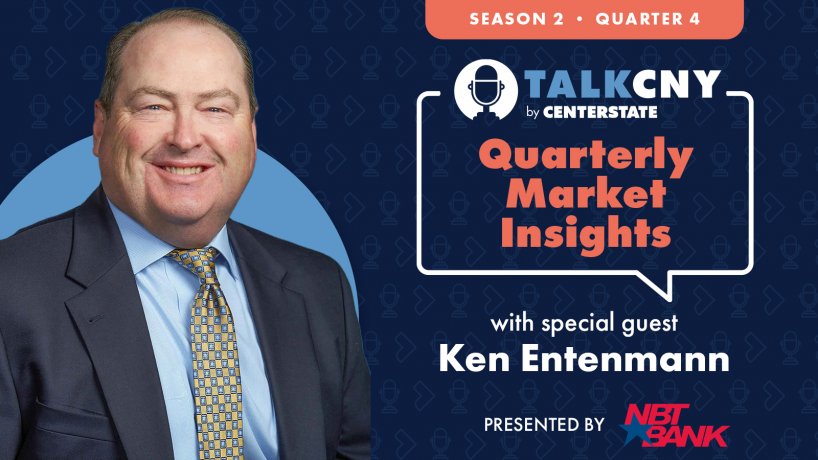
2025 Q4 - Ken EntenmannPosted on December 24, 2025 |
Image
|
Kevin Schwab | Host, Quarterly Market Insights:
Hello, I'm Kevin Schwab. Welcome to another episode of Talk CNY, where this time we feature our Quarterly Market Insights with Ken Entenmann from NBT Bank, where he's the chief economist. Welcome.
Ken Entenmann | Chief Economist, NBT Bank:
Great to be here.
Kevin Schwab | Host, Quarterly Market Insights:
There is a lot to talk about right now in this economy as we head to the end of 2025. So many good signs. So many signs that make you scratch your head a little bit. We're going to dive into that a little bit. But first thing I want to ask is, given that we're seeing record stock markets, given that we're seeing concerns continue about inflation, given that we see what looks like a little bit of a softening job market, but really good GDP growth, how do you put all those things together? We're going to jump right in. What's your overall thought of where we are in the economy right now?
Ken Entenmann | Chief Economist, NBT Bank:
Yeah, I think 2025 was the year of great distortion. We started the year out well, and then we had the tariff announcements on April 2nd, and that sent the world into a tizzy. Then we had the government shut down in the early fall, and it's just distorted all kinds of economic data. So that's a difficult question to answer normally. It's especially difficult to answer here at the end of 2025 because the government data is all distorted.
Kevin Schwab | Host, Quarterly Market Insights:
So let's break some of these down a bit. We'll get into each of them. We'll talk, maybe sort of globally or nationally first, and then we'll get into what we're seeing here that might be a little different locally. Stock market, right? Everybody's looking at their 401 (k) and has to be pretty happy right now. Yeah.
Ken Entenmann | Chief Economist, NBT Bank:
Yeah. Well, the stock market as of this morning is up about 15% year to date, barring any kind of horrible market action in the next 10 trading days or so. It'll mark the third consecutive year of double-digit returns. And that is a big factor in terms of what's been driving the economy because the consumer is always 70% of our economy. It's driven by the wealth effect and the fact that the stock market, when you look at the average American household, their two biggest assets are their investment accounts in all the various forms, IRAs, 401ks, investment accounts, and their homes. When we look at the NBT footprint, home prices are up 41% over the course of the last three to five years. So you've had this big wealth effect. It's kind of fascinating because when you survey consumers, they're very dollar-conscious. But when you watch the way they're behaving, they're not cutting back on spending.
So it's kind of like, how do you feel, well, I'm really worried, but I got to go on a cruise. So it's really challenging to kind of ... When it comes to consumer spending, the wealth effect has been really powerful, and it's become kind of a do as I do, not as I say, because what they're saying is they're very concerned. The reality is they're spending pretty healthily and continue to do so.
Kevin Schwab | Host, Quarterly Market Insights:
So let's talk about that for a quick second. Are there particular sectors that you watch when you say, okay, because if it's just that they're spending the same buying groceries. Are they buying fewer groceries? But if you're looking at sort of optional things that people do.
Ken Entenmann | Chief Economist, NBT Bank:
Yeah. So I think when you look at the cyclicality of the economy, there are necessities in life. You have to buy food. You have to buy energy. I have to put gas in the car. So when we're trying to look for inflection points in the economy, we will look to more cyclical types or discretionary types of payments.
So one of the things I like to look at is the airline industry and the cruise industry, because they tend to be big dollar purchases. Flying on a plane or going on a cruise is not cheap. You would think that would be one of the first things that would be cut back if people were really worried. And that's part of the difficulty because the cruise lines are booked out for 18 months. The Thanksgiving holiday travel season was a record travel season. So there doesn't seem to be a whole lot of cutback in consumer spending in general in that discretionary space, at least not yet.
Kevin Schwab | Host, Quarterly Market Insights:
And yet we keep hearing the word affordability. Inflation, which was a big part of the last campaign cycle, is basically unchanged, might even have ticked up slightly since the beginning of the year, and it seems to account for why people are feeling a bit nervous right now.
Ken Entenmann | Chief Economist, NBT Bank:
Yeah. I think we need to make a distinction between the price level and inflation. So I think we tend to kind of mash them together, and they're very different. So if I have say something I paid $5 for and it goes to 10, that's a doubling in prices. It's unusual for those prices to go back down. So you get that increase in the price level. If we have inflation, and you're right, Kevin, it's running give or take somewhere between 2.5% and 3%. Well, if 3% inflation, then my $10 good goes to $10.30, but the damage was done when it went from 5 to 10. And that's where I think it's very challenging, particularly for the political world, to kind of get your arms around it because the consumer is absolutely right that there's been pain and that these prices have gone up pretty strongly over the course of the last two or three years.
The good news is the inflation rate when it was running, it maxed out, I think the consumer price index at 9.2% is now running give or take around three, and it might have ticked up a 10th or two most recently. So that's what's paining people is the aggregate price level, not necessarily inflation. Inflation has come down, and there's reason to be somewhat optimistic that it will continue to come down a little bit. The tariffs will be grandfathered, coming in the first quarter, so that should be a one-time effect. There should be a whole lot of tax payments coming into the tax rebates coming due to the tax policy changes. And then you have the whole push of AI and the potential to increase productivity, which is deflationary. So I think we're in a position today where we're kind of stuck in no man's land, but I think there's reason for optimism when it comes to prices.
Kevin Schwab | Host, Quarterly Market Insights:
So you did hit on something that was walking me into it perfectly. This is what a pro you are at this. Productivity. People talk with concern about AI. We know that AI is driving an awful lot of investment right now because of the promise that it holds. In terms of increasing productivity, and of course, you've got some folks who are then worried about either a loss of jobs or realignment of jobs, but we do see productivity rising right now. Tell us why that's a really good thing, because it is.
Ken Entenmann | Chief Economist, NBT Bank:
It's incredibly powerful. Higher productivity raises wages over time. It increases our quality of life, and it really turbocharges economic growth. It is the fuel that creates that rising tide that lifts all boats. And obviously, we're in a period of time now where AI is viewed as a big driver of that. I think we're starting to see productivity enhancements largely in the tech space so far, where, for example, simple programming can be done by AI. But the net result of that is that the big tech companies are doing more with less, i.e. they're using less programmers. And I think that's fueled the notion that productivity is going to result in massive layoffs. And I don't buy that. I think if you look over the history of time, going back to 40 acres and a mule, and then the tractor came along, and if you think about over time, things like the automobile and electricity, aviation, the computer, the internet, in every case, there was this fear that everybody was going to be unemployed by this new cool technology.
That's not to say there aren't dislocations, and certainly people are going to lose-
Kevin Schwab | Host, Quarterly Market Insights:
It opens up jobs we weren't thinking about.
Ken Entenmann | Chief Economist, NBT Bank:
Exactly.
Kevin Schwab | Host, Quarterly Market Insights:
Five years ago, 10 years ago.
Ken Entenmann | Chief Economist, NBT Bank:
The way I think of it is, I don't think anybody laments the fact that people aren't pushing a share plow with an ox. I don't think we are concerned that we no longer have blacksmiths on every street corner. I don't think we're concerned that there are no longer switchboard operators at the local telephone. So all of those jobs went by the wayside because of technology. And certainly if you were in those jobs, there was a dislocation, but that being said, there are so many more new jobs that come out of this. Will this time be different? Perhaps, but I don't think so.
Kevin Schwab | Host, Quarterly Market Insights:
So that said, though, we have seen a sort of consistent slowing in the number of new jobs coming out in the monthly job reports this year. The most recent one just came out with an addition of 64,000 jobs. That is, I think, below what we would normally consider the number of jobs that you need to replace with people coming into the workforce. What are your thoughts right now on why we're seeing this, and is this concerning you?
Ken Entenmann | Chief Economist, NBT Bank:
Not yet. I mean, obviously, if there's this great deceleration in job growth and more importantly, losses in job growth, it will become a problem. So it's certainly something we have to watch. A couple of reasons why I'm not overly concerned. One, I mentioned the great distortion. We had tariffs, and then we had the government shutdown, which grossly distorted the numbers. I think that's part of it. Secondly, I think the AI thing is going to dislocate some jobs, but I think it's going to create more jobs than we think. And then lastly, and I think this is particularly relevant for CenterState CEO, the majority of our companies that are associated with CenterState, they're not 50,000, 100,000. We're basically more mom and pop, 50, 100, 250 type people. And those jobs I don't think are going to get dislocated. And when you read the data on small businesses, still close to 50% of small businesses report that they can't find qualified workers.
And so I think of that and say, okay, maybe the employment numbers come down, maybe it's a function of overhiring and hoarding of employees coming out of COVID because we had the great difficulty there. So that might be part of it, and there might be a normalization of the workforce. Certainly, AI is having an impact, but at the end of the day, I still see really big demand. And then lastly, immigration, whether you agree with it or not, has limited the growth in the labor force, which means there's fewer people for the current jobs. And so for all those reasons, I think when you combine them, I think the likelihood that we're going to have a collapse in the labor market and unemployment's going to spike to eight, nine, 10%, I think that's highly unlikely.
Kevin Schwab | Host, Quarterly Market Insights:
So where we are right now nationally, 4.6% was the last number I saw from BLS. I want to switch over, though. Let's start talking a bit locally. Let's get down here into Syracuse and Central New York a bit. In Onondaga County right now, 3.9% unemployment.
Ken Entenmann | Chief Economist, NBT Bank:
That's right.
Kevin Schwab | Host, Quarterly Market Insights:
We have outperformed the nation and the state all year long by a good margin, typically at least a half point. We have watched our labor force grow here. We've watched large employers add significant jobs. Now, some of this is driven by construction, right? We have a really large construction project going on right now in I-81, some 1,500 people working on that right now. We've seen growth in logistics. We've seen growth in hospitality. We've seen growth in a number of different areas. Give us your outlook for what you see at this point, especially as we head into our economic forecast in January, but what do you see as the outlook for how we're doing right now, but also where you see us heading regionally?
Ken Entenmann | Chief Economist, NBT Bank:
Yeah. I think as you alluded to some of the numbers, we're in pretty good shape here in Syracuse. And most importantly, that's before Micron really-
Kevin Schwab | Host, Quarterly Market Insights:
Doesn't it feel good? Doesn't it feel good to be leading and not behind?
Ken Entenmann | Chief Economist, NBT Bank:
And so the Micron construction project, you mentioned the roadwork, which is significant, but Micron is going to be bigger than that, and it's going to be long-lasting. So there's an immediate impact in terms of construction jobs and the infrastructure that supports that, which is very powerful. But as we talked earlier, Kevin, the defense industry, which we have some pretty significant employers in town is doing incredibly well. They have been hiring. It's hard to see how that's not going to continue given the geopolitical environment that we're living in. The Micron plant, importantly, I don't think is, while it's indirectly related to AI, the more computers you have, the more memory chips that Micron's going to be able to sell, but it's not just a pure AI bed, it's a little bit different. So I think when I look at New York, particularly Upstate New York, there's a lot of room for optimism in that we have a lot of water, which is critically important to the electronic manufacturing process.
Our electricity rates are pretty favorable, largely because of Niagara Falls is the two million gallons a minute over the cliff gift that keeps on giving.
Kevin Schwab | Host, Quarterly Market Insights:
An economist who knows the amount of water over Niagara Falls, that tells you the importance of it right there.
Ken Entenmann | Chief Economist, NBT Bank:
I know that's the rough number, but that's really powerful. So water, the availability of water, the availability of open land, and relatively speaking, decent electricity rates, I think provide really good reason for growth. And then when I look further down the road as Micron starts to come into play, Syracuse, in terms of home price appreciation, is in the top 10 of major metros. I think that's a reflection of supply constraints that we've had over the years. We haven't built as many houses, so I think we're going to have to do that because of Micron. So I think there's going to be a boost to our economy in terms of building housing units. So I think in upstate New York, we tend to get a little dour, particularly this time of year, because of the weather. The skies may be gray, but I think the prospects for upstate New York are pretty promising.
Kevin Schwab | Host, Quarterly Market Insights:
Let's talk about ... It's funny, you brought up the housing market a bit, and it's certainly something we are focused on here at CenterState from a policy perspective, from working with developers and contractors in this region to try to accelerate the construction of new housing, because we know we are going to need a lot more. But given what you just said about the economy, and I also think one of the drivers of the growth that we see happening in the value of housing here is not only the constraint, but the fact that we are still below, noticeably below the national average. Is it a good time to buy a house right now, given where we are in interest rates, and where the current pricing is, and what you see? What would your recommendation be?
Ken Entenmann | Chief Economist, NBT Bank:
Well, I think Micron provides us a clear economic stimulus that is difficult. We certainly hope it comes to fruition to its full extent, so that's going to be a driver. We need lots of housing units because of that project in and of itself. So I think that's going to be consistent. So when I look at housing, it's a big part of the affordability. And clearly, when housing prices go up 41%, by definition, they-'re not as affordable as they were. But again, Syracuse is far more reasonable, even despite the recent home price increases than just about anywhere. And I think that's going to make us, again, an attractive place for investment. I am not a big believer that the mortgage rate, while it is higher than the 3% we could have gotten a couple of years ago, 6.5% is right around the median of where it's been for 20 years.
So I think there's a little bit of sticker shock that people are kind of saying, "Well, I'm going to wait till that 3%." I would encourage people to think of that as that was the abnormal period. Six and a half is the normal ... So I'm not here to haggle over whether mortgage rates are going to be three, five and three-quarters or six or six and a half. Maybe they go down a little bit, but I would encourage people not to sit on the sidelines waiting for mortgage rates to come down because I think they're really kind of normalized and not far off where they should be. It's not to say they can't go marginally lower, but they're not going back to 3%.
Kevin Schwab | Host, Quarterly Market Insights:
Well, that might be the best advice of the day right there. There you go. Do not wait on those interest rates; if you see the opportunity.
Ken Entenmann | Chief Economist, NBT Bank:
Well, you know what's really interesting is the Fed has now cut interest rates three times since September. And in each rate cut, long-term rates, which is what mortgages are priced off of, have gone up, not down. And so again, I think it's important to understand if you're in the housing market, mortgage rates track the 10-year treasury and longer-term maturities as their base pricing mechanism and not Fed funds. So the headline reads that the Fed's cutting interest rates, and a lot of times we get questions from clients, "Well, why is my mortgage rate not going down?" And they're really two different spectrums to think about when it comes to interest rates.
Kevin Schwab | Host, Quarterly Market Insights:
So we're near time to wrap up on this session. We are getting ready to wrap up the year. Reflections in a few words on what you think this year has been like for us and maybe what you're hoping for in the new year.
Ken Entenmann | Chief Economist, NBT Bank:
Well, as I said, 2025 was the year of great distortion. We had so many major events. We had clearly the institution of tariffs in the first quarter, which were very destructive and created all kinds of uncertainty. We had the government shutdown in the middle half of the year. We had pretty significant geopolitical involvement in the Middle East and Russia-Ukraine, so there was a lot to worry about.
Kevin Schwab | Host, Quarterly Market Insights:
There really was.
Ken Entenmann | Chief Economist, NBT Bank:
Yet the economy has proved to be remarkably resilient.
Kevin Schwab | Host, Quarterly Market Insights:
Is that the word of the year?
Ken Entenmann | Chief Economist, NBT Bank:
I think resilient is the word of the year. And right now, the Atlanta Federal Reserve Bank forecasts economic growth, and they have a 3.5% growth rate on the third quarter of this year. And as I look into 2026, I look at things like, just like Micron here, there are all kinds of infrastructure products throughout the country that I think will provide economic stimulus. You're going to get extraordinarily unusually high tax rebates come April 15th, which will be a spur of the economy. We have better understanding of tax policy. The tariff impacts should be grandfathered, which should mean that they're less meaningful. So I think those things are pretty good reasons for optimism despite some of the slowing in the employment that we're seeing in the fourth quarter.
Kevin Schwab | Host, Quarterly Market Insights:
Okay.
Resilience. Optimism.
Ken, thank you. We appreciate the update. Happy Holidays and Happy New Year to you.
Ken Entenmann | Chief Economist, NBT Bank:
To everybody.
Kevin Schwab | Host, Quarterly Market Insights:
And to everyone. Yep. Thanks so much for joining us.
Other
Talk CNY Quarterly Market Insights
| 2026 Q3 - Ken Entenmann | August 5, 2026 | |
| 2026 Q2 - Ken Entenmann | May 4, 2026 | |
| 2026 Q1 - Ken Entenmann | March 6, 2026 | |
| 2025 Q3 - Ken Entenmann | October 6, 2025 | |
| 2025 Q1 - Ken Entenmann | May 2, 2025 | |
| 2024 Q4 - Ken Entenmann | December 11, 2024 | |
| 2024 Q3 - Ken Entenmann | October 9, 2024 | |
| 2024 Q2 - Ken Entenmann | July 17, 2024 | |
| 2024 Q1 - Ken Entenmann | April 3, 2024 | |
| 2023 Q4 - Ken Entenmann | December 18, 2023 | |
| 2023 Q3 - Ken Entenmann | October 1, 2023 | |
| 2023 Q2 - Ken Entenmann | July 6, 2023 | |
| 2023 Q1 - Ken Entenmann | March 6, 2023 |