

2026 Q2 - Ken EntenmannPosted on May 4, 2026 |
Image
|
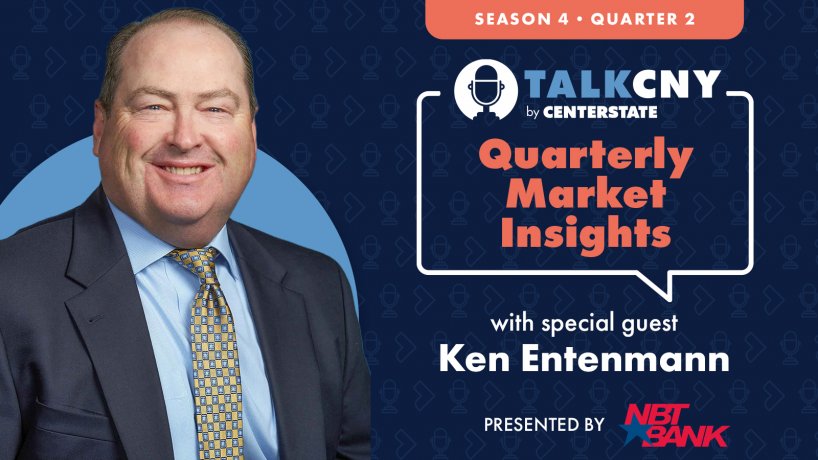
Welcome to Quarterly Market Insights. I'm Kevin Schwab with CenterState CEO, and I'm here with Ken Entenmann, the Chief Economist at NBT Bank. Quarterly Market Insights brought to you by NBT Bank.
Ken.
Yes.
We'll give people a little bit of behind-the-scenes here. We talked about a week before we do these. We say, "Hey, what are we going to discuss? What are things looking like? " Yeah, that's all going out the window. Things are changing that quickly. So we're giving this a whole new brand. This is officially Fast and Furious 14. Ken's the driver, by the way. I'm the guy going for the crazy ride somewhere in the passenger seat. There is a lot to talk about.
Sure is.
We talked about jobs when we were prepping for this. We talked about really what a shift in that looked like. We talked a bit about the markets. We talked a bit about oil and its impacts, and where it was headed and what we were expecting. And as we sit here, even a week ago, that feels like ancient history.
Sure does.
Let's talk about some of the things that are happening right now. First of all, we both said we were going to do a deep dive on what could really be a shift in the way we look at jobs reports. And when we said that, that was before we got the latest jobs numbers showing nearly 190,000 new jobs in the U.S., which was way beyond expectations. Talk to us a little bit about that and what you read into that, and then let's go back to that conversation we were talking about first.
Yeah. So the jobs report was a pretty solid report.
Really was.
Any way you can slice it. So I think our long-term view is that while job growth isn't very strong, the labor market seems to be fairly stable. A lot of the noise you hear in the marketplace is about AI and people getting laid off, and certainly some of that is happening. But overall, the labor market's holding its own despite all of the noise that we're experiencing.
So if we were to go back a year, certainly a couple of years, 190,000 new jobs reported in a month would have been, oh, okay, that's not bad. People talked about replacement and jobs above replacement. 190,000 feels like a much bigger deal now because I think of what we are starting to talk about as a fundamental shift in the way that we look at monthly jobs reports, whether it's due to immigration, whether it's due to baby boomers retiring out of the market, whether it is things like AI, increasing productivity. How are you looking at what we should be looking for in jobs reports these days?
Yeah. So I think the jobs statistics across the board, not just the employment rate, were grossly distorted by COVID. I think it's taken several years to kind of churn our way through that and get back to some kind of normalcy, whatever that means. But to your point, normal now is very different than it was certainly pre- COVID and even coming out of COVID. And what do we mean by that? Well, the unemployment rate technically is the number of working-age individuals who are unemployed divided by the size of the workforce. So the question is, are those numbers changing? And the answer is, particularly in the denominator, the workforce is changing dramatically. What are the major factors affecting the workforce? And you mentioned both of them. One is immigration. So, whether you agree with this administration's approach to immigration or not, we know that immigration, certainly on the illegal side, has been cut down to next to nothing.
And coming out of COVID, legal immigration slowed down. It's starting to recover back to longer-term levels, but we know immigration is lower in terms of a contribution adding into the workforce. What the problem is, immigration is needed to make up for this baby boom generation. And Kevin, you and I are similar ages, and we're in that last stage of the baby boom generation, but it's estimated, depending on who you ask, between 10 to 15,000 people, baby boomers retire every single day.
So you have this massive decline in the workforce. So the overall workforce levels are going down because of less immigration and a lot of exiting by the baby boom generation. And then lastly, the third part, which we've touched on, is we as a globe, let alone here in the United States and the United States is a little bit better off, but what we call a replacement rate, how many babies are being born relative to the number of people dying? That number has been declining as well. So there's no natural growth to the population and workforce. Immigration has been constrained, and we have this negative impact of the baby boom generation retiring. It's lowering the workforce and therefore the number of new jobs we have to create in the numerator, given that-
To get to full employment.
... is far less than it was. So to your point, and that's what makes this 190 of last week so strong, most economists believe that that replacement rate, that just to keep the rate neutral, is somewhere between zero and 50,000, which is considerably less than the 200 plus thousand we were expecting two, three years ago.
Okay.
So the dynamics have changed. Regardless, I still think the employment market is pretty stable, at least for the time being, and that's good news.
So that was one of the cinematic pyrotechnics that's been thrown into our fast and furious episode. Once we stop talking about jobs though, we then turn to things like oil and the impact that that's having. We have seen, certainly compared to a month and a half ago, dramatic spike in oil. We have now seen it go way up, take some real dips, go way back up, take some more dips. And on any given day that someone might be listening to this, it could be going in either direction. But you and I talked about looking out over the horizon a bit. And what are you seeing as we look six months, eight months, a year down the road in how the market is positioning itself relative to oil?
So there's no doubt that oil is one of the most critical inputs into global economic activity. It's in everything and it's not just filling up your gas tank. It's jet fuel, it's diesel fuel, it's petrochemicals, it's fertilizer, it's plastics, it's a big input. So it is something that we have to pay attention to. Obviously, the military conflict in the Middle East between the US, Israel, and Iran has exacerbated that. So we've seen oil prices go up well above $100, and we've seen enormous volatility with that. But I would caution people that they should really think about this in the long term, because as we've learned today and last week that that price can go up 15, 20% in a flash. But when I look out longer term, in the investment world, we have what's called futures markets. So you can look at what the market expectations are for oil prices five, six months from now, nine months from now.
We can also look into the treasury market futures and look at what the expectations for long-term inflation are. So the concern, and it's a legitimate one, is if oil prices go up, does that affect the overall inflation rate? Where I take a little bit of solace in this, and frankly, it all depends on what the duration of this conflict is. And we're starting to get some sense that it may be not be as long, but I would argue from the beginning, the markets were anticipating this being a shorter-term event. And I'll leave that open-ended. Whether it's four weeks or six weeks, I don't know, but it's not being measured in years. And why do we say that? Well, we say that because when we look at oil futures, and they go out in three-month increments, when I look at the December oil contract, it's about $80.
It's not $120. It's not $115 where it was last night, and it's not $94 where it is this morning. It was $80. So the oil markets are telling us that they don't expect this to be a long-term impact. Let's be clear, $80 is still considerably higher than the $60 it was six months ago, so there's still an impact, but the market is anticipating-
But at $80, we're not looking at $4 and $4.50 cent gallon gas. Correct. We're not looking at airlines seeing billion-dollar impacts in a quarter. We're not looking at ... So yeah, we...
I would use the word manageable. If it's $80, is it higher than $60? Yes. But $80, is it higher than $60? Yes, but is it manageable for U.S. corporations and people to get around? I think the answer is yes. The question for individuals is how does that impact inflation?
I was just going to careen in that direction, but again, you're driving us down this crazy road.
So again, when I look at the futures markets, so Kevin, you and I were talking about there are securities that the treasury issues, they're government bonds. We call them TIPS, which stands for Treasury Inflation Protected Securities, and they pay an interest rate that is considered a real interest rate. So they are excellent proxies for long-term future inflation expectations. And the benefit of these protected securities is they are adjusted by CPI, consumer price index, and they adjust up. So your principal payment gets adjusted, your interest payment gets adjusted up or down based on inflation. So it's a really good place to go and get a snapshot for what the market is anticipating long-term inflation expectations are. And when I look at the five-year TIPS bond, it's trading at $130. So that means that's the real rate, the inflation-adjusted rate that people would look for five years out.
Importantly, that $130 has been up to $140 down to $120. It barely has changed throughout this military conflict. So again, I think the market is anticipating that the conflict and the impact of higher oil prices is going to be short-term. Let's be clear. It doesn't mean the market's right. We could be stuck in a quagmire and talking about this a year from now, in which case I think the economic ramifications are pretty dire.
Okay.
But the market's not expecting that. So to continue to torture my Fast and Furious analogy right now, we are at this point really heading down a macro in our conversation, sort of national super highway. We've just talked about a number of key elements that impact our economy. We haven't really talked much about the market. The market is reacting to a lot of whatever the news is driving in a given day, it seems. How do you feel broadly, given all of the inputs that we just discussed, about the state of the economy at that macro level now versus how you felt about it a month, month and a half ago?
Well, the interesting thing is, despite all of the chaos coming out of the Middle East and the volatility in market prices, interest rates, oil prices, to be honest with you, it hasn't changed that much. And the reason for it is I still think we're on pretty solid footing as long as this remains relatively short-lived and it's a short-term spike. So why do we think that? Estimates for GDP, economic growth, have barely changed. The employment market that we talked about has been pretty solid and looks like it's stabilized. The inflation expectations, mainly because this is not our grandfather's 1973 economy, where we were getting four miles to a gallon, and we were much more dependent on foreign oil. Our economy, particularly here in the United States, isn't as dependent on oil price, still very critical input, but it's not as bad as it was.
And when I look, so the inflation expectations while they have moved up haven't really changed that dramatically. Interest rates have moved up, but if I think back to early in my career, and if you told me oil was going to go up 50% in six weeks, I would've told you the market would've been down 20%.
And that hasn't been the reaction.
It was down 7% from, the S&P 500 was down 7% from its peak. As I left, given the strong market today, it's down 1%, and that's after being up 87% in the last three years. So if you think about all the negativity that we've been kind of chewing through in the last six weeks, and then you conclude that the market's down 1%, it kind of becomes ... And then I go back...
Consumers are still confident, too.
Well, and so
Last-
Despite complaining.
That's correct. So two anecdotes on that. One, what's amazing throughout this, including the corporate earnings estimates for the S&P 500 have increased in the last six weeks.
Have gone up.
That's unexpected.
So, if I have a decently growing economy, a fairly stable employment market, not a strong one, it's stable. We have inflation expectations while they've gone up, seem to be fairly controlled, and we have earnings across the board going pretty well. That's a pretty good story. And then the other anecdote I would throw out is Delta Airlines had earnings, and they were spectacular. And not only did they have great revenue, their revenue was up 14%, and that was based on consumers buying more premium seats. That is not an indication of a consumer that's ready to clam up and go hide in a corner. So the consumer has remained remarkably resilient throughout all of this noise. Again, I don't think a six-week military conflict is enough to knock that off of its perch. If it's longer, then maybe you'll start to see, but we haven't seen it yet.
I think you're speaking to a real core point there, which is that the fundamentals are strong. You made a 1973 reference, who doesn't love a '73 Stingray or a '73 Mustang? We love to complain about our cars now, but you know what? They're faster. They're better. They do a lot. They last longer.
Yes, absolutely.
It seems like an apt analogy to say when you've got that strong base, when you've got more capability for higher productivity. When you've got strong consumer activity, that we can get through a lot.
Yeah. And I think we've talked about the higher income brackets being really kind of flush because they've benefited from that strong 87% three-year return in stocks. They benefited from increased home prices, they paid down their liabilities, so they're really strong. And the fact that gasoline has gone from $3 to $4 may result in those higher-income people having to pay an extra $10 to fill up their tank, but that's not enough to knock them off buying a business class ticket on Delta, right? So it takes a lot more to kind of shove the consumer into this, I am clamming up recessionary type environment. So we've seen nothing of indications that we're going into a recession. The forecast for recession's perked up from 20 to 35, they're always 20%. Stuff happens that causes recession, but one prominent national economist reduced it from 35 back to 20 based on the recent news out of the Middle East.
So it really amazes me. So your initial question is, how have my expectations changed? Really hasn't, which is, to me, it's amazing that given all this activity, the economy seems to be chugging along just like it was.
Ken, this perspective and this analysis is why we are incredibly fortunate to have you with us every quarter, to have you and your colleagues at NBT with us every day in this community. And I can't tell you how much I appreciate that. And with that, I want us to get off the highway and get down onto the surface street and talk a little bit about what's happening here in Syracuse and Central New York right now. For as much as we are talking about the sort of crazy shifts that we see impacting the economy on a macro basis on a national and international basis, when we look at it here regionally, we have maybe a better story to tell right now. Micron's in the ground. Hundreds of people now working on the site every day. That number is expected to be in the thousands, upward of 4,000 by the end of next year, working at that site every day.
We see housing building permits have gone up substantially in the last year. Talk about what you see happening in the local economy and how that sort of meshes into what we see happening nationally and how it maybe puts us ahead of that.
Yeah. So as we said, I think the national economy's on pretty solid footing. I think Central New York and Upstate New York writ large have more or less been a net beneficiary of the COVID migrate out of the big cities into more smaller metros like a Syracuse. Housing is a big driver of that. And even though housing prices in the Syracuse market have been really solid, they're still very reasonable relative to the rest of the country, particularly when I look at Boston or New York. So I think we're a beneficiary from that. I think one of the biggest constraints for housing is simply raw land. One of the reasons why housing is more expensive is the land is very scash when you get into big metros. And here, think about the Micron. There's not that many places where you have that much land available to create a mega project like we do with Micron, but that's true if I'm going to build a hundred home single family home unit or a multifamily unit condo type process or apartment complex.
We have land here. It's relatively inexpensive relative to the bigger cities. Our employment market, our labor market, we are blessed with incredible education institutions, engineering capabilities with Syracuse and Clarkson and St. Lawrence and Cornell. And I don't want to skip, but- It's there. We have a highly educated workforce. We have a major catalyst in Micron. We have an unemployment rate that's lower than the national average. There's a lot to be said for what's the potential here in Upstate New York.
Well, let's talk about jobs here though a little bit. We were for much of 2025 among the strongest performers in terms of job growth of large and midsize metros anywhere in the country. Yes. There was a good chunk of the year where we were in the top 10. We did see that dip at the end of the year. We lost some of that ground in the December report. It looks like that was largely driven by a loss of jobs in the public sector, government jobs. We know we took a real hit in terms of our federal workforce that is here in some of the agencies in Central New York. What kind of impact do you see that having losing those jobs, right? Those are good paying jobs those are, right? I mean, what does that mean as you kind of analyze that?
Yeah, so certainly I feel for people who work for governments and have lost their job, but governments aren't immune to economic cycles either. But that being said, I think we need to keep the government story and perspective. So our workforce, our population is roughly 325 million people, a billion people. We have-
325 million.
As a population, 160, give or take in the workforce. The federal government employs roughly three million. And if I estimate a 10% cut in government, it's 300,000.
300,000 jobs nationally. Sure.
On a total relative basis, we just added 190. So I am sympathetic to the people who've lost their job, but I think we get a little bit hyped up about government, and it's not there. What's more important on a government jobs basis is on the state and local levels. That's where the volume is in terms of the number of workers. And so far, there hasn't been a really big initiative to cut back materially in those areas.
Okay. What are you looking for over maybe the rest of this year or the course of the next 12 months as sort of key signals of whether we're on track to where you'd like us to be, where you think we're headed in terms of our local and regional economy?
Yeah. So I'm going to continue to look at corporate earnings as a big driver. And not that the S&P five, we don't have that many S&P 500 companies in Central New York, but they're a very good barometer for what happens across the economy in small and mid-size businesses. So the question is, does all this activity really over the course of the last year and a half, if you think about all the AI competition, the worries about AI on job losses, tariffs, government shutdowns, all of these things, we've been fighting through these uncertainties for quite some time, and then obviously we have a very large one given the Middle East conflict, but throughout it all, the consumer has been fantastic, has been incredibly resilient. The overall economy has been resilient. So I think the big question is, what is the ultimate duration of this military conflict?
And I think we have to define that.
I don't think this is going to be a three-year quagmire. I also don't think it's going to be buttoned up and done and everybody goes home in two weeks either. So I think this is going to continue on. It's a question of the magnitude of it. And I think as long as we can get a reasonable flow of oil, we can work out the government details and what the Iranian government looks like. But as long as the oil flows, which is my expectation, and the reason why it's my expectation is if you think of the Persian Gulf and the oil that flows through it, there are a lot of countries in the world that want that to happen. Asia is very dependent. So whether it's Japan or South Carolina or China, very dependent on Mid-East oil. Europe, very dependent on Mid-East oil and natural gas.
But most importantly, when you think of the countries that's around the Persian Gulf, so Saudi Arabia, Kuwait, Bahrain, Qatar, and then Iran itself, Iran's economy is 50% oil driven.
So they can play this game where they're going to shut down the straight, but then they're cutting off 50% of their economic activity. And that's not something they're in a position to subvive very well for a long period of time. So I keep looking at that as my rationale that I think the military conflict and the cutoff of oil is going to be shorter in nature. And that's what I think the markets, as we talked earlier, are anticipating. Doesn't mean I'm right or the markets are right. If we're wrong, then all bets are off. But assuming that we're going to kind of have this jousting between the political players, but it's relatively short term and contained, I think there's the possibility that the economy can really accelerate because we've effectively had a timeout.
So the biggest thing you're looking for is weeks and months as opposed to months and years, and assuming we're at the shorter term into that spectrum, you're really bullish.
Yeah. I'm pretty optimistic. And I think a big driver, especially for the U.S. economy, is the consumer. And the consumer has demonstrated time and again, to be incredibly resilient despite all kinds of obstacles being thrown in its way. And I don't want to make too much of one airline company's earnings, but not only are we flying around a lot, we're paying up to get premium seats. That is not an indication of an economy ready to collapse into recession. So yes, it's one anecdote, but it speaks to the strength of the consumer and the resilience of the U.S. economy.
Ken, NBT, his trips on Delta, that's the last word. Perfect. Thank you, my friend.
Great to be here.
Other
Talk CNY Quarterly Market Insights
| 2026 Q3 - Ken Entenmann | August 5, 2026 | |
| 2026 Q1 - Ken Entenmann | March 6, 2026 | |
| 2025 Q4 - Ken Entenmann | December 24, 2025 | |
| 2025 Q3 - Ken Entenmann | October 6, 2025 | |
| 2025 Q1 - Ken Entenmann | May 2, 2025 | |
| 2024 Q4 - Ken Entenmann | December 11, 2024 | |
| 2024 Q3 - Ken Entenmann | October 9, 2024 | |
| 2024 Q2 - Ken Entenmann | July 17, 2024 | |
| 2024 Q1 - Ken Entenmann | April 3, 2024 | |
| 2023 Q4 - Ken Entenmann | December 18, 2023 | |
| 2023 Q3 - Ken Entenmann | October 1, 2023 | |
| 2023 Q2 - Ken Entenmann | July 6, 2023 | |
| 2023 Q1 - Ken Entenmann | March 6, 2023 |