

S4,E11 - Jared Shepard and Jess AbbottPosted on June 10, 2026 |
Image
|
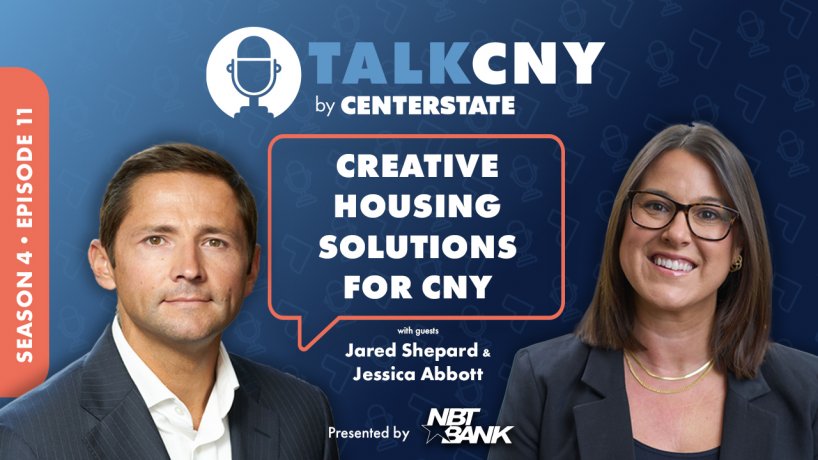
This is Talk CNY, a semi-monthly podcast by CenterState CEO, recording in the production studio at CenterState's INSPYRE Innovation Hub. CenterState CEO is Central New York's premier leadership and economic development organization. Join us as we meet the people and explore the projects driving the regional economy forward. This is Talk CNY, presented by NBT Bank. I'm Katie Zilcosky, Director of Communications at CenterState CEO and your host for Talk CNY. One of the greatest challenges we will undertake as Central New York grows is building enough housing to accommodate all the region's residents. Available affordable housing is imperative to creating a truly inclusive, sustainable, and competitive future for Central New York. For this reason, CenterState CEO, along with a number of the members in its network, have prioritized examining the region's housing landscape, its obstacles, and finding ways to create meaningful change. On this episode of Talk CNY, presented by NBT Bank, I'm joined by Senior Vice President of Member and Business Experience, Jess Abbott, and Director of Research and Planning, Jared Shephard, to talk about the importance of housing to the regional economy and how we're supporting creative, practical solutions.
Jared, Jess, thank you both so much for being here today.
Thank you.
Glad to be here.
So today we are talking about a priority of CenterState's - housing. This is something that we've been working on in a variety of ways over the past couple of years. But I think before we get into some of the projects and initiatives that we have been engaged in during that time, it's important to lay out the why. Why is Ceter State CEO engaging in housing conversations and housing solutions for our region? So Jared, Jess, why don't you want to start and kind of explain what the idea behind this is?
Sure. Just to kind of like level-set the overall importance of housing in the economy, it's a $55 trillion, is the total amount of housing stock in the country. And in Central New York it's growing into an additional $1 to $2 billion annual industry. And as like a comparison in a similar, that's in an economy of around $50 billion a year for our GDP. So it's a major part of the national economy of the local economy. And along with all of the other work that we do in economic development and industry development, it's a critical part of it. And then there's other questions about what happens if we don't play a role in helping to develop the housing that is going to necessarily come as a result of growth. What happens if we do play a role in that how that shapes the outcome for how prosperity is shared and how the growth of our community is translated into the lives of the folks who live here.
Yeah, and if you look at the actual mission of Center State CEO, it's to create a region where business thrives and all people prosper. So when I'm explaining the work that we do to folks who might be out of market or not familiar, I always say, think about everything you need for a business to be successful from anything the permitting to find a site, to work with local or state or federal elected officials on policy to help find people to work at the jobs to find supply chain. We do all of those pieces. We have somebody at our organization who can lean in in all of those places. And to steal a line from my colleague, Jared, homes are where jobs go to sleep at night. We can bring as many jobs here as we want. We can grow this local economy as much as we want, but if we aren't also leaning in other areas that we see are necessary to keep these companies afloat and thriving, then we're missing the mark of our overall mission.
Jess, how have members reacted or engaged to our housing initiatives so far? I mean, I'm wondering when you're having these conversations with people out in the community, what are their reactions to our housing work, to just the housing efforts in general?
I don't think any of us really expected to be this in the trenches on housing a few years ago. And so sometimes there's folks who are familiar with what we do and they're like, "Oh, I didn't realize you all were doing that. " But I think the biggest thing is you look at our housing work group and just the breadth of folks who are in the room. I think it's one of the best groups that we convene for that very reason. We were hearing a lot of times, in membership, we act as I always mix sports metaphors, but a quarterback and a goalie. So we are trying to bring opportunities to our members, but also field problems and stop things before they become one. So when I hear things from the same thing from a few different members, especially in different industries, that's when I start to reach out to one of my colleagues to say, "Hey, what's going on here?" With housing specifically, it was coming from folks who were looking to grow or expand their business, worried about having people move in from out of state or growing their workforce, but it was also coming from the contractors, from the banks, from the brokers, from the developers.
Everybody was noticing the stagnant housing rate that we had and looking ahead at what was coming and wondering what we were going to be able to do about it.
The Housing Work Group, which is made up of some of our members' variety of different members though. It's not just developers or just banks and funders. It brings a very large group of people together. Can you tell me a little bit about who makes up our Housing Work Group right now and what their primary task is at the moment?
I mean, I know some of them more directly who came over from the housing task force. And so again, that's a group of people who are directly in the residential industry. And the Housing Work Group after we completed the task force, I think that had a lot to do probably with what you were learning from your practice about getting involved.
Yeah. And I think the Housing Work Group - it's big. I think that's one of the things too, is like a measure of how interested people are, but truly when you think about what it would take to address this, it's anybody. I mean, we'll talk a little bit more about some of the things that have come out of it, but it's everybody from the banks who can finance these projects to the people who are going to be building them, to the realtors who are going to be selling them, to the folks at Erie Materials who are going to be supplying the actual materials to build it. So it truly is a comprehensive group of people and it's a mix of a report out from different experts in the field. I think ESD, you can speak a little bit better to the study that they did that kind of like level set the group, but it's a report out and it's also an opportunity for those folks to be in the same room quarterly to meet each other, have organic introductions.
We're always happy to help solve a problem, but if folks can see each other or see a partner in the room, sometimes it gets a little bit faster that way.
Yeah. The work group meetings start with about five to 10 minutes of informal networking. We sort of see how that's going before we jump in. So that's an opportunity for developers and bankers, construction companies, anybody who's policy makers and electeds planners to talk about what's going on in the communities. And we've been joined by people from surrounding counties, not just Onondaga County. And then the content usually is somebody either from Empire State Development. The Department of State joined us this week and talked about smart growth principles. We've had the commissioner of housing and community renewal join us and recently we had Nick Petragnani from CPC join us to talk about the housing fund. So it gives them a pretty big chunk of a 30, 40-minute information about a policy, some questions, and then we talk about what's going on with permit data, which is one of several ways to ... It doesn't cover everything, but it's a good indicator.
And then we dig into our housing dashboard tool, which has started to really pull some great information about projects on a quarterly basis.
Can you talk a little bit about what some of the results of this housing work group has been so far, whether that's indirect connections between folks in the room or whether it's major initiatives like our housing dashboard presented by Erie Materials that you mentioned?
I know one of them, we had a financial institution that has been in market, but it was expanding their presence and had wanted to connect with a lot of realtors in the area. I had gone through a list and sent a few to them that I thought might be important for them to meet with, but I said, "If you're going to come next week, I think most of them will be in the room." And then I was able to in the room just actually personally introduce as opposed to just sending an email out and kind of connecting. And I just always think that people are more likely to be honest about their needs and where they can help each other if they've sat down and chatted. So just that was our actual first housing work group. I was able to use that networking time to introduce this gentleman to about four different realtors that he was looking to meet anyways.
And so I think that's happening more and more because as we continue to convene, people see the same people in the room and much like anything with our membership at CenterState CEO, there's like sort of a filter of you'll be a good partner if you're part of this organization because every dollar of membership dollars translates into $4 of programmatic spend that is everything from the work that Jared's doing to the work that's happening here at INSPYRE to all the different things that we do. And so there's kind of like a good, we're in this together filter. So if you've been in the room a couple of times with somebody, you're like, "Okay, we're on the same team here."
And the dashboard, Jared, can you talk a litle bit more about what are some of the things you're learning from it? What are some of the things you're tracking? How did it come about? The whole overview.
Okay. I think there's a lot of origin stories for the housing dashboard.
I want to hear what you pick one.
I want to hear what you say.
My stock story is that I got annoyed with the spreadsheet, so, it's a good motivator. So, really deep on the origin stories, Dave Mankiewicz, one of the things he was doing before he retired was looking at all of the proposals that were in the paper, which was a very new thing at the time, to see that many new housing proposals going into being publicly announced. So the common sense approach to that is like we should be tracking what's going on. So we started to build this list and could aggregate some of the data, but it was a good start on it. It was also a clear request from Andy Breuer, who chaired our housing task force. We want to know what's going on in the market for a lot of reasons. And one of the things that we kind of discovered after we made the tool is that we know that housing is a manufacturing industry. It's a distributed manufacturing industry with multiple projects at multiple stages in different locations, all with different financing needs and different markets.
So it makes it pretty hard to track it in terms of an actual manufacturing process. But if you draw a geographic area, a circle around a geographic area and then track it according to the phase that it's at. So is it a proposal? Sometimes I say, is it just a proposal? Meaning like, well, it's maybe not going anywhere, but actually a lot of them are, but how do we filter to also what's in front of a planning board, what has been approved, what's in construction? So as we're figuring out the best way to think about this, on a phone call or we're joining a phone call for the National Housing Task Force, I think, and Atlanta has a housing strike force. They had a dashboard that showed their housing in terms of where the projects are and some information about it. We have this terrific new hire from about a year ago, Skylar Richardson, who manages our impact and valuation and she's able to learn almost anything.
So we just sort of pointed at it and said, "Can you do this? " And I think then you asked if we made any progress and -
Yes. Sky is terrific. Shout out to Sky. But also, I will just say we had been tracking a lot of this information in our traditional project tracker for what we would consider our economic development tracker, but we work in so many projects that are NDA or even if not closehold. And so we were tracking it internally, and we didn't have a good way to share externally. And so in having some conversations with some of our members explaining, I have this stuff, but I don't have the ability to kind of filter through and in asking Jared for a spreadsheet a lot of times, I think those two things combined plus Sky got us to where we are today.
Someone who can actually code it and put it all together.
Now the tool, even from like on a quarterly basis, we update it. I think one of the biggest questions we get is that the data is obviously the most important thing. Where are you getting this data? Most of it is, it's pretty labor intensive. We're following planning board minutes at the municipalities throughout the region to update projects, but we're also using a little bit of AI to automate that. And now that more people are using it, it allows us to get updates from them. So if we share something and somebody sees that a project's already moved to another phase, that's one of the ways that we can go back into the tool. And then on a quarterly basis, we've just started building a report that we shared at the housing work group that summarizes here's everything that happened this quarter, like the new projects, projects that moved from planning board into approval, everything that started construction and anything that was completed.
So that definitely helps guide our strategy. We are going to have more about what we're doing in regards to housing, but first we're going to take a quick break for our word from our presenting sponsor, NBT Bank.
I would recommend NBT Bank to any business. My name is Chris Polimino, and I'm the president of Atlas Fence. Chris had decided to purchase Atlas Fence from the previous owner. He had previous connections at NBT Bank. NBT Bank provided me with equipment financing, doubling our entire production workforce. It's important to me as a business owner that the decisions of our banking relationship are made locally.
Welcome back. This is Talk CNY, presented by NBT Bank. I'm Katie Zilcosky, Director of Communications, at CenterState CEO and your host for Talk CNY. I'm joined on this episode by Jess Abbot and Jared Shephard. We're talking about housing today. Thank you both for being here.
Thank you.
Thanks.
We talked a little bit about the housing dashboard, presented by Erie Materials, who talked about our Housing Work Group, but what we haven't discussed yet is a pretty big initiative that we helped to launch earlier this year, a $150 million housing fund. So I just want to start with kind of explaining what is a housing fund, and how are we trying to help build supply in the region through the activation of these funds?
Sure. So regions throughout the US facing a need for more capital in their market to support housing development in a lot of ways, sometimes in the construction or in the permanent financing of it, put together some type of either revolving fund or other types of fund. And what we looked at was a revolving loan fund structure that would allow a pool of capital to exist for a period of three to four years to help bring capital into the market to spur construction in particular, like the financing of construction, to get a lot of the projects that were facing a financing gap, particularly on the equity side, to move forward and unlock some of the stalled pipeline that was looking for financing that just isn't in the area.
And the fund is for a very specific type of housing, right? It's not just for any housing project, not single-family projects, correct?
Yeah. So, understanding that we are going to work with the public on this, so we have public dollars in this Empire State Development contributed $30 million as a grant into the fund. Philanthropic partners involved as well, including Center State. In addition to getting the supply, which we need for the initiative, we also want to see it develop housing that is efficiently constructed. So sort of what the market is looking for because that's more cost effective. So there's a density requirement for the construction that it's 10 units per acre of housing. We wanted it aligned with New York State's priorities through HCR, which is the Pro Housing Community's designation. And we have it committed to the six counties in our housing catchment, which is our usual five-county region, but also includes Oneida County.
So this fund, like you said, there are lots of housing funds throughout the country. This is a common tactic to help communities increase supply in their regions. But this fund in particular is very large, $150 million and the people who are funding it are kind of unique funders. So I'm wondering if you can tell me a little bit about who makes up the fund and what sets the fund apart from some of the other actions taken across the country or even in New York State.
Sure. This is a good representation of what we look to do in anytime we have an opportunity to lean in with our membership, which is bring together people who can address an issue in the community by, as I always say, like a little coopetition. And so this one in particular is a public-private investment. So this has a large investment from Empire State Development, so there is state investment. There is private investment through several private partners, including Micron and then also a lot of different banks and credit unions that have come together to contribute to make this fund. It is, I think, one of the largest in the state, and it is fairly unique in both its size and the speed in which it came together. And so it's interesting because we have Canandaigua National Bank, we have Community Bank, M&T Bank, KeyBank, Pathfinder, Broadview Federal Credit Union, NBT Bank.
And so there's a lot of different banks and credit unions that are at the table to also have the state participation, to also have the private investment and then to have it managed by a partner like CPC. It just really shows how when we've identified a problem, we can go to our membership and say, "Where would you like to be part of the solution?" And everybody's hand goes up.
Yeah. All of those partners that just mentioned, the ability to pull that off when we started looking at what the demand was going to be like, probably a really simplistic way of thinking of it was whatever the number, couple thousand of houses per year or housing unit aggregated is like almost a billion dollars of new housing. So that's a billion dollar house that Central New York has to build now that we didn't have to build. And if you were in the market for a billion dollar house-
Of course.
As I'm sure you are, you'd have to come up with a down payment for that. And so they'd probably want you to come up with, I don't know, about $200 million or so.
So where's that going to come from if you've never built that before? And Rob Simpson was immediately behind doing some of this work and saying that the challenge here is that we are going to talk with all of our members, our banks in particular, and get them to do something that's pretty tricky, which is get them all to play together in the same sandbox on making low cost lending into a fund, even though they're competitors. And as we started to shape up this idea, then Sky was making a lot of the phone calls. I'm sure Jess and the rest of our membership team was a part of Smoothing Silver, but we needed them all to come up with some kind of contribution.
Yeah. So a couple of things to that point. So we keep saying how quickly, right, but really these things take a little while to be identified and then what is the problem, what is the potential solution and then who can help with it and then how do they help? And so we have a highly engaged board and so this came up a lot there. We do a board retreat and so there was some ideation around that. And then we convene folks by industry often. And so we had our financial affinity group. These are people who are not only invested in CenterState CEO and the region, but also come together to sit at a table and do exactly this, like where can we lean in as an industry to create impact? And so we kind of pulled from the coalition of The Willing there and that was how we got to this point.
But I think one thing I want, we talk about this a lot, so I want to highlight one point is that this is a very low-cost capital. So the rate compared to what it would be just on the market is significantly improved. It is not only that it is available and set aside specifically for that, it is also very attainable.
I was going to say, what does it say about our broader business community to put something together like this, identify an obstacle, come up with a solution and then really heavily engage to implement that solution identified. Yeah.
I mean, one of the ways I can answer what that says about our community is some of the reaction that we've been getting at a few housing conferences. We've been attending housing conferences for the past three years. A lot of factors have been making our market more attractive, but when you go to a housing conference, and you're able to say that our region has put together $150 million attractive financing construction fund, that sets the stage. So I mean, even if that's not money that they're going to be able to use for the project, it sends an incredible signal that we are organized and have capital on the ground, and that's been a big part of the change in the conversation with potential investors and developers and banks and all sorts of contributors to that industry that see the growth in our market.
Yeah. I think our keynote speaker at one of our recent events, Amy from Brookings, said to the entire business community, "You all are unique in the way that you approach these problems together, and that is why you are able to achieve outcomes faster is because you're doing it together." And we know that, especially when we're in the work or working with the members or on these projects, but it was very good I think for the community to hear that a group like Brookings was identifying this region as a teamwork region.
So the housing fund addresses workforce housing in the community, but we know we need all types of housing in order to accommodate the region's growing population in the next few years. So what are some of the other initiatives and projects that we are helping to support within our network to make sure we can get there?
Yeah. So as you say, that the housing fund is a mixed-income fund, so it does support some of the units are required to be at 80% median income. Affordable housing throughout our community is still a significant need. We're lucky that some of the organizations like Housing Visions, Home Headquarters, and a Tiny Home for Good are outstanding organizations that have been in our community for a while, and we're seeing them scale up and rise to the challenge.
Yeah. Even some of the partners that we listed in this housing fund are also in partnerships and support with Tiny Home for Good and others. So it's pretty incredible to see everybody.
So this is a lot of work. We can't do it alone. Obviously, we've had so many partners that have got us here, but there's still more to be done. So if someone, whether they are a member or just an individual in the community wanting to get involved, how can they do it?
Yeah, I would say feel free to reach out to myself or Jared, whether you are a member looking to learn more about it, whether you're a member who wants access to this member-only dashboard, or if you are interested in applying to the fund, feel free to reach out to either one of us, and we will happily get you to the right place.
And I'd also add, reach out to a Tiny Home for Good and ask if there's anything you can do to help.
Jared Jess, it is always a pleasure to have you on. Thanks for being here today.
Thanks, Katie.
Thanks.
Talk CNY, presented by NBT Bank, is recorded in the production studio at CenterState's INSPYRE Innovation Hub. Talk CNY is available on all major podcast platforms or centerstateceo.com. Additional content and clips can be seen across Center State CEO's social media channels. For new episode reminders, be sure to subscribe in your favorite podcast listening app and don't forget to leave a quick review or five-star rating. Thanks for listening to Talk CNY, presented by NBT Bank.
Other
Talk CNY Main Series Transcripts
| S3,E1 - Rob Simpson | January 15, 2025 | |
| S2,E24 - Kevin Schwab | December 18, 2024 | |
| S2,E23 - 2024 Highlights | December 4, 2024 | |
| S2,E22 - Tony Baird | November 20, 2024 | |
| S2,E21 - John Liddy | November 6, 2024 | |
| S2,E20 - Rob Simpson | October 16, 2024 | |
| S2,E19 - Dr. Juhanna Rogers | October 2, 2024 | |
| S2,E18 - Tylah Worrell | September 18, 2024 | |
| S2,E16 - Ben Sio, Dottie Gallagher, Joe Stefko: Part 2 | August 21, 2024 | |
| S2,E15 - Ben Sio, Dottie Gallagher, Joe Stefko: Part 1 | August 7, 2024 | |
| S2,E14 - Rob Simpson | July 24, 2024 | |
| S2,E13 - Dave Kavney | July 10, 2024 | |
| S2,E12 - Ebony Farrow | June 26, 2024 | |
| S2,E11 - Aimee Durfee | June 12, 2024 | |
| S2,E10 - Kristi Eck | May 22, 2024 | |
| S2,E9 - Nora Spillane | May 8, 2024 | |
| S2,E8 - Housing Taskforce | April 24, 2024 | |
| S2,E7 - Rob Simpson | April 10, 2024 | |
| S2,E6 - Durin Leckie | March 20, 2024 | |
| S2,E5 - Erik Jankowski | March 6, 2024 |