

S4,E2 - Ryan McMahon and Rob SimpsonPosted on January 28, 2026 |
Image
|
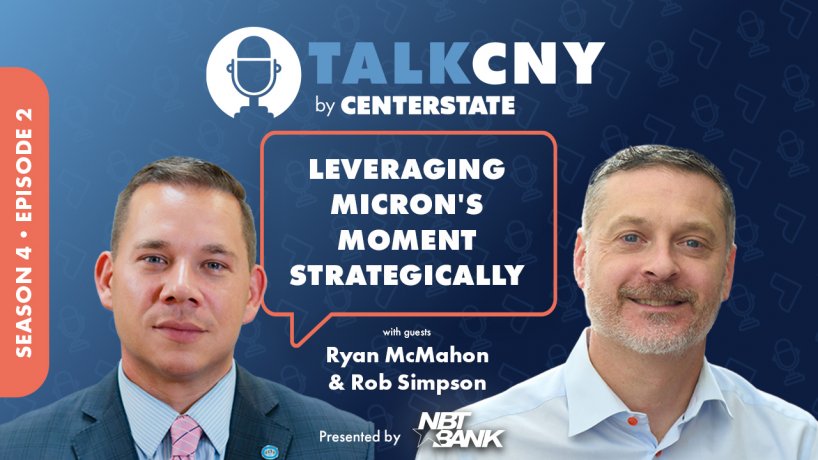
This is Talk CNY, a semi-monthly podcast by CenterState CEO. We're an independent nonprofit committed to creating inclusive, equitable, and sustainable economic growth in Central New York. Join us as we meet the people and explore the projects driving the regional economy forward. This is Talk CNY, presented by NBT Bank. I'm Katie Zilcosky, Director of Communications at CenterState CEO, and your host for Talk CNY. Earlier in January, we marked an exciting moment for Central New York's economic future, the groundbreaking of Micron's historic project in Clay. A vital partner in bringing Micron to the region was Onondaga County, led by County Executive Ryan McMahon, but CenterState CEO's work with Onondaga County goes beyond just attracting major projects like Micron and extends to all facets of creating a vibrant community for all. On this episode of Talk CNY, presented by NBT Bank, CenterState CEO, President and CEO, Rob Simpson, sits down with Onondaga County Executive Ryan McMahon to reflect on the work that got us to Micron's groundbreaking and discuss priorities for the future.
Well, thank you for joining us today. We're really excited to bring you this episode of Talk CNY. We're joined today by my friend and partner, colleague, County Executive Ryan McMahon. Thanks for joining us today, Ryan.
Hey, thanks for having me, Rob.
So we'd probably be remiss if we didn't start with the biggest news of the moment, which is that Micron has officially broken ground in Onondaga County. As someone who's been working on bringing the White Pine Commerce Park into the 21st century for a very long time, tell us a little bit about what that moment, what it meant for you.
Yeah, I think it was interesting, right? It was Friday. We knew there was going to be a lot of national dignitaries. We probably knew the community was going to be at the forefront for maybe some of the national political rhetoric, which of course it was for a moment a little bit. But it didn't hit me because Rob, we've been working on this every day, literally every day, consumes so much of your time for years, literally years. And so when I got there, and we were waiting and then I saw Sanjay, that made it feel a little real. And then when Secretary Lutnick came in, and then all of a sudden you're like, okay, this is real. Senator Schumer comes in, key partner, Governor Hochul and others, and then all of a sudden you're like, all right, really history is being made. You had two cabinet-level secretaries, Secretary Chavez-DeRemer was there as well, and then Secretary Lutnick, the governor, senior senator, who was the majority leader when this all happened. So that was real. And then, you start to feel the butterflies a little bit, as you know.
That's a big stage.
Yes.
I don't ever have prepared remarks. I just go up there, and I just go with it. So certainly started to feel the gravity of the moment, hearing Sanjay talk about what we've been talking about to the community. He's a better ambassador. His words matter more than ours. So I felt like the community is finally getting what's about to happen.
I thought you had a great line during the course of the day that sort of resonated on a lot of levels. In the midst of some of the back and forth of some of the heated political rhetoric that was being thrown around, you made a comment that I think resonated with a lot of people. It was like, Hey, we had some people up here who are on Team Red and some people are on Team Blue, but we're all on Team Red, White, and Blue. What I love about that comment is how it exemplifies the collaboration that was at the root of our success at bringing Micron to Central New York. I just thought that maybe you could expound on that a little bit. What was it that sort of brought that comment to the fore for you on a day like Friday?
I was thinking about how we got there. You talked about this. I remember when we first started working on the Intel project. I spoke to you. You said, get on the team. Help us do all this. We started from there, specking out a mega site for a mega project, and it ended up being Micron, not Intel. When I reflected on all of the different partners and phases and all of the things that had to align, the alignment of leadership at the end of the day was a key element. It started off having our local team aligned. Certainly, when this started, Donald Trump was President in his first administration, and Andrew Cuomo was Governor, but Chuck Schumer was still there. And Chuck Schumer...
He sure was.
And what Chuck Schumer did was he was the guy who actually gave us the Micron lead, and then Micron went through a site selection process later on, but he was in a unique position as majority leader, and to put together CHIPS and Science and the Investment Tax Credit. We live this, but so everybody understands, the company was very specific. They said, you need a mega site. You need to be cost-competitive with other states. You need chips, you need the Investment Tax Credit, or it doesn't happen. And Senator Schumer actually, when he was Majority Leader, he had a Democratic president, President Biden and a Democratic House Speaker, Speaker Pelosi. He used all his political capital to move that forward. And so I thought back, and I said, geez, it's amazing because Senator Majority Leader Schumer delivers that. The Speaker of the House gets it through. John Katko, in the minority had centrist Republicans ready to give her the vote she needed if she needed it. President Biden signs it, and then you have the world change, right? Everybody was worried. The question I got all the time was, is President Trump going to kill this? We said, relax. This is a national security project first and foremost.
Absolutely.
Later on, President Trump delivers support. Secretary Lutnick specifically gets engaged, gets a new deal, a little bit different than what we had.
It's still good for Central New York.
It's still really good for Central New York. Overall, if we didn't have Democrats and Republicans and Congressional Member Tenney getting the Investment Tax Credit expansion through, and the Big Beautiful Bill. Democrats kind of bring this process through, and Republicans didn't kill it at the national level. They could have. They didn't. I think overall, the credit game's always complicated when you're in politics, but everybody kind of deserves credit because certainly without that at the federal level, the local level, Governor Hochul stepping in, making sure we're cost competitive with green chips, all critical to the process.
Yeah, I mean, we talk about this all the time about how important collaboration is to everything we do. When you're at the local level, it is even more true, right? It's easier to sit in Washington and sort of throw grenades across the aisle, but when you're actually trying to implement a project, do something for your community, you've got to find ways to reach across the aisle to partner with unlikely people, business and labor in this case, right? Government, private sector, workforce development partners, higher education, everybody pulling their weight to make this happen. Was there a moment that really resonated with you amidst all the speeches and amidst all the venues? Was there one moment that sort of stood out as like, "Oh yeah, alright, this is real, and this is why you as county executive, your team, why you've put in all the effort for this moment, for Central New York?"
Yeah, I think at SU, after you've lived through the groundbreaking out at White Pine, at SU, as you're just sitting there reflecting on the moment that everybody's worked for. You've worked so hard. Your team's worked so hard. All of our partners locally worked so hard to get us to this point. I kind of just went back to why I did this. Why are you in this world, in this role you're in? I got into politics when I was in my early twenties, for the main purpose because I love this community.
When we talked about when I got elected county executive, I talked about the issues we're going to talk about and try to find short, mid, and long-term approaches to is finding causes of poverty and trying to find pathways out of poverty for people. Modernizing our infrastructure as a process to do that, and that will create economic opportunity. And here we are, the greatest project any community's ever landed. This is the pathway. This is how we figure out ways to get people out of poverty and into careers. We could have done everything right, educated every single kid, Rob, over the last 20 years. We could have educated every kid, unless there's jobs, they're going to be the workforce somewhere else.
Well, you and I were raised in a generation where we were all told that to make something of ourselves, we had to leave the region. I think for me, the moment sitting there listening and reflecting on the scale, the impact, it's like our kids, your children, my son, are never going to be told that they have to leave Central New York because there are no jobs. That's just what a wonderful thing to be able to be, to play a role in, let alone a leading role, be able to drive this kind of change. But I think for folks who are listening, some who may have been skeptical of Micron, hopefully they're less. Some who've been excited, hopefully they're even more excited that the reality is that the work doesn't end with the groundbreaking. There's still a lot of work to do on the site, on the project. The fabs have to come out of the ground. They've got to get the construction workforce, but we also have to find ways as a community to build on Micron's investment and leverage that into the maximum amount of community impact for the residents who call Central New York home.
Some of that has to do with attracting supply chain partners and developing more sites, making sure that Micron has the companies and the ecosystem around them to help them be successful. Just a couple of weeks ago, you and I were in Japan together on the other side of the world, which is a fun experience to be promoting our community in a different country. Tell us a little bit about what you saw and felt and experiences in Japan, and what sort of takeaways you have from talking with supply chain partners that are considering making investments in the U.S. maybe a little bit skeptical, understand there's a huge market opportunity. What sort of takeaways did you bring home from that visit?
I think first and foremost, the power of Micron and the success of the company. I think we get used to hearing Micron, Micron, but they're literally the greatest memory technology company in the world. They're the best at what they do, and that technology is driving the future with artificial intelligence, which there is an artificial intelligence arms race essentially with the United States and China. The power of Micron gets you to in the door just because they're here, they're in the door. What I learned is that each one of these conversations is kind of like a miniature selection process that we lived through with Micron. You need to have this site. You need to be able to talk about how you're going to deliver the infrastructure. You need to be cost competitive against really Phoenix and Texas at this point. You need to certainly be able to talk about workforce.
Where are the chemical engineers going to come from in many of these cases. Where the technician is going to come from, and we just live through this. What's beautiful is that, and I think you touched on it, if we don't create the Central New York semiconductor cluster, we missed an opportunity because we have Micron. We need to deliver the gas and chemical companies, which we're talking to. We need to deliver the tooling companies, which is a little bit easier. Their tool's got to be in the fabs. We needed to be able to deliver the material supply companies in the United States so that our supply chain's supply chain is not so dependent on China. By doing all of this, we will meet our moment and our potential. And I think to everybody that's listening and watching the first wave are going to be these gas and chemical companies that need to be here for Micron. Certainly, they want to get their business deals done with Micron, but the fact that the shovel's in the ground that starts at the clock, and they have to be here about six months before Micron's operational, and that sets a clock. How long is it going to take you to build...
And Micron if they're going to start operating, they need chemicals and gas and consumables in the plant. They have to get here somehow, right?
Yeah. So we are laser-focused on continuing to develop sites, developing that industrial wastewater that will support Micron, but also will support these gas and chemical companies. That gives us a distinct advantage against other communities that really throughout the country because to build this industrial wastewater costs a lot of money. You need that anchor user. We have it with Micron and then the tooling companies. These tooling companies aren't going to need massive facilities. They're not manufacturing here, but it'll be hundreds of jobs essentially per company. They'll need office space. This is where a downtown Syracuse is going to be really attractive. They'll need warehousing space, really attractive for some people in that line of business to start thinking about investing heavily in Onondaga county. And then the material supply companies. These will be more strategic, probably site selection processes where we'll compete more because that will probably be a lot of manufacturing as well.
I think one of the things that absolutely resonates with everything we heard. I think one of the other things that I want to touch on after the break, we also heard really interesting questions and conversations about amenities. Folks who don't really know Central New York who want to understand, "Hey, if we're going to move people across the ocean, if we're going to build a facility in the U.S., what is there to do in Syracuse and Central New York all year long? And we'll touch on that after the break. Right now, we're going to pause for a brief moment from our sponsor, NBT Bank.
NBT Bank. We know that this day starts with this one. This day starts with this one because no matter how unforgettable the extraordinary days are, there's a lot of every day that leads up to them. You can count on NBT Bank to help you get started. NBT Bank, it starts here.
Welcome back to Talk CNY, presented by NBT Bank. This episode, we're talking with our great friend and partner, County Executive Ryan McMahon. Ryan, thanks again for joining us. Before the break, we were talking a little bit about the trip to Japan and some of the things we were hearing from stakeholders, literally 12,000 miles away. One of the things that we heard from them was a desire to ensure that if they're making investments in Onondaga County, in Central New York, they want to understand what the ecosystem is. The ecosystem includes workforce, but also things for their workforce to do. It brought back to me a really poignant moment from the site selection process. I'll never forget this. We're sitting, you and I, sitting in a car with Sanjay Mehrotra, the CEO of Micron, pitching our community, and we're sitting down in the inner harbor in a black Suburban SUV, looking out at the developable acreage in the Inner Harbor, talking about how your plans at the time to invest in an aquarium here in Onondaga County. There had to be a moment on Friday when you were thinking back to that day, right? Because even Sanjay mentioned that day from the stage about how he came in skeptical. He left, convinced. That anecdote, I don't know, has been talked about publicly. I know I haven't told that story before, but maybe take a moment and chat about what that conversation was like, sitting in that vehicle, pitching the CEO of a global 250 company on how we're going to build a place that Micron's workforce is going to want to live.
Yeah, I think so. It was actually, I think it was January 3rd, I think, 2022.
It was 11 degrees.
It was freezing.
It was beautiful.
It was blue sky. The sun was out, strange foreign object. But literally, and remember, we're competing against Austin, essentially, Phoenix, Raleigh, North Carolina, a site that sat between Chicago and Milwaukee. Absolutely. I think Sanjay was there to cut us. To basically say, we're not coming here. Compelled, but the company and all of these companies look at workforce as the ability to develop, recruit, and retain. And retention, Sanjay specifically asked us, well, what are my employees going to do? And of course, Rob, we pivoted to, well, it's a great place. You should be here in the fall this summer, water, the parks, everything. We had professional sports.
Showed him the JMA Wireless.
Yeah, yeah. But he was talking about on a day like today, which was freezing out. And so not everybody likes to ski. Not everybody likes to snowmobile, ice skate, do snowshoeing or whatnot in our county parks. But we talked about the Inner Harbor and its potential and the plan for the aquarium. I think what Sanjay valued out of that conversation was the fact that the community knows if we're going to compete at a level to have this project and win this project, we need to be able to invest back in ourselves. I think Sanjay likes aquariums. I believe it. The aquarium was a symbol that they're willing to make a substantial cultural investment to help companies in workforce. As we went through that process of getting those votes initially on the aquarium, the support letters all came from businesses and their HR departments saying, this will help us with young families and anything in modern society. I know this. People will call me anytime they're angry about something, right? If you're mad,
Never when they're happy.
It festers, right? You're like, you're pissed, right? It's festering, right? I'm going to call, I'm going to write him that email. So you always, in politics, you always hear from the negative. You don't always hear from the positive. So it took a little bit, look at the project, got politicized without question. Over the course of a couple of election cycles. It's going to be ready in July, opening in August, just this upcoming week, some of the glass from Italy, which are the major tanks, we'll be coming in, and people will start to be able to see that.
That's cool.
This is at a magnitude that is going to draw people into the community. It's going to give year-round entertainment infrastructure. It's going to be a research partnership with higher education. But most importantly, it is the catalyst, which is going to unlock a tremendous amount of potential for our Inner Harbor, which is really going to be the most critical neighborhood in our city five and 10 years from now.
I think the piece that really, two things. One, and I want to give you credit. I think both with the initial phases of acquiring the real estate for White Pine, right? Seeing that as an asset, beginning to acquire more acreage, assembling the mega site that wasn't particularly politically popular. I think there were points in the aquarium journey where some might say it wasn't politically popular. I respect immensely that you have had the courage of your conviction, see something, understand why it might be valuable, and you push forward, and you do that. I don't think that most people in Central New York, even with the excitement of Micron's announcement, I don't think most people understand the scale of growth that we are on the cusp of realizing here in this region. Estimates range from 125,000 to 200,000 new people in this community over the course of the next 20 years.
That's growth on the scale that even our grandparents didn't experience in Onondaga County. That brings with it a lot of pressure. Pressure for amenities like the aquarium, but also pressure on more basic amenities like housing. And housing has been a really pernicious challenge in this community for the better part of the last five to 10 years. The county obviously plays a huge role and has been doing a lot to support housing. Talk a little bit about what Onondaga County has been doing to support the creation and the development, not only of a solid plan for building housing, but also supporting individual projects as well.
So we need at minimum 20,000 new units over the next eight to 10 years. And so that number may change, right? Based off of how successful we are bringing companies...
And we're going to be successful.
Yes. And so, right away, the first thing we did plan on, we passed a comprehensive plan, haven't had one in 30 years in the county, focusing a lot on housing. Housing is one of the five main pillars. All the above housing strategy. We need affordable housing. We need workforce housing, mixed income, mixed use, single-family, senior communities, not necessarily assisted living facilities, all of that. And we have to do it in a time where the economics aren't as bad as maybe we think they are, but they're not where they were. So in addition to that, we've had our municipal partners specifically in suburban communities, we do planning with the City of Syracuse and for the City of Syracuse, we've paid for grants to these municipalities to update their comprehensive plans with housing being a focus, looking at zoning, figure out where you can create density in your community and where you don't want density.
Let's figure out a way to work together. And now on top of that, we're making investments. Our O-CHIP program, we put forward literally cash grants, kind of like those gap funding that projects run into with inflation or workforce costs. And that's been very successful. We still have resources there. We've put together cash for infrastructure to help drive more dense development and maybe looking at commercial centers and looking at turning them into residential centers. We've updated our uniform tax-exempt policy at the county IDA, so the county IDA can now do housing deals, whereas before they weren't. Right. So that was a start.
You've done a bunch of them already.
We have, and we're starting to see them. I think the big thing is the shovel getting in the ground is going to free up capital. I know you're working to find solutions to capital, too, and you've taken the lead on that about ways to provide more financing options for...
To really get the private sector to do what they should be doing, which is lending money, right?
Yes. And so I do think we're looking at it. We had a housing study for Phase one, looked at the housing strength in each municipality, graded it and said, this is what it looks like without Micron. And what it could like with Micron. Phase two is give me more tools, more ideas, more concepts to unlock the ability to get more units online faster. I'm going to have that. I do think we're going to come out with a phase two housing plan, which we'll probably look at. Certainly some regulatory things we need to do. Also, probably some more programming to drive more construction, more homeownership opportunities for Gen Z. But this is going to be the next issue. This is the issue now, it's going to get really focused on in the next two and three years, and part of it's going to be the workforce to build the housing. That's going to be a huge issue.
I think listening to this, talking about supply chain, talking about amenities, talking about housing, we haven't even touched on transportation and some of the other infrastructure investments that are going to be needed. I am reminded of the experience of working with you and with our state partners and our federal partners and higher education obviously on landing the Micron deal. I think you and I both said this publicly, when we work together, we win. That's never been more true than during that experience with Micron. I've never seen collaboration, even when it was really hard, even when there was violent disagreement amongst people on our side of the table about how to approach something, we ultimately got on the same page, and we presented a unified Phase Two to Micron and the rest of the world. That same level of collaboration is probably more important today as we try to execute on this Post-Micron agenda. Talk to us a little bit about how you, as the chief executive of Onondaga County, our highest ranking local elected official, how do you see, what message do you want to deliver to partners who think and see this moment as maybe, "Hey, we did the thing now maybe we retrenched to our corners." What do we need to be reminding people as it relates to collaboration here in the region?
So our goal is the Central New York Semiconductor Cluster. If we accomplish that, we're going to create jobs and opportunities for every resident from every corner of Central New York. And then it's going to grow. It's going to grow up and down the Thruway in other parts of Upstate New York to do that. If that's our goal, that's our shared goal. We need all hands on deck at the local level, at the town level and at the city level. We need to work together to make sure that we are making smart decisions so that we're in growth mode, we're building more, we're growing more. We're doing it in a way where we're stronger. At the county level, we need to continue to play regional government. We have a lot of new players. You and I are going to end up being the old guys in the room at some point here.
And that wasn't the case, right?
No, it wasn't.
That wasn't the case. We have new members of the county legislature. We have new town board members, new town supervisors, a new mayor, right? New common counselors. We all need to stay on the same page when it comes to this opportunity. Politics cannot get in the way of the Central New York semiconductor cluster. It's too important at Congress. We got a new congressional member, right? Katco was there when it all started. Now John Mannion is there, right? John hasn't had to take a vote yet related to Micron, but he will, right? John, we need you in the game at the state legislature. We've got some members there that are seasoned. We've got some new ones. This is bigger than everything else. So we all need to stay in alignment on this issue. I think if at the national level, if the Biden team and the Trump team can stay in alignment on that. At the local level, at the regional level, at the state level, so can we.
Yeah, I think it is interesting. At the end of the day, they've been able to maintain that alignment at the top level because of the fact that this is a national security imperative. I think sometimes it's easy to forget that sitting here in Central New York, we see jobs and we see a project and positive change in our community. This is critical for our country's security. We are part of executing on the U.S. National Security Strategy, which gives it all a different weight and importance. Well, listen, County Exec., I just want to say with all of our listeners and followers watching, I'm really proud of you. I'm really appreciative of the partnership we've had. Your team has done a great job. This is remarkable what's happened here in Central New York. Not only will our generation benefit, but successive generations of residents in our region are going to benefit from the things that you and your team are helping to lead. So congratulations and thank you to our partners at NBT Bank for sponsoring this podcast. To all of our listeners, thanks for joining us. Have a great day.
CenterState CEO's podcast Talk CNY, presented by NBT Bank, is available on all major podcast platforms or centerstateceo.com. Additional content and clips can be seen across CenterState CEO's social media channels. For new episode reminders, be sure to subscribe in your favorite podcast listening app, and don't forget to leave a quick review or a five-star rating. Thanks for listening to Talk CNY, presented by NBT Bank.
Other
Talk CNY Main Series Transcripts
| S4,E19 - Rob Simpson | October 7, 2026 | |
| S4,E18 - Craig Marcinkowski | September 23, 2026 | |
| S4,E17 - Nora Spillane, Craig Witmer | September 9, 2026 | |
| S4,E16 - Joan Royle, Emilija Postolovska | August 26, 2026 | |
| S4,E15 - Dave Kavney | August 12, 2026 | |
| S4,E14 - Carrie Large | July 29, 2026 | |
| S4,E13 - Corporate Leadership Team | July 15, 2026 | |
| S4,E12 - Dr. Carlene Lacey | June 24, 2026 | |
| S4,E11 - Jared Shepard and Jess Abbott | June 10, 2026 | |
| S4,E10 - Sara Nozkova | May 20, 2026 | |
| S4,E9 - Kara Jones and Brad Banikowski | May 6, 2026 | |
| S4,E8 - Joe Nehme | April 22, 2026 | |
| S4,E7 - Rob Simpson, Ben Sio | April 8, 2026 | |
| S4,E6 - Lindsay Mastrogiovanni, Kathleen Avery Connell, Jim Connell | March 25, 2026 | |
| S4,E5 - Jess Abbott & Honora Spillane | March 10, 2026 | |
| S4,E4 - Sara Broadwell | February 25, 2026 | |
| S4,E3 - Brandon Mastrangelo | February 11, 2026 | |
| S4,E1 - Rob Simpson | January 14, 2026 | |
| S3,E24 - Sharon Owens, Ben Walsh, Rob Simpson | December 17, 2025 | |
| S3,E23 - Tanika Jones | December 3, 2025 |