

S4,E20 - Cainaan WebbPosted on October 8, 2026 |
Image
|
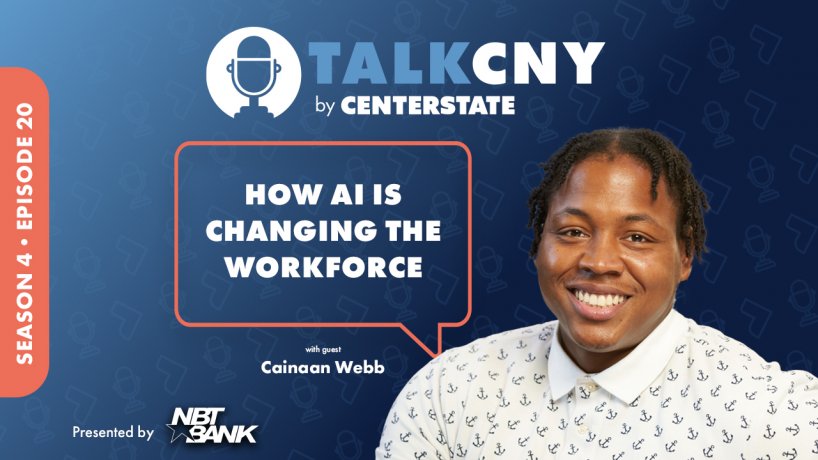
This is Talk CNY, a semi-monthly podcast by CenterState CEO, recording in the production studio at CenterState's INSPYRE Innovation Hub. CenterState CEO is Central New York's premier leadership and economic development organization. Join us as we meet the people and explore the projects driving the regional economy forward. This is Talk CNY, presented by NBT Bank. I'm Katie Zilcosky, Director of Communications at CenterState CEO and your host for Talk CNY. Artificial intelligence is undoubtedly changing the way we work. To ensure that our entire region is prepared for its range of impacts, CenterState CEO is working with partners locally and across the country to make sure our workers are set up for future success. On this episode of Talk CNY presented by NBT Bank, we are joined by CenterState CEO's Cainaan Webb to discuss the impacts AI is having on our regional workforce infrastructure. Cainaan, thank you so much for joining us here today.
It's a pleasure to be here. Thanks for inviting me.
So I want to start this conversation with where we currently are as a community, what you are hearing both from our employer partners and from the folks who are looking to start new careers. How is artificial intelligence impacting that process?
Well, it's a very innovative technology ,and it's moving at a very rapid rate. So it's changing a lot of things at the same time. We find that our employers are incorporating it into different workflows and avenues. They're at the level of governance now after tinkering with it for the past couple months.
So what does governance mean if you want to...
Yes, absolutely. Governance is the policies and procedures in which you are allowed to use the tools, which if you want to say things, particular workflows and a workflow is like the steps in the process that you take to accomplish a particular goal, you find which workflow and area within the workflow would give you maximum efficiency if you imported the AI tools, and the governance is to put headers on what is available. A bit of a limiting factor because there's a lot of sensitivity with the data, some high level complications if you don't use these systems properly. So the governance is to keep everything on the proper railroads.
So the employers are starting to really put this in their workflows, like you were saying, starting to find the limits that they want to put on to keep their data safe, their employees kind of working within these tools in ways that's actually helpful. For workers, how are they seeing the impacts of AI affect them both in applying processes or even as their roles are changing?
Workers are experiencing a capacity boost at the moment. There is about a 30% boost to certain avenues when incorporated into particular workflows. Think if you are an IT firm and they're ticketing systems, you can get a lot more resolved more quickly by having AI do the initial consultation of the ticket to see what needs to be fixed and reference some solutions so that the person running the help desk has more access to run through more of those tickets, have the solutions more ready without doing a ton of consideration and can implement right away. For example, there are also improved gains in things such as your ability to brainstorm or generate initial ideas. We're seeing a lot of the busy work, so to speak, offloaded to these AI systems, initial drafts of forms, reviewing paperwork. There's even an insurance where they're using it to review policy and do some simple adjustments of rates.
But like everything else, when you use these systems, it's very important that you have a strict review process, you know what output you're trying to get out and having a little bit of, or a lot of background knowledge in the subject allows you to better review the outputs.
Now you mentioned that this technology is changing really fast. How is the approach that you have with the work that you do different from a year ago or even six months ago in terms of artificial intelligence?
Certainly. So I've incorporated a lot of these tools that I've been hearing about from employer partners into some of my workflows to help keep up with the pace of change and innovation here. It's been really useful, actually, in my work as the technical lead here at CenterState for our workforce strategy. I've also done a little bit of that rollout process here internally doing some trainings for staff and team members so that they can incorporate it and hopefully get that 30% boost in efficiency. But really it's the ability to, again, offload that busy work and leave myself more time to do some of that high level conceptual thinking and working with partners, being able to pull their data together more evenly. For example, I attended the AIRLab Conference recently. AI readiness research field that we did a bunch of interviews with employer partners. Other regions also did, there were six other regions who also conducted those interviews. I did a lot of events down there, but I was able to utilize the AI systems to record those, a lot of the speeches like the fireside chat, transcribe that information, take those transcriptions, upload them into my LLM.
We utilize Claude here and Copilot, upload those transcripts into that system and then have it create an executive summary for me, give me some bullet points, and then I compile all of those into a gigantic file that I continue to grow as my AI research. But things of that nature to where I don't have to handwrite every single note, so I can really focus and engage on the action, and I'm still capturing a lot of the information with 82% accuracy, which is -
At 82%, yes.
That's kind of the hallmark for effective AI systems. You want to get it to at least 82% accuracy.
Well, I'm happy to hear that you're there. You mentioned AirLab. You are recently back from Atlanta where you mentioned that you were there with a team from CenterState as well as a number of other metros from across the country talking about regional AI readiness and what that means and looks like in our community. So to start, some of your big takeaways. So what were some of the things that you guys really talked about and dove into during that time?
Yeah, so big takeaways. One thing that I really appreciated about going was there was a high level of validation about a lot of the metrics or activities that we were starting to work out in our area. Some of the things that we were looking to implement such as pulling our partners together, understanding that it is a region-wide initiative and that a single organization or group of individuals wouldn't be able to pull off what needs to be orchestrated for the region to truly be ready for AI to be accessed equitably. And it's very important for that equitable and the spread of the information technology to be able to get to folks at relatively the same time because it is moving at such a rate and you want to make sure that individuals can capitalize on the advantages and efficiency that is given equally to lower the disparity that we already are in a disparate society and this could either accelerate that or can slow that down by providing some opportunities.
AIRLab really did a good job of highlighting how you need the physical structures, you need the access to the technology and the compute power, the amount of tokens that individuals in your region would need. You need the governance that we spoke about earlier, both collectively within organizations, but also at a state level or regional level, what are acceptable use policies and procedures in that space. You need the cooperation of the economic forces, the big corporations, the small companies, everyone who has opportunities for work, project-based learning, upskilling opportunities. You need all of those folks to be in alignment about what they're going to do, especially regarding the entry-level positions, because I've seen a little bit of a squeeze from some different directions. And then you also need the training partners to be agile and to maintain communication with the industry so that they are teaching skills that are in demand, and that demand is moving so fast because the technology is moving so fast.
So just have to have a continual verification loop of what skills employers are utilizing in those entry-level spaces, mid-level spaces and so on and so forth.
Those are a lot of different threads and things to really try to make work together, but we aren't the only metro across the country trying to figure out a solution to some of these challenges and how to capitalize on the opportunities. So I know there were a number of different metro areas there at AIRLab with you. Tell me what it was like to work with them. What kind of collaborative conversations did you have? How did what they reported from their areas inform some of the things that you took home with you?
Absolutely. So as we mentioned before, the entry-level challenge of shrinking that space and needing to be able to replenish the skill set of organizations if the entry-level positions are being squeezed, eventually you end up without the mid or senior positions. So that's one thing that we really all took away and have to pay serious attention to. It will take some adjustments from industry to create opportunities for individuals to gain upskilling and project-based learning with the shrinking of the entry level position. So maybe we reclassify or re-skill some of those roles and provide opportunities that are not being taken away by the AI technology and the efficiency gains. There's additionally, we had opportunity at AIRLab to do a regional assessment essentially map and discover where we are as a region relative to the other regions in terms of being prepared for things that were very important for successful integration of these technologies across the region.
And how did we do?
We are pretty much right on track.
Cool.
We landed about around a three out of five, which means that there's still some work to do, but we are at least addressing key areas of concern such as the collaboration, making sure that we have our industry tied together with our academia, with our community partners. We're doing really good with that thanks to the Emergent Technology Consortium, which I'm very excited to be leading in partnership with a lot of our big academic giants in the area. There's also the need for providing upskilling opportunities to individuals who are already in career spaces and then the job seeker avenue to be able to continue to replenish our workforce. We need individuals to gain new skill sets, primarily in editing, reviewing, and critical thinking. Some of the things that we might not consider high-level skills, but with the advent of this new technology are going to be very necessary to have proper inputs and to guard your 82% accuracy, you have to verify that other 18% yourself and make the adjustments on the back end.
Yeah. And you mentioned collaboration as one of the things we're doing well right now. And I know that collaboration is something that for our workforce innovation team has been really a hallmark of the success for that team in a lot of ways. So how are you taking kind of the preexisting partnerships that you've had in the past and just creating new workforce systems in the Central New York region and applying that now to this new technology and integrating it into that entire infrastructure?
Absolutely. The way we're designed to do it in this region was through the Emerging Technology Consortium. Again, we put together our big educational partners in the area to have a full inventory analysis of the training opportunities and upskilling opportunities that are taking place in Central New York so that we can provide a menu to candidates looking to enter this space. And there is a track for folks of varying skill levels when they enter. If you have no high school diploma, there's a pathway for you to get in and matriculate all the way through from high school all the way up to a master's or Ph.D. if you so choose. So we make sure we're serving the entirety of the population base where they're at and providing supports around those educational opportunities so that they can maintain and actually complete a certificate or a degree program.
We're connected to the industry so that we can stay informed and be agile about the type of trainings that we are rolling out. We were lucky to receive a AI prep grant from the governor. So very excited to roll that out as an opportunity to instill some of these AI-specific skills into a group of candidates. And then additionally, we have project-based learning opportunities that we are rolling out with our employer partners to get access to some of the actual in the field work flows that will be going on at employers so that our candidates in training have opportunities to work on some of those things and have some more realistic or life-based experiences that could apply to positions. And then also we are keeping track of what is going on with the physical infrastructure side of things. We're currently in a moratorium for the data centers, but that's a question that we will have to have answered within about a year's time, whether that's something we want to actually build here.
And then we are also considering the policy side and how employers are rolling out these metrics by having, again, our employers inform us about different ways that they are implementing some of the successes that they've had with that and then some of the challenges and tribulations they've had with that. So kind of putting all that information together as an opportunity to share with employers who are asking the question, is it time to implement? Where should I implement? How do I go about doing it? Because again, it is a very beneficial technology, but if it's not used properly, it could be very damaging. And so we want to make sure that our employers are incorporating this technology as safe as possible, as ethically as possible, and in a way that will be advantageous and not disadvantageous.
Cainaan, sounds like a lot to take on, a lot on your plate, and we will talk more about the future of AI in the workforce in just a moment. But first, we are going to take a quick break for a word from our presenting sponsor, NBT Bank.
At NBT Bank, we know that this day starts with this one. This day starts with this one because no matter how unforgettable the extraordinary days are, there's a lot of every day that leads up to them. You can count on NBT Bank to help you get started. NBT Bank, it starts here.
Welcome back. This is Talk CNY, presented by NBT Bank. I'm Katie Zilcosky, Director of Communications at CenterState CEO and your host of Talk CNY. I'm joined on this episode by CenterState CEO's Cainaan Webb. Cainaan, thank you so much for joining us here today.
Great to be here.
We are talking about artificial intelligence and its impacts on our workforce and workplaces. And something you touched on a bit at the top of the show was the importance of equity in this technology and that it can be a super useful technology, but it is something that we have to be super mindful of to make sure that inclusion and accessibility are at the forefront of its implementation. Can you talk a little bit more about why that is so important and what doors it both opens up and the challenges it presents when we do or don't forefront equity?
Absolutely. It really is an evening factor where it puts tools into the hands of people who would traditionally not be able to afford those tools. So there's opportunity to grow and develop your own personal skillset that you then could apply to a career or a work opportunity, but then there's also a lot of entrepreneurial ability and access that it provides you. Again, you can't afford an accountant, maybe you can do some simple budgeting on these LLMs. 82% accuracy, always have to kind of beware that that is the mark and there will be some inaccuracies in this, but that's again, part of the equitable distribution of the capabilities of utilizing these systems and the knowledge to utilize these systems so that folks will know that there's a verification process that you have to go through with and not build an entire business on 82% accuracy without thinking about the other side of it.
So this could be a great equalizer if we do it properly and effectively, but that is a community-wide initiative. It takes everybody involved at once kind of pulling in the same direction. Thanks to this technology, we have a little more capacity to be able to do so. We cut 30% off of the work that we had to do previously. That's the more time that we have to extend our hands and pass that olive branch to individuals who could potentially need either some access or some experience with these systems.
I mean, I think something I'm hearing you saying often is that how important it is to keep the human in the loop, how important that this is still a human and learning process, that it's learning how to use a new tool, not relying entirely on the thing to do something for you. So how do you kind of navigate that kind of hard skill boundary where you are, how much should you give over, how much do you not, and how do you explain that to someone, especially in career spaces?
Right.
Yeah.
So one of the important things is that there are some, like most technologies, there are downsides. You can have something called cognitive offloading where folks are entering so much into the systems that they're forgetting to critically think themselves or consider much. So as long as you stick to the, like I said, the process of understanding what it is that you are trying to accomplish before you even touch the LLM, which LLM is best at accomplishing that thing that you're looking to accomplish, because they all kind of have different quirks or capabilities or advantages. You enter what you need into the LLM, you get your prompt output back, and then that's where, again, the human enters back again, and you have to decide if this is what you were looking for, if it's presented in a way that you want it to be presented, if the information is valid and has been verified, which you can have it generate some links to its sources.
So you can do some verification in that way. But actually, it's a really important point that it's important to have a general understanding of what you're asking it to do so that verification process is a lot easier. But yeah, ultimately, these systems are not fully autonomous at the moment, and we are still conducting their outputs. And so anything that is generated from LLM is still considered your output. If you send it, you are responsible for it. So maintaining that level of responsibility and care and actually reviewing and reading the outputs, it's actually a really good way to learn the information as well, to kind of battle some of that cognitive offloading. Make sure that you stay diligent with what you're trying to get out of the system and have that information stored to memory if you're going to utilize it.
So from the folks who are in some of these career pathways and job training programs who are starting to learn these skills, how do you hear and see them adapting to trying to take some of the skills that you're talking about and putting them into their own career pathways and own just really personal pathways as well in life?
So yeah, it's interesting because there are kind of two avenues we can go down in the AI space. There's the AI data science, which is kind of the more extremely technical side, actually coding or the machine learning part of this where you're training the models and things of that nature, which is a little more, again, like I said, a technical hard-skill based kind of thing. But then on the other side of that, we're seeing the human in the loop, what's called AI-augmented work, where it's being implemented into positions that are already standing and don't have necessarily a high technical barrier to entry for those roles. And so you see it in upskilling opportunities for folks who are augmenting their work and slowly adding it to workflows with the guidance of supervisors or the company's deployment policies. And then for the more technical people who are looking on the technical side of things, AI native builders and such who are building software through the LLMs and doing some vibe coding, again, they're using it to upskill themselves.
They're generating first drafts of the code and using their coding knowledge to do some editing of that and running programs and seeing how it works and going back to fix the bugs. But a lot of it is repetition. A lot of it is getting used to kind of the quirks of each individual LLM and how it is going to interpret what you're asking it to do, understanding that, and then using that to your advantage to have it produce the output that you're looking for as efficiently as possible. And we don't want to waste tokens, they cost. So learning that process of prompting and reviewing and actually building things that are acceptable outputs for sharing across both stratums.
Now, we were talking just about the individual and skills, but I mean, we talked about it in the beginning of the episode and I think throughout really is that this is a community-wide effort. It's going to take all facets of not just our business community, but our community as a whole to make sure that we as a region are using this technology responsibly and effectively. So what are some of the ways that employers or just general members of the community can get involved in kind of shaping our workplace futures when it comes to artificial intelligence?
Absolutely. So if we can kind of go through each level, the community partners are very important because oftentimes you find that individuals that need a particular thing are outside of the network to receive that thing, whether it's access to a particular training or information regarding some type of service. The people who really need it are not in the loop to know about it. So we need our community partners to really spread the message. There's some hesitancy justifiably so regarding this technology and some concerns about the future. And if we fully implement, there are people who are resistant to that. So we need the community partners to help us roll it out in a way that can help those individuals understand, like we were discussing previously, the advantages to them themselves by utilizing and understanding how to use these tools, at least for personal gain. The industry partners, our employer partners, have to make sure that we have opportunities available for individuals to continue to gain experience in the workplace.
As we continue to roll these things out and capacity is boosted, we still need to make sure that there's an emphasis on upskilling current workers and future workers potentially. And then they also are the ones who are actually utilizing these technologies for the capacity gains. So we need that information fed back to us so that we can share it with employers who haven't necessarily implemented yet, just like with individuals. We don't want certain corporations due to lack of implementation being out competed by a company who has that 30% gain from implementing through the workflows. And then our educational partners have to continue to be flexible and agile in how they're training, how they're providing skills to the particular candidates that are looking to enter this space and understand that while AI is a technical space, it is across broad industries now. It's in construction, it's in editing, it's in marketing, it's across industry.
It's not just like a Google thing anymore.
Such as deep tech.
Yeah. It's not just deep tech. It's everywhere. A lot of different things are being augmented, and we have to figure out ways to make that accessible to individuals. So if anybody would like to join what we're doing with the Emergent Technology Consortium in Central New York, they can shoot me an email at [email protected], and we'll make sure that they're signed up either to receive those updates and stay kind of on the cutting edge of different implementation policies and ethics and strategies or to provide some of this project-based learning opportunities or coordinate and reach out to the community and let them know about some of the awesome things that can be done with this new technology, and to not be afraid.
Kaden, we will definitely put your email, your contact information in our show notes as well so people listening can get in contact with you if they want to chat more. But this has been a really great conversation, and I appreciate your time. Thanks for joining us here today.
Thanks for having me. It's always fun to spread this message, and I'm right on the tip of innovation,so I'm having a blast.
Good to hear. Thanks, Cainaan.
Thank you.
Talk CNY, presented by NBT Bank, is recorded in the production studio at CenterState's INSPYRE Innovation Hub. Talk CNY is available on all major podcast platforms or centerstateceo.com. Additional content and clips can be seen across CenterState CEO's social media channels. For new episode reminders, be sure to subscribe in your favorite podcast listening app and don't forget to leave a quick review or five-star rating. Thanks for listening to Talk CNY, presented by NBT Bank.
Other
Talk CNY Main Series Transcripts
| S1,E10 - Ryan Benz | June 14, 2023 | |
| S1,E9 - Kevin Schwab | May 24, 2023 | |
| S1,E8 - Maria Hudson | May 10, 2023 | |
| S1,E7 - Rob Simpson Q2 | April 26, 2023 | |
| S1,E6 - John Liddy | April 12, 2023 | |
| S1,E5 - Juhanna Rogers | March 22, 2023 | |
| S1,E4 - Melanie Littlejohn | March 8, 2023 | |
| S1,E2 - Maarten Jacobs | February 8, 2023 | |
| S1,E1 - Rob Simpson Q1 | January 24, 2023 |