

S4,E7 - Rob Simpson, Ben SioPosted on April 8, 2026 |
Image
|
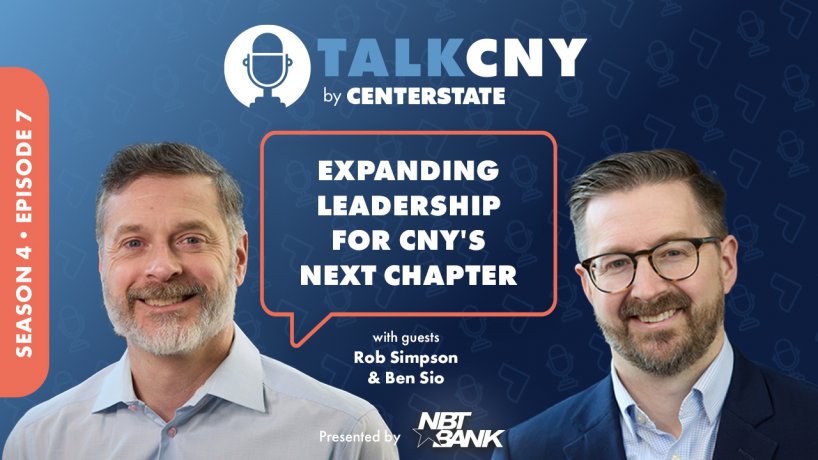
This is Talk CNY, a semi-monthly podcast by CenterState CEO. We're an independent nonprofit committed to creating inclusive, equitable, and sustainable economic growth in central New York. Join us as we meet the people and explore the projects driving the regional economy forward. This is Talk CNY, presented by NBT Bank. I'm Katie Zilcosky, Director of Communications at CenterState CEO and your host for Talk CNY. After more than 15 years, CenterState CEO is changing its leadership structure, splitting the CEO and president position into two roles. But taking on these new titles are two very familiar faces. On this episode of Talk CNY, presented by NBT Bank, we speak with Rob Simpson and Ben Sio about their new titles as CEO and president. Rob, Ben, thank you both for being here today.
Thanks for having us.
So as our listeners might know, recently, at our last board meeting, I think about a month ago, the board voted to separate the position of CEO and president into two roles. So now we have changed our leadership structure a little bit. Rob, you are CEO. Ben, you are now president. Can you tell me a little bit about these new titles for you both and what you're focusing on in your new roles?
Yeah, this is a really exciting moment of evolution for CenterState's CEO. I think it corresponds not surprisingly with this moment of evolution that we are in as a community. As you think about meeting the Micron moment, what I think that requires from organizations like ours, but also so many other partners in the community, whether it's our healthcare system, our arts and cultural organizations, capacity is the thing that our community needs to focus on right now. And in that moment, I think we are trying to be very intentional about the fact that CenterState has more on its plate to execute than we have ever had in our organization's history. We're really proud of what we've been able to build, but in order to execute on that, it requires a level of focus that has changed. The organization's grown a lot. We are a lot more complex.
We are engaged in a lot more conversations. What this change, I think, enables us to do is both focus on the execution, where Ben is uniquely capable and talented to drive that across the portfolio. And it frees me up to think a little bit about the vision, where we're going as a region, where the organization is going, and looking for the major lanes where we can have not only the most significant mission impact back to Central New York and our members and the community, but also where we can position ourselves as an organization to continue to grow and scale.
What he said?
I cannot add anything more to that. No, I will say though, so when we started this work to create CenterState, the organization was completely different than it is today.
This year, we're a $34 million organization, and we have something like 72 total employees. We have 28 grants that we're managing on a daily basis at CenterState. It's just the size and the scale, the operation and the commitments that we've made to the community are so much bigger than they've been when they originally conceived of these positions being as one. I think we've begun to realize that, hey, let's free some space up for both of us. And a lot of the ways we've communicated this is a change in Rob's role and an addition to my role. But also importantly, I think it frees both of us up to focus on really unique and distinct things within the larger title that the president and CEO used to focus on in general and gives us the space to be able to actually think strategically about forward leading vision and strategy, but also how the organization should run and operate and execute all those promises it's made over the past couple of years.
So what are some of the things now as far as strategy and day-to-day that you are working on that you guys are focused on in these new roles?
I've been spending quite a bit of time really looking at building out a long-term revenue diversification strategy for the organization. As Ben mentioned, we've grown a lot. I think at the point of transition when CenterState was created, we were like a $7 or $8 million organization. We've grown almost 5X over the last 16 years, and looking to continue to find ways that we can both drive mission impact and generate additional revenue is critical, not just revenue for us, but revenue for our partner organizations and the ecosystem of service providers that are helping to make this moment in Central New York possible. That's one scope of work. The second is really looking at how we increase our thought leadership and our advocacy, not only here locally in Central New York, but in places like Albany and Washington. We have a great track record as an organization. When we roll up our sleeves and we engage on issues, whether it's things like the Historic Preservation Tax Credit or the New York State Land Banks or some of the advocacy we've done around the Climate Leadership Act in New York State and the announcement that Governor Hochul made just last week, we have a very strong voice.
That voice can be even stronger if we are more focused and more intentional about allocating resources necessary to project that voice into the public debate. And whether that's an issue in front of the Syracuse Common Council, or something going on up in Fulton or Oswego or something important that matters to our members down in Albany, we want to be more thoughtful and intentional about how we do that. And the third thing and something that I've been incredibly excited about has been really rolling up our sleeves as we here we are in the podcast, the new podcast room in the INSPYRE Innovation Hub. And we have been for the last 15 years investing real dollars, more than $30 million over the course of the last 15 years in our startups. We have several dozen companies in our portfolio and really started to do a top to bottom review of that portfolio and think how we can help some of the companies that we have invested capital in, how we can engage with them more, help them get access to customers, help them grow, scale, not only to monetize those investments back to the organization, but to expand the impact in terms of the jobs that they can create here in Central New York.
And for you, Ben?
I think from my perspective, I came into this position knowing that we already have a fantastic team. The team didn't need more oversight or me getting involved in their work or their day-to-day. What they needed was that we were able to make things as efficient as possible from a leadership perspective. So I've been really intentional about freeing up my time to be able to support them on decisions they need to make. Also, something we hear on a regular basis from our team and from our board is understanding the impact that CenterState has, but the next couple steps in that impact and what our strategy is and making sure we're communicating that down through the entirety of the CenterState team, but also up through our board of directors. And so I've been really focused on that the first couple of days of this is just taking all the dashboard that we're putting together, all of the strategic plans or the strategic priorities that we've created as an organization the past couple of weeks and years and getting them into a place where we are more regularly communicating to our team about what our goals are and how we are performing against those goals and communicating to our volunteer leadership of the progress as wall just to show people that, hey, we do a lot as an organization.
So as you guys said, still in the very beginnings of these new roles, but much work underway already, what has surprised you about them so far?
I think the thing that maybe has surprised me a little bit, although we've been very intentional about it, so it shouldn't surprise me, but Ben and I have actually had more time to talk with each other about the strategic priorities of the organization over the course of since this transition than we had in the previous several months. And part of that is because we are both focused on ensuring clear and consistent communication all the way from the top through the entire organization. So when we built this plan for a transition, we also built a cadence of communication that would ensure that we are always going to be in sync. And that creates opportunities for us to chat every day, to connect at the end of the course of the day and make sure that we're updating each other on the major work streams, any issues that need to be troubleshot together.
And I found that to be a really great cadence for us and deeply rewarding.
I think the biggest surprise for me, and maybe this is not really a surprise, but things haven't really changed much, right? Yes, titles have changed and how we organize our days have changed a little bit, but Rob has been very intentional, not just during his sabbatical, but over the past couple months on letting me grow into a space where I'm handling some of the stuff that he might be normally handling on a day-to-day basis. So yeah, there was a point in time where we made a decision that had to get voted on by the board of directors to be made official. But I think it's really just been a gradual evolution into these roles and responsibilities. And it's not like you flipped a switch on the day it happened and my calendar filled up with new meetings that I've never seen before. It's been stuff that I think we've been evolving into for a while now.
You guys have worked together for...
...Too long.
Some would say, but what's it been like to see both your roles change, the organization change, the community change during your tenure together?
I mean, I love it. I'm thrilled. I'm so proud of Ben. I'm happy for him, and I'm really happy for our team. I think the practical reality of an organization that's grown and scaled as quickly as ours has is that inevitably the span of control at the top, the ability to manage the diversity of programs and services and offerings that we have, the major projects, the strategic initiatives, it just becomes on some level overwhelming. And so the ability, I'll speak for myself, the ability since the transition, just to have a little bit of white space to focus on some of the big strategic questions that we know not only hold our organization back, the pain points or the friction points that our team maybe faces, but also to think about the way that our community is positioning itself for the future and where Central New York needs the most investment in advocacy and support in order to meet this moment.
I think that's going to be huge dividends, and I'm really excited about that. That would not be possible if it weren't for the extra workload that folks on our management team and our corporate leadership team and Ben himself have agreed to take on.
We'll have more with Rob and Ben coming up in just a moment, but first, we have a quick break from our presenting sponsor, NBT Bank.
I would recommend NBT Bank to any business. My name is Chris Polimino, and I'm the president of Atlas Fence. Chris had decided to purchase Atlas Fence from the previous owner. He had previous connections at NBT Bank. NBT Bank provided me equipment financing, doubling our entire production workforce. It's important to me as a business owner that the decisions of our banking relationship are made locally.
Welcome back. This is Talk CNY, presented by NBT Bank. I'm Katie Zilcosky, Director of Communications at CenterState CEO and your host for this episode of Talk CNY. I am joined today by Rob Simpson, CenterState CEO, CEO, and Ben Sio, CenterState CEO President. Thank you both for being here.
Thank you.
Thank you.
We are at the start of quarter two here in April. Lots to look forward to. Lots happened last quarter. So, can you give us a summary of what you're looking forward to, and what we've accomplished so far in 2026?
Oh man, second quarter 2026, we're at a really exciting inflection point with respect to some of our key initiatives. The GENIUS New York program, which is one of the signature programs here in this building, we are in the process of launching Cohort 10, closing out applications, reviewing those companies, ultimately, selecting the next cohort to come into this building. That's incredibly exciting. I think we're making great progress with ON-RAMP. I think I was just down at ON-RAMP with Dr. Lacey the other day, and they had 120 different people through the building for various trainings and programming throughout the course of one single day. That's 120 human beings in our community that are being supported by that programming to get a better job, to grow their income, to support their family, to create generational wealth. And those are really amazing things. We're also starting to see some uptick now that Micron is in the ground, not surprisingly, on supply chain activity.
Those are really important and exciting conversations that we know are going to keep us and the county and the state and other partners busy for years to come. It's really exciting to see it come to fruition.
Yeah. I think at the beginning of the year when we were talking about our objectives and goals for this year, it was just a lot of executing the existing promises we've made to the community. So there's a lot of projects we've been talking about for a while, ON-RAMP, Tech Hubs, Micron, activating the INSPYRE Innovation Hub. So they're not news to anybody, but this is, in my opinion, the quarter and the year where they all hit their stride, and they all need to hit their stride, right? We are under the gun to execute, and Q2, especially, is when we turn on a lot of the new programs that we've received funding for over the years. We go to market, we bring in companies to participate in those, we're bringing people to participate in some of the training programs. So to me, it's a heads down quarter, do what we said we're going to do, make sure we're executing and make sure we're hitting the outcomes that are expected of us, which is great because all of the things we brought to market this year and are bringing to market over the next quarter, we're seeing a lot of resonance with, right?
So there's always this question of, "Hey, we're doing a grant application, and we're creating a training center. We're going to open up the program, or we're going to start the TA, and we've done the analysis, we've done the research. We know there's people out there that want it, but there's always that little thing in the back of your mind when you turn a program on for the first time, which is, are people going to apply? Are people going to use this? Are people going to show up to the information session?" And I think I've been pleasantly surprised by just the interest and the demand of all these things we're turning on right now, which shows to me that there's a lot of people out there that are grasping for that next thing. We need to execute on that, make sure that we add the value to them as they participate in this.
But to me, it's really great to see there's so much interest for the stuff we're turning on.
I think one of the things that I really love about the work at CenterState CEO is that when we approach these things, we try to do these big audacious programs and projects. The reality is to Ben's point, we don't always know how it's going to land in the market. We have an opinion, right? We've done our homework, we've done our research, we've put forward our best thesis, but until you actually start it and try it, you don't really get that market feedback. And what I love is our team's openness and willingness to pivot and adjust and to adapt, right? We set an objective as opposed to hold ourselves to a standard of executing on a set of tactics from day to day. And that allows us to be nimble, to be a little agile, and to make sure that we are doing everything in our power to actually move the needle for our members, for the Central New York community, and for the people that depend on us.
What's it like kind of being in a moment where you're actually doing the things you've planned on doing for many, many years?
We don't talk as much about this publicly at CenterState, but there's a lot of pressure on this work, right? We feel that on our shoulders every single day, as Rob says, that's great, that our community is in a moment, and that's super exciting, and that's great, but we need to make sure that we achieve everything we want to achieve during this moment because this moment's going to hit us. And if we don't do the things that we are prepared for, that we're funded to do, that we're excited about that fits our strategy about creating equity and creating sustainability with this growth,
We're not going to, in our opinion, succeed on that as much as we can. But with that pressure, it's a lot of work. It's weighed on us. It's also a privilege for us as an organization to do this work, to be in a position that we have the funding, we have the partners, we have the demand driver coming. So it's weighty work. It's exciting work. It gets us up in the morning and makes sure that we come to work every single day to focus on the stuff, but it's a lot of work. And I think with these changes and all the stuff that's happening in 2026, we're in no better position to execute and execute it in the way that we've always envisioned executing on it.
Yeah. I was having coffee with a member yesterday who, after a really interesting conversation about their business and where they are and where they're going, was just like, "Hey, thank you to you and the team at CenterState for all the support, not only that you give to us as a member, but also to what you're doing in the community, the leadership." And it's interesting, obviously, we appreciate that. It's wonderful when people see that. At the same time, my immediate reaction was like, actually, thank you, because you and the business community, our members, are the ones who have helped to create a platform like CenterState's CEO that is not like most regional chambers of Congress. It's not like most economic development organizations. It's not like most incubators or accelerators. It is a truly unique platform that the business community here in Central New York resources and empowers volunteers provide leadership and they give us a tremendous amount of latitude for how we pursue that agenda and they encourage us to innovate and to think creatively and what a remarkable opportunity to be in this moment surrounded by people who want nothing but the very best for Central New York and who are consistently willing to let us take some risks and try some crazy things and bring forward some big and bold and audacious ideas, never quite knowing whether or not they're going to materialize, but feeling better about taking those chances than not.
And I think that really, at the end of it, to me, that's the center state story in a box, business, community, supporting our ability to be innovative and flexible and agile, to not only rebuild the Central New York economy, put us back into that global value stream, but now to figure out how we capitalize on that once and for all.
We'll be hearing a lot more soon at our upcoming annual meeting about Central New York's position in the global economy, especially with a very exciting keynote speaker. Can you share who we will be hearing from?
Yeah, super excited that Manish Bhatia, who is the Executive Vice President at Micron, is going to be joining us. Manish was a constant presence in the site selection process. We had an opportunity to get to know him and so many others on the Micron team as they were contemplating the biggest decision they ever had to make as a company. We obviously were contemplating one of the biggest decisions we've ever made as a region and really grateful that he is going to join us hopefully to share a message about just how unique and competitive the memory landscape is. I think one of the things I've heard Manish say multiple times in the years that we've known each other now is that memory in semiconductor manufacturing is one of, if not the most competitive marketplaces in the world and that every single day they are in an existential fight for their lives.
It is a commoditized business. The business is driven by driving cost down as low as possible, and the competition is fierce. Layer on the remarkable growth that we're seeing in AI and the pressure on companies like Micron is intense. And I think part of what we'll talk about at the annual meeting is that that marketplace that is so important to Micron is also now really important to us. And if our goal was to reinsert ourselves into the global marketplace and that global slip stream, I think we've done that. What it means for us though is that we have to be prepared to compete on an entirely different field every single day going forward. And that requires some adjustment, I think from the Central New York community. We talked about capacity as being one of the most important elements that we need to build. We are going to need to compete and earn everything that comes to us in this moment.
And I know that's a perspective that is shared by companies like Micron and other members and companies that are here in Central New York. And it's a perspective, I think that we also feel as an organization, the competition is going to be fierce. We asked to be back in this place, we are there and now we have to compete, and we have to win.
Our annual meeting is a chance for us to really share with the entire, not only business community, but Central New York community, our vision for the next year, really kind of let people know where our heads are, what we're focused on. So what are some of the top-line messages that you're hoping to share with the community at this upcoming annual meeting?
I think top-line messages, we've arrived in our moment. As we were just talking about, we have been working for years and years and years. We've always known and believed in our heart of hearts that if we followed a data driven approach, we could get back to a period of economic prosperity for Central New York. I think we will also be talking about the fact that when you're in a moment like this, and we need to scale, just think about housing for, for instance, we know we're going to need 2,300 to 2,500 units of housing every year for the next 15 or 20 years. On average, we've been building seven or 800 for the last five years. In order to achieve the metric that we need to hit and not fall behind, we have to take as much friction out of the system as possible.
And I think that is one of the core messages we'll be delivering. How can we, as leaders in that room, in the business community, in the political sector, in the civic sector, our educational institutions, healthcare institutions, how can we reduce the friction to enable us to achieve the scale and the capacity that we need as quickly and as efficiently as possible? That's going to be critical to our ability to succeed or fail. And that really is the competitive moment I think that we're in.
Rob talked about a couple of the top-line pieces. One thing that we're also toying around with, and we're still figuring out exactly how to message this though, but if you think about a semiconductor fab, they are the most complex factories that humans have ever built. The tooling that goes into them is some people call it alchemy, right? And that's been used to describe it because it's so complex, it's so difficult to make it the systems, how machines and humans interact with all these different steps to make this final product at the end is one of the most complex designs and environments that we've ever seen. And I think that there's a similar analog to the work that we have to do in our community to position CenterState, to position the community, and to position the entire ecosystem to support this growth, as we said, in a way that is affordable, that preserves equity, that preserves sustainability, all those important things for our community, right?
We have to make sure CenterState is structured and positioned correctly so that we are sharing responsibilities and recognizing what we're good at so that we can actually meet the moment, right? We also have to support the rest of the ecosystems and all of these larger ecosystem workforce development, startup support, small business support, the infrastructure that's needed, the power and the energy that are needed to power these things. So for us, it's the interplay of all these systems together, creating one final product that ultimately rolls off the assembly line. And as we think about it for CenterState, it's meeting all these objectives that we've set for ourselves this year and over the next couple of years. So it's exceedingly complex. It's exceedingly difficult. The thing that I get excited about at CenterState is the fact that we are in a position that we can look into all of those individual things.
We can help with the care and feeding of those individual things, and we can see how they interplay against each other. Because I think one of the secret sauces of our work is not just being experts in the workforce development space or the startup support space, but seeing into all of these systems and showing how they interrelate and the strategies that we can use to execute one sometimes actually can be transferred to the other one and vice versa and keeping them coordinated for us is a really important piece of all this. So that's what we're toying around with. I don't know if it's going to sound exactly like that at the annual meeting because he's talking about me, but we'll figure it out.
I'm sure the Annual Meeting is going to be a great event. For someone listening who wants to get their ticket, where can they go to get a ticket?
Www.centerstateceo.com.
Perfect. Well, Rob, Ben, thank you so much for being here today. It's always a pleasure to have you on.
Thank you.
Thanks for having us, Katie.
Center State CEO's podcast, Talk CNY, presented by NBT Bank, is available on all major podcast platforms or centerstateceo.com. Additional content and clips can be seen across CenterState CEO's social media channels. For new episode reminders, be sure to subscribe in your favorite podcast listening app. And don't forget to leave a quick review or a five-star rating. Thanks for listening to Talk CNY, presented by NBT Bank.
Other
Talk CNY Main Series Transcripts
| S4,E19 - Rob Simpson | October 7, 2026 | |
| S4,E18 - Craig Marcinkowski | September 23, 2026 | |
| S4,E17 - Nora Spillane, Craig Witmer | September 9, 2026 | |
| S4,E16 - Joan Royle, Emilija Postolovska | August 26, 2026 | |
| S4,E15 - Dave Kavney | August 12, 2026 | |
| S4,E14 - Carrie Large | July 29, 2026 | |
| S4,E13 - Corporate Leadership Team | July 15, 2026 | |
| S4,E12 - Dr. Carlene Lacey | June 24, 2026 | |
| S4,E11 - Jared Shepard and Jess Abbott | June 10, 2026 | |
| S4,E10 - Sara Nozkova | May 20, 2026 | |
| S4,E9 - Kara Jones and Brad Banikowski | May 6, 2026 | |
| S4,E8 - Joe Nehme | April 22, 2026 | |
| S4,E6 - Lindsay Mastrogiovanni, Kathleen Avery Connell, Jim Connell | March 25, 2026 | |
| S4,E5 - Jess Abbott & Honora Spillane | March 10, 2026 | |
| S4,E4 - Sara Broadwell | February 25, 2026 | |
| S4,E3 - Brandon Mastrangelo | February 11, 2026 | |
| S4,E2 - Ryan McMahon and Rob Simpson | January 28, 2026 | |
| S4,E1 - Rob Simpson | January 14, 2026 | |
| S3,E24 - Sharon Owens, Ben Walsh, Rob Simpson | December 17, 2025 | |
| S3,E23 - Tanika Jones | December 3, 2025 |