

2026 Q3 - Ken EntenmannPosted on August 5, 2026 |
Image
|
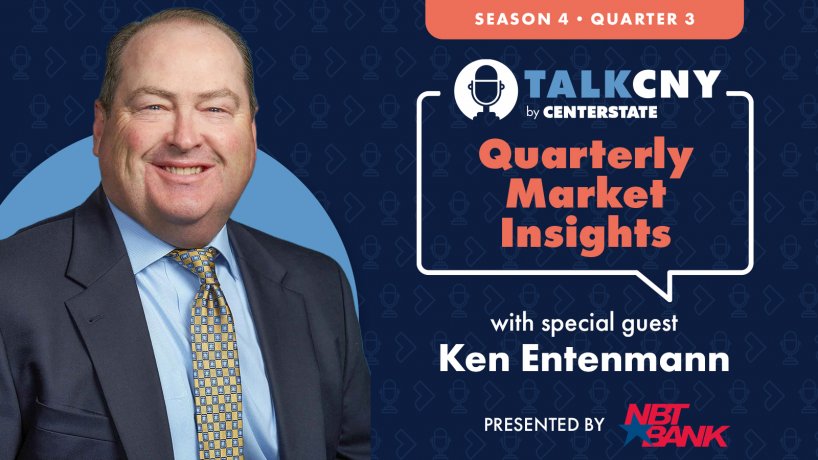
Kevin Schwab: Welcome to Quarterly Market Insights, presented by NBT Bank. I'm Kevin Schwab with CenterState CEO, and I'm joined today by Ken Entenmann, the chief economist for NBT Bank. Ken, how are you?
Ken Entenmann: I'm great. It's great to be here.
Kevin Schwab: It is a really good time to get together for this conversation right now. I think something we started on our last episode was sort of the secret word. And I feel like we have two this time: volatility and probably shrug. That I think kind of captures what we're seeing right now, but let's dive into it a bit. We've got the war in Iran. Strait is open. Strait is closed. Strait is open again. Strait might be closed again. I cannot remember in the numerous conflicts that we've had to engage in over the years as a nation the last time one seemed to hold as much peril for the global economy as this one does, and yet oil prices, which shot up initially, have come back to earth. The market's doing well. Inflation does not seem to be getting worse, might even be getting better. Let's touch on those first and foremost. Let's talk about oil.
Kevin Schwab: Are you surprised at all by the oil reaction and what we're seeing, and why do you think the oil markets are reacting the way they are?
Ken Entenmann: Well, I think there's a couple of reasons for that, Kevin. First and foremost, this is not our grandfather's or our father's economy. So we have become far better in terms of energy consumption. So I think back to my days of parking cars at a golf course in Long Island in the late '70s, and a Lincoln Continental or a Cadillac would pull up, and it would get eight miles to a gallon. So we're just better at oil consumption. So I think that's part of it. Secondly, I think we have a more diverse source of energy that allows us to kind of toggle back and forth. So I think that's a factor of it. And then thirdly, and I know this is difficult because every time we talk about it, we're kind of thinking we're close. We have a memorandum of understanding, or we have a ceasefire and a couple of days it seems to unravel. But I think the world has just gotten better at adapting.
Ken Entenmann: And this started in basically March and April, so we're several months into it. And I think the world has adapted. We're moving oil around the world in different ways. So then lastly, I do think the markets are concluding that, and I'm going to put short-term in quotation marks, this is a short-term event. And we've discussed this before. I do think that Iran in particular, there's two constraints here. One in the United States, we have this thing called a midterm election coming up. So there's a big incentive for President Trump to have this, if not fully resolved, but at least reasonably under control. And we're not that far off. Here we are in the middle of July. So I think there's an incentive on the United States side, but also I think Iran has some pretty significant social problems. And most importantly, because of all the sanctions, the flow of oil out of the Persian Gulf through the Strait, they're running out of cash.
Ken Entenmann: So sooner or later, they're going to have to have a reconciliation. And so because of all those reasons, I think the oil markets have been reasonably well behaved. Most recently, oil got down to almost $70 a barrel, which wasn't too far. Back in April before the conflict started, oil was $65. So we're within spitting distance of where we were. So when it first happened though, shot up to about $120 a barrel, I think people were really, really concerned.
Kevin Schwab: Yep. But perhaps one of the surprises in all of this was China's reaction?
Ken Entenmann: Yeah. I think this wasn't a surprise either. This has been percolating for a while. One of the real head scratches in this is China has significantly reduced its demand for oil, whether that's by government decree, but they've added a huge fleet of electric vehicles, which reduces the consumption of oil. And China, I think, somewhat in anticipation of Mid-East turmoil built a huge stockpile of oil so that they've been able to weather this storm pretty well by reducing the demand. And that's what I mean by people adjusting to the world that we live in. All of those things add up to an oil market that is remarkably well behaved considering the past history of what happens when you have a Middle East conflict.
Kevin Schwab: So the other factor in all of this, of course, when we start talking about inflation, we are starting to see, we saw some very concerning signs again toward the beginning of the war. We're starting to see that ease a bit. And we've also got a new Fed chair. So inflation and interest rates, touch base on that.
Ken Entenmann: Yeah. So the inflation data has been really interesting. It was coming down prior to the start of the military situation in the Middle East. So we were trending in the right direction. The recent, over the course of the last three months, increase in inflation is 80% due to oil prices and energy prices. The month of May was the shocker because it broke like three or four months of declining inflation numbers and they came in very, very high. The most recent CPI and PPI data that came out recently showed not only a decline in inflation, both on the consumer price index and the producer price index, but very serious downward revisions of inflation in the month of May. So the month of May was kind of an outlier, and the most recent CPI and PPI data, it kind of reversed out.
Kevin Schwab: So the implications then when we look at the Fed and what they might do going forward and we start talking about interest rates?
Ken Entenmann: Yeah. So the inflation data kind of forced the Fed's hand. As we've talked many times, the Fed has a dual mandate: maximize employment and minimize inflation or maintain price stability. What is clear is that the employment market is pretty stable right now. I think the AI job apocalypse that was feared at the beginning of the year just has not materialized. And if anything, in my experience going around the NBT footprint, which is primarily the Northeast, New York and New England, if anything, the constraint that small businesses, the core of what CenterState advocates for, their concern is the constraint of labor. They can't find qualified labor. So I think the Fed can comfortably say the labor market, at least in the current environment, is pretty stable. And therefore they can focus on inflation.
Ken Entenmann: And indeed, Kevin Warsh in his testimony before Congress is saying, “Yeah, it's great that the numbers are coming down, but we can't say mission accomplished yet.” But we have ebbed and flowed in terms of interest rate expectations throughout this year. In the beginning of the year, we had forecasted three or four rate cuts. Then the war started in March, April, and concerns about inflation started to pick up. As of today, there's still a fairly decent probability that we'll get a rate hike by the end of the year. I'm a little suspicious of that one. I think the data trending where it is. And again, we're really talking, it sounds wonderful to say that the June CPI and PPI data were good, but oil dropped 12% in the month. So that explains it. And the most recent saber rattling that we've experienced, oil has gone from 72 back to 79. It's not 112, but it's up, say, 10% over the course of the last few weeks.
Ken Entenmann: So that being said, what we're arguing over is whether the Fed raises rates from three and a half to three and three-quarters or whether they cut rates from three and a half to three and a quarter. I just don't think it is that big of a factor, even though it sucks so much oxygen out of the room and it's on the headlines every day. That's what we're talking about. Nobody is talking about rates going up to Fed funds rate going from three and a half back to five where it was, say, a year ago. And nobody's talking about, and I hope we don't go back to 0% interest rates because bad things happen to get to that situation. So I continue to be amazed that we spend so much time and energy trying to sort out the tea leaves of the Fed when the reality is the economy is in pretty good shape. The labor market's in pretty good shape. The inflation data appears to be easing in the right direction.
Ken Entenmann: So I don't think you're going to get a whole lot of change, whether it's up or down remains to be seen. But I don't think it's going to be enough. And I don't think Fed funds rate, whether it's three and a half, three and three-quarters or three and a quarter, that quarter-point differential is enough for any business to make any big, bold decisions on their future.
Kevin Schwab: Ken, I think that might be the most important thing that you've said and that you're saying in this episode is that as much as we talk about these types of moves, we're talking about it in a very narrow range here.
Ken Entenmann: Yes.
Kevin Schwab: And that's likely a reflection on the overall health of the economy that we're dealing with right now. Certainly, we've talked about how the market has done very well. But then when you dive into it, and when you talk certainly about our GDP growth as well, you see where AI comes into play. And there's credible analysis that says that as much as two-thirds of our economic growth as a nation this year has been driven by AI activity, AI investment. Is that a good thing? Is that something that should make us nervous? How do you look at that?
Ken Entenmann: Yeah. Well, first and foremost, our economy is consumer-driven. In the last week or so, we received earnings reports from all the major money center banks, and they were fantastic. And the data that comes out of those earnings reports show that the consumer across all income spectrums remains remarkably resilient. It's 70% of the economy. So that portion of the economy seems to be humming along. And that to me is my biggest concern is that whether it's inflation, higher oil prices, that starts to chip away at consumer spending. There is zero evidence that that's happening. So that's really positive. We estimate, the market estimates that in 2027, there'll be over a trillion dollars in AI-related spending. And we're living it here because the plant in Micron up in Clay is a direct result in response to the amount of computing power that's being requested.
Ken Entenmann: So I think that that is a driver of the economy that I think has a pretty high degree of clarity, at least for the next year or two. The one thing I would caution our listeners on, there's a difference between the economics and the investments. So I'm the chief economist and the chief investment officer. I am pretty confident. I think AI is going to be a major contributor. Kevin Warsh, testifying before Congress, believes that we are on the brink of a significant productivity enhancement due to this new technology. I tend to agree with him there. That doesn't mean the individual stocks we're talking about are all going to be winners. And so you need to kind of separate the two, the investment piece from the economics. From an economic standpoint, which is our focus in this podcast, I think you have pretty good clarity that for the next year or two or maybe even three, you're going to have some really big investment dollars.
Ken Entenmann: And that has to be good for the overall economy. And you can see it in the stock market where you have these kind of AI-adjacent trades going on. So something like Caterpillar Tractor, which is a dull, boring industrial manufacturer. Well, it's kind of hard to build a Micron plant without a whole lot of Caterpillar Tractor equipment rolling around the footprint. And we're seeing that across the board. So Caterpillar Tractor, huge beneficiary of the AI trade. So it's not just Microsoft, Micron and OpenAI. It's really across a pretty wide spectrum, and it's being reflected. We're right on the cusp. We just began the second-quarter earnings season, and so far it's been great.
Kevin Schwab: Drive anywhere up Route 31 in the town of Clay near the site, and you're going to see a whole lot of heavy earth-moving equipment and a whole lot of trucks. So completely understandable. By the way, we do introduce you here as the chief economist. For those looking for our after-hours show, that's when Ken, the chief investment officer, is giving advice. So that's the after-party though. Let's be very clear about this. Look, we did talk about this, and as we look a little closer to home, the enormous demand for memory is directly related to what we're seeing in terms of the AI revolution here. Of course, that's a great time to be a company like Micron. And that does bring us closer to home and what we're seeing here. Micron's at a breakneck pace right now. Six months into this, they are three months ahead of where they thought they would be since breaking ground.
Kevin Schwab: They've already started pouring foundation on the first fab, and we're going to see that project go vertical in a matter of months. What are some of the impacts you're already seeing here? And what do you expect to see in the coming months and perhaps even maybe as far out as a year from now?
Ken Entenmann: So you're going to see a whole lot of activity. It's unequivocally a good thing for our local economy, but there are also other impacts that remain to be seen. So the fact that that plant is going to require so much material, whether it's aggregate for building roads, it's going to impact the cost of doing business for everybody. The cost of building a new home, for example. It's going to suck up an awful lot of skilled labor. So you think electricians and plumbers and carpenters. And so if they become more scarce because they're dedicated to this major project, well, in theory, that's going to make it more difficult to put that addition on a house or build a new house. But overall, the impact of Micron is unquestionably a good thing. And while there was plenty of money being spent locally on the design and the marketing and all the things that CenterState has been involved in, I could recall going to a function at the zoo.
Ken Entenmann: Well, somebody catered that event. The caterers benefited from it. That kind of spreading of the activity is very clear. But in the long run, you're talking about thousands of permanent jobs that are really high paying, and that has to bode well for our economy.
Kevin Schwab: Well, and we're already seeing cranes in the air, certainly in Syracuse, a number of new housing developments that are underway. We're seeing that happen outside the city as well, more housing in particular. And we've seen a number of other microelectronics industry investments here, including the recent grand opening of the TTM expansion over in East Syracuse. So we see a lot of this activity happening already here. And that translates to after these projects get built. And we're already seeing some signs of that, right? The manufacturing sector performing well here. What do you see in here and in New York?
Ken Entenmann: Yeah. So the most recent New York State Empire Manufacturing Index came out, and it was twice the estimate. It was estimated to be 8.4. It was up 15%, a little bit more. The numbers are suggesting that manufacturing activity, which includes building fab plants, is up across the board. So again, it's one of those things where there's a lot of grumpiness on an individual basis, but when you look at the macro data, it's happening. At NBT Bank, we look at our experience in Utica with the Wolfspeed plant. We look at our experience in Malta with GlobalFoundries. And NBT Bank, we're not a big enough bank to bank Micron, but we do bank the companies that build roads, and we do bank companies that build strip malls, and we do bank franchisees that open. And you go down to Malta, and you look at what's happened on that roadway by the.
Ken Entenmann: It's just remarkable the amount of condominiums and apartment complexes and strip malls and Jersey Mikes and all kinds of entities going up. It's really remarkable. And that's where NBT Bank's going to benefit. So we're huge fans of Micron. We sent a team out to Boise to see what's happened there, and it's nothing short of remarkable when you do it. I think it's going to be phenomenal for us.
Kevin Schwab: So we've had a lot to talk about. I think we said at the top when it concerns a lot of macro volatility that I think is getting attention in every direction. But you kind of struggle and you say the fundamentals still look good.
Ken Entenmann: I've been talking about this for well over a year, and whether I'm calling it hard ice cream or soft ice cream or the best of times, the worst of times, we are as a society a very grumpy society. Whether that is due to our political environment, which I certainly think is part of it, I think social media contributes to it because no matter what your opinion of things are, you can magnify that opinion by going to certain sites and reading it so you can kind of leverage that negativity if you want. But as grumpy as that data is, the underlying fundamentals of our economy is 2% plus probably pushing 2.5% GDP growth. Unemployment that's trending toward 4%, which is remarkably low on a historic basis. Even inflation, if you look at CPI at 3.5%, is that above the 2% target of the Fed? Clearly, yes. I'm old enough to remember double-digit inflation. In fact, in COVID, the CPI peaked, I think in June of '22. I think it was the month at 9.2%.
Ken Entenmann: Three and a half is we'd like to see a trend toward two, and I do believe we'll get there. But 3.5% inflation is manageable. People can manage that. It's the spikes and the volatility that are really difficult for businesses to handle. And I suspect that that's going to diminish over time. And with the key criteria being that we need to have a reasonable understanding. I'm not saying it's a ceasefire, it's a peace accord, but just a sense that the Middle East is under control and is not going to be the source of the volatility that we're experiencing. Who knows where we're going to be? But I think the oil markets have concluded that it's going to be manageable. And if we can get that sense, I think the remaining piece of worry is inflation. I think I can see light at the end of the tunnel when it comes to inflation.
Ken Entenmann: So when you look at a pretty strong above-trend GDP growth, a very stable labor market, and inflation trending toward the Fed's target, that's a pretty good economic foundation to build upon. And I think that's where we are.
Kevin Schwab: Ken, I always appreciate your expertise and your insights, your quarterly insights. See what we did there. Looking forward to doing this again in three months. Thank you so much.
Ken Entenmann: It's great to be here. Thanks for having me.
Other
Talk CNY Quarterly Market Insights
| 2026 Q2 - Ken Entenmann | May 4, 2026 | |
| 2026 Q1 - Ken Entenmann | March 6, 2026 | |
| 2025 Q4 - Ken Entenmann | December 24, 2025 | |
| 2025 Q3 - Ken Entenmann | October 6, 2025 | |
| 2025 Q1 - Ken Entenmann | May 2, 2025 | |
| 2024 Q4 - Ken Entenmann | December 11, 2024 | |
| 2024 Q3 - Ken Entenmann | October 9, 2024 | |
| 2024 Q2 - Ken Entenmann | July 17, 2024 | |
| 2024 Q1 - Ken Entenmann | April 3, 2024 | |
| 2023 Q4 - Ken Entenmann | December 18, 2023 | |
| 2023 Q3 - Ken Entenmann | October 1, 2023 | |
| 2023 Q2 - Ken Entenmann | July 6, 2023 | |
| 2023 Q1 - Ken Entenmann | March 6, 2023 |