

Leadership Lessons E6 - Michael MondsPosted on December 10, 2025 |
Image
|
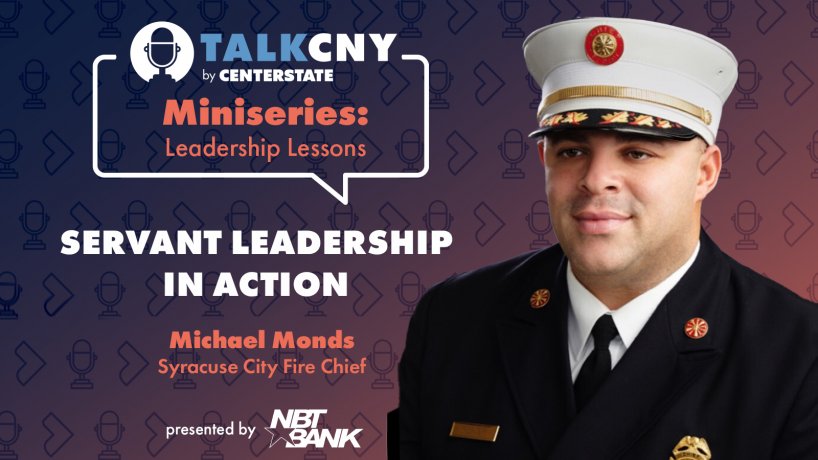
Welcome to the Talk CNY miniseries Leadership Lessons where we sit down with business and community leaders to discuss the lessons that have led them to where they are today and serve as a guiding light forward. Our guest today is someone who is making a huge impact on the City of Syracuse. We are joined by Syracuse Fire Chief Michael Monds. He grew up on the city's South Side, graduated from Nottingham High School, and then after college he committed his life to serving the home where he grew up. He officially began at the Syracuse Fire Department back in 2000. Then he was promoted to lieutenant in 2011, then became the fire chief in 2018, and today he leads more than 350 firefighters who are committed to helping the people of Syracuse. Chief Mond's journey is one of hard work, dedication, and leadership, and today, we are really excited to learn more about it. Welcome, Chief Monds.
Thank you for having me. I appreciate being here today.
We're looking forward to hearing from you. You have been a leader for so many years. When you think back over your leadership style, what is it today, and how has it evolved over time?
I think starting off being a firefighter, you learn early on that this job is to protect the citizens of the city when they're having their worst day. And as you become a firefighter, and you learn all the hands-on skills you need. The mental toughness you need to be able to deal with some of the situations. Back then, I realized that I was being supervised by some really, really great leaders at the time, and I always hoped one day I could be a leader or even one promotion up then a firefighter to be a lieutenant or a captain. And I always try to take the good out of every leader that was in my life to try to formulate what I would be like if I ever got the opportunity. So I try to live my current career that way, and I think the goal is to serve the City of Syracuse residents, but also at the same time serve our firefighters, who are our number one resource and to protect our citizens. So being a servant leader is kind of what I try to model myself after. I know I'm not perfect all the time, but that's my goal.
So what does effective leadership look like in a fire department setting, especially when you've got high-stakes decisions that have to be made under pressure?
I think the main thing is that people are going to have bad days, that the fire department needs to respond to. I think my ultimate goal is to make sure I provide the resources for the firefighters to make sure they're safe, that they are trained to the level they need to be, to make sure all their tools and equipment, everything they need to do to be at some of the most dangerous situations when other people need their help the most. To ensure that they have those resources is my job. And to also balance making sure our rules and regulations and policies put them in a position to be safe. So they don't have to think about a lot of things they need to do when they're on scene. It's just reactive based on their training and based on the policies that we try to instill in the department.
That sounds good.
Yes.
How do you personally train to stay calm in such high-pressure situations?
Well, I think my faith, number one. Every day, I try to do the greater good for all people. And in this role, that's the citizens, making sure that everything that I touch, every decision I make is going to be the most beneficial for every citizen in the city. And it's the same with the firefighters. There are decisions that have to be made every day. Dozens of questions or situations that come up, that in my opinion, ultimately, is usually the decision maker, and just making sure that it's fair, there's accountability to the decisions we're making.
You hit on something I really wanted to touch on, which is the firefighters as well who are out every single day in the community.
Yes.
How do they train as well to stay calm and have the mental toughness that you were talking about?
I think we're such a busy fire department that you come on and you get hired, and we give you the basics over at our recruit academy. You get the foundation of what it takes to be a firefighter, but just the coworkers that you're going to be assigned to when you go to a fire station, the training that we put in place, which is a pretty regimented system that you have to have certain amount of hours of training a year, but really going on the calls and getting the experience under your belt, learning how to use the training that you're given to provide help to somebody. The more you're able to do that, the calmer I believe the firefighters can be. The more situations that they're put into those circumstances, they understand sometimes there's room for improvement, and they can build off of that.
And our firefighters do a really good job. There have been fires that we've gone to that we haven't had really great outcomes. And there are firefighters, that before I was a chief, that I used to look up to and try to emulate myself. And when a fire doesn't go our way, and to see how disappointed they were and them talking about what they're going to do to make things better the next time, it just makes me want to make sure I'm giving them everything I can to make sure they're successful, so they're in good places to help people.
That's great. You're leading me into my next question, which is how do you take away those key lessons, whether it's a rescue or a past fire, to pull some of that out and then really implement that into the training or the protocols?
So most of our really dangerous calls are structure fires, and after that we do an action analysis. We kind of get all the firefighters that were at that alarm, and we discuss what did they do, how did that go, could things have been better? And I think without being critical or having any sarcastic or negative conversations, the firefighters want to learn. They want to do great things. And I think just being able to talk through those situations, and when you're on a call, and you get back to the firehouse, even without the big group of everybody that was there, your crew that you work with, usually it's a supervisor on three firefighters. They're constantly figuring out how to make things better, because even when things go a hundred percent right in the fire service, firefighters get hurt. So they're very understanding that everything they do could be a dangerous situation. So the more they're prepared, the more they're ready to learn and move on and improve in whatever categories they have. So they take our training program very seriously. A lot of our firefighters go off on their own, and do a lot of training on their own. But ultimately, I think we all know that training is the number one foundation to keeping our firefighters safe.
So Chief Monds, you've mentioned that servant leadership is so important to you. What type of legacy do you hope to leave?
I hope that when I'm retired on and off duty, I am remembered that anytime there was a circumstance or situation that was put in front of me, that the decisions I made, the battles that I fought, the conversations that I had were to only help the greater good of all of our firefighters and the people that we serve.
Alright, so our next section is the Rapid Fire section. The goal is for you to answer the question on the card. Please read it out loud, then answer it, and you've got about 30 seconds, then you can move on to the next one.
Okay. What aspects of your job bring you the most joy and fulfillment? I think seeing the younger firefighters get on the job, some of them don't have any knowledge of the extent and how complex our job is and watching our young firefighters grow to be great servants for our city.
Beautiful.
Number two, what strengths do you rely on most as a leader? I think the strengths that I rely on the most are the people that work with me. I certainly don't have all the answers. The people that work on our command staff, all the way down to our newest firefighter, I can learn something from everybody, no matter what their rank, no matter how much time they have on the job. So they are my greatest asset and my resource that I rely on the most.
Beautiful.
What personal habits or routines help you maintain resilience and focus? Well, my number one thing I do to stay organized is to make sure the things that I'm working on every day are the priorities. Sometimes you can come to work and you can look busy, you can do a lot of things all day, but are what you're doing every day actually making an impact on the things you're supposed to be doing to help other people. So I think before the week starts, I go through the list of my priorities and when Friday comes at the end of the business day, I hope that I accomplish most of those things. And then as things pop up, it reorganizes my priority list. But trying to stay organized is my number one key to stay focused.
Beautiful.
How do you stay motivated to lead each day? I think knowing that there's such a need for our services in the city, for our people. We've had record-breaking amounts of alarms and 911 calls that we have to respond to. And being the chief for eight years is a long time. But when you realize that you're able to help our firefighters stay safe, to help our citizens stay safe, that is what keeps me motivated to know that I'm trying to do what's good for the greater good of our city and our firefighters.
How do you continue to grow and refine your skills? I think every opportunity of any situation that comes up helps keep me sharp, or it gives me an opportunity to learn and/or improve. I think just the day-to-day work, trying to do the right thing, trying to hold myself accountable, trying to follow the procedures, and having expectations of myself as a fire chief.
I have a lot of expectations of others, and I try not to have any expectations that I wouldn't place on myself. So I think that helps me grow to make sure that the things that I'm expecting are reasonable and that I myself would put myself in those shoes and do the same things that I think the other people should be doing at the same time.
Next, what role does mindset play in leading through good times and times of adversity? I think how you view things. How you perceive things. How situations come up, and your plan to overcome them or to remedy that situation. It all starts with your mindset, that one, you have to be confident in yourself. Two, you have to be confident in the people that you're depending on to help you achieve these remedies or whatever we need to mediate a situation. But it all starts with having confidence in your ability to get to the finish line on whatever subject or issue that comes up. So I think confidence is very important to be able to do that.
What hobbies or activities outside of work help you stay motivated and grounded? I think just hanging out, spending time with my family and friends and just having conversations. I have two older professional daughters. They have very good careers, and we discuss that. Being home with my wife, being able to discuss things that are going on, just living life and trying to be normal outside of the hustle and bustle of being the fire chief. That's what I do for relaxation.
Beautiful. Well, you have a beautiful family.
Alright, well, thank you so much.
You're welcome. As we prepare to close, my final question is, if someone watching this wants to become a firefighter, what advice would you give to them?
First, I would say I do every week make sure you have your goals and your priorities in line, and understanding what a firefighter is going to be, and then you have to start doing the research. We're currently in the process of giving a civil service exam in the City of Syracuse. You cannot be hired unless you take that exam. So if you go on our website, syr.gov, underneath the Fire Department, you can go on there. We have links on what you need to do to take the exam to become a firefighter, but outside of that, always being ready for the opportunity whenever it knocks on your door. And are you setting your goals enough to be ready when the opportunity comes?
Well said.
Preparation is key.
Preparation is key.
Well, thank you so much Chief Monds for joining us today.
Thank you for having me. I really appreciate coming in today.
It was a pleasure.
Well, if you'd like to hear more in-depth responses from Chief Monds, they will be available across CenterState CEO's social media channels. CenterState CEO's podcast Talk CNY, the miniseries Leadership Lessons is presented by NBT Bank. It's available across all major podcasts, platforms, and on centerstateceo.com. Thanks. Have a great day.
I would recommend NBT Bank to any business. My name is Chris Polimino, and I'm the president of Atlas Fence. Chris had decided to purchase Atlas Fence from the previous owner. He had previous connections at NBT Bank. NBT Bank provided me with equipment financing, doubling our entire production workforce. It's important to me as a business owner that the decisions of our banking relationship are made locally.