

Leadership Lessons E7 - Andrew LunettaPosted on December 29, 2025 |
Image
|
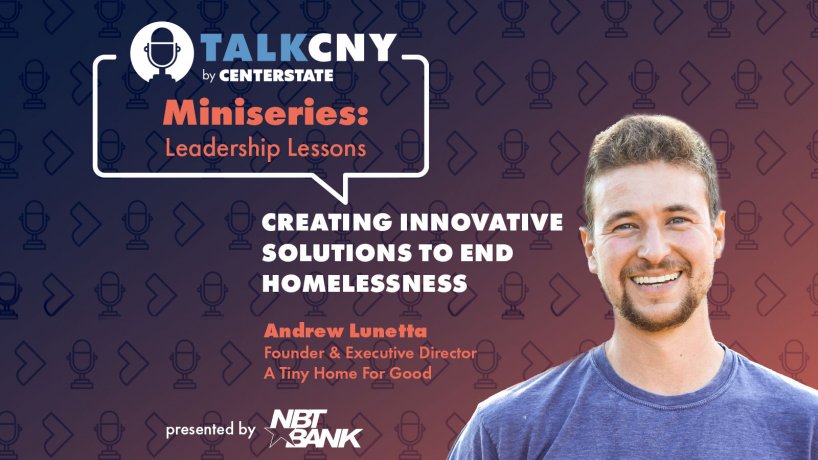
Welcome to the Talk CNY Miniseries: Leadership Lessons, where we sit down with business and community leaders to discuss the lessons that have led them to where they are today. Today's guest is Andrew Lunetta, the Founder and Executive Director of A Tiny Home for Good. It is a small organization with a mighty mission. Their mission is to end homelessness in Syracuse. After spending nearly a decade working at a men's shelter, Andrew noticed what led people back into homelessness. Therefore, he created A Tiny Home for Good, where they provide affordable housing for people who are homeless, as well as long-term solutions to help them with the transition. There is no doubt that A Tiny Home for Good is transforming lives each and every day, and today, we are speaking with the man behind the mission. Welcome, Andrew.
Yeah, Brittni, thanks for having me. That was a great introduction.
Oh, you're very kind.
It's a pleasure to be with you. You do such great work.
Awesome. Thank you. Appreciate that.
Yes, honest. So my first question for you is, can you share some of the success stories from A Tiny Home for Good?
Yeah. I have to talk about our very first tenant who joined us. His name's Dolphus. He joined our homes in 2016, very first tenant ever. And previous to that, Dolphus was in and out of shelters, tough housing, pretty much entire adult life. In 2016, he moved in with us and hasn't looked back since. So he's coming up on what is going to be 10 years of housing next year. And he's now on staff with A Tiny Home for Good. He's our janitor. We exist because of him, frankly. As I was imagining what A Tiny Home for Good could be, it was how do we provide a space that really fits Dolph as well? And the fact that we've done that is, I think, our greatest success.
That is absolutely beautiful.
Thank you. He's everything.
Community support is really integral to A Tiny Home for Good. Can you share some examples or just some information about people who volunteer, or how they help out?
When I had the idea for A Tiny Home for Good, it's not like I was independently wealthy or frankly even knew how to build a house or the steps it would take to form an organization. So we exist because of community support on literally every level from the funding to the homes being built to how we support our tenants. So when you go into each of those things, there's the very basic, we exist because individuals, companies, organizations see what we do as a permanent solution and want to invest resources into that. So there's the financial side. And then in order for us to build what is now going to be 42 units by the end of this year, it's with a ton of community support on the hands-on side. So every Monday, Wednesday, Friday, we have a group of half dozen retired individuals who are volunteering with us for about five hours a day.
That's great. Most weekends, we have a group coming out to do something. It could be painting a fence. It could be digging for a fence. It could be painting a wall. So those are the tangible sides of it, but then there's the - how do you actually build an organization? And I had no idea. Frankly, it's a group of board of directors, a lot of partnerships at the city and the county that has kind of led us to where we are today. And all of that can be couched as community support. Yeah.
That's beautiful. So then, as you talk about your journey, I hear you saying that it's really been a learning lesson along the way. So then what made you decide, okay, this is what I want to do. You could have done anything, but yet you decided to open this organization.
In 2008, I enrolled at Le Moyne College and started volunteering at what was called the Oxford Street Inn. It was one of the two homeless shelters in the city for men, and I just fell in love with that place. I just thought that their model of providing support and services to some of the most struggling in our community was something that just really struck a chord with me. So I was showing up there all the time as a sophomore. They hired me on staff and started learning a lot more about the issues that the residents there faced, and started seeing men move out of the shelter only to come back in a matter of months because frankly, the housing that was affordable to them did nothing to sustain any long-term stability. So I was finishing up my time at Le Moyne, finishing up a grad program at SU, still working at the shelter.
And these issues just kept stewing with me. And guys were still at the shelter from when I started there in 2008. So in 2012, I rented a house on the south side of the city, big, five-bedroom, old, drafty, big old house, and invited guys who I got to know really well at the shelter to come and live there. So for five years, I managed this home and guys from the shelter would come, and most of them stayed there for the full five years and have since moved on to actually some of the tiny homes. And it was an incredible experience that really got me intimately involved in the lives of these men and working very closely with addiction, mental health challenges, and what's necessary to overcome those. And I just wanted to extend that service to more people. So A Tiny Home for Good was kind of this way to offer it to a larger population.
And that's kind of like the origin story of a Tiny Home for Good, all based around a need that I saw desperately for individuals who were facing homelessness and just a commitment that I had to that cause.
Wow. That is so beautiful that you are so dedicated to all this.
So when you started your organization with anything, anything you pursue, there will be challenges.
Oh yeah.
So what are some of the challenges that you ran into, and how did you overcome them?
Well, the very first thing I did before we signed any paperwork was I talked to a lot of the emergency service providers who were already doing really, really good job of supporting our homeless population here with emergency services, some housing, medical care, and asked them about the reality of building these tiny homes on vacant city lots. And despite everyone saying it's a fabulous idea, there was no organization that really wanted to sink their teeth into it in a way that I thought was necessary. So I did a lot of homework for a couple of years to figure out if this was something that should start, right? Maybe it should have been under an umbrella of another organization, but I learned that there just wasn't the appetite to do that. So that's kind of the first realization that this had to happen. So in 2014, we signed all the paperwork and started going out and sharing about why I thought this model would work and raised the money pretty quickly to build the first two homes.
So honestly, by the end of 2014, we had about $50,000 to dedicate to the first two homes. And I ran into what every affordable developer runs into, which is Nimbyism and neighborhood pushback.
So I would have bound up on a neighbor's porch, just super excited about this idea only to be told that while they love the tiny homes, love cleaning up the vacant lot, they wanted no part of having individuals who had faced homelessness living there. And there were a lot of times when I was ready to throw in the towel, like really had applications ready to rock to do anything else. But I was still living with the guys who I knew would live in these houses. Ultimately, I was still working at the shelter, knew that a lot of the men who I saw every night would really benefit from these tiny homes. So that just continued to light a fire under my butt. After two months of knocking on doors and making phone calls, a woman on the South Side of the city owned this tiny postage stamp of a lot, said, "I don't want to pay taxes on it anymore. Sure, you can buy it for $2,500." And with that, we had the ability to get started. So the biggest challenge was that first couple of houses in the ground, but once that happened, we were able to point to, "This is what we mean when we say we're going to be here."
So how would you describe your leadership style? How was it when you started the organization and how has it evolved to who you are today?
A couple of years ago, A Tiny Home for Good went through the Gifford Foundation's Embracing Disruption Program, which invites not-for-profits to spend a one-and-a-half-year program where we look at the needs of the organization and figure out where they are, where they could be with a couple of extra changes. And we go through what's called the not-for-profit life cycles where you identify, not necessarily problems, but where an organization sits in this life cycle. And while what we do is different to other not-for-profits, the problems we face are not unique at all. We are squarely in growth mode of our not-for-profit life cycle. That means that we have very specific leadership challenges that didn't exist when we were an idea, that didn't exist when we're a startup. When it was an idea, I was doing literally everything from spending eight hours with my tool belt on to then coming home and trying to raise the money to then once we finally got houses built to then taking care of the tenants.
I mean, that's what's necessary at the idea and startup phase. We are now into a stage though where, look, I have a really talented staff around me and a lot of my leadership style is now getting out of my own way and recognizing that what they bring to the table is what the organization needs. That they have a lot more skill on the construction side, on the case management side, on the development side. And I'm just, if I'm still involved in those, I'm kind of in the way. So my leadership style has transitioned a lot more to like, how do I best engage my staff, let them run with a ball and just try and keep people on the right path.
That's beautiful.
Yeah. You're doing such great work. Trying to. Certainly trying to. Yeah.
All right. Well, we are at our Rapid Fire Section. Great. So I am going to hand you these cards, and the request is that as you go through the card, please read the question out loud and then answer it within 30 seconds and then go on to the next question.
Okay. Within 30 seconds.
Yes, please.
Kind of rapid. I can try and be faster. Who are the leaders or mentors who have made the biggest impact on your life? Mike Sullivan and Peter King. They were the two men who founded the Oxford Street and Homeless Shelter, which was the shelter that I worked at. They saw a problem. They made a solution out of it, and it has been one of the most incredible experiences in my life and for hundreds, maybe thousands of men who have passed through those doors.
Beautiful.
What aspects of your job bring you the most joy and fulfillment? In the short term, it is without a doubt building walls. I don't mean like metaphorical walls. I mean actual framing. It is so awesome to see the tangibility of that work. Longer term, though, I love doing lease renewals. So our tenants are with us permanently. So that means they can hopefully be with us for potentially the rest of their lives. And every year we renew a lease, and that's just one more indication there's a success happening there.
That's awesome.
How do you continue to grow and refine your skills? I think it's leaning on my team more. My team is really better at me at the things that I've hired them to do, and I think my skill as a leader is refined as I kind of lean on them more and encourage them to take more off my plate. How do you stay motivated to lead each day? Knowing it's not going to be perfect, I think is really, really important for me. Knowing that we're trying to do something that's really hard and it's not going to go that was exactly in my head. And the sooner that I come to terms with that, the easier it is to stay motivated to lead and know that when something's not going exactly right, like that's okay. What role does mindset play? I am leading through good times and times of diversity.
I think it's everything. It's absolutely everything. Sure, there's some tangible things that if they're not going right, look, it's not going to go right if you have the best mindset, but if those things aren't going right and you don't have a great mindset, there's no way they're going to get better. You know what I mean? Like you need to have the right mindset to get through the adversity. For me, a key part of that is just staying very close to my tenants, staying very close to the mission at hand.
Well, to close us out, for anyone who's watching, if they're interested in starting a nonprofit, what would be your advice?
My first advice would be look around the environment that you're already in, like talk to the other service providers that may be already providing services to the population or sector that you're trying to support and get a really good understanding of what's already going on. Because if you can key into that already and just help grow an existing organization, well, guess what? You don't have to set up QuickBooks. You don't have to set up anything. You can lean right into something that's already happened. That would be my first advice. But if you're looking around and realizing that this doesn't exist yet, it's a problem, and I actually have a good solution for it. Tangibly, get a bookkeeper on the team right away and find a couple very committed people who you're going into battle with, who know are going to be those champions of you for the next couple of years because it's not going to happen overnight, and you're going to need some people on your team who are nudging you forward every single way.
Thank you, Andrew, for joining us today.
Sure. Happy to be here.
If you'd like to catch additional clips from Andrew, they will be available across CenterState CEO's social media channels. CenterState CEO's podcast, Talk CNY, the miniseries Leadership Lessons is presented by NBT Bank. It's available across all major podcast platforms and on centerstateceo.com.
At NBT Bank, we know that this day starts with this one. This day starts with this one, because no matter how unforgettable the extraordinary days are, there's a lot of everyday that leads up to them. You can count on NBT Bank to help you get started. NBT Bank, it starts here.