

Leadership Lessons S4E1 - Dr. Martin StallonePosted on March 20, 2026 |
Image
|
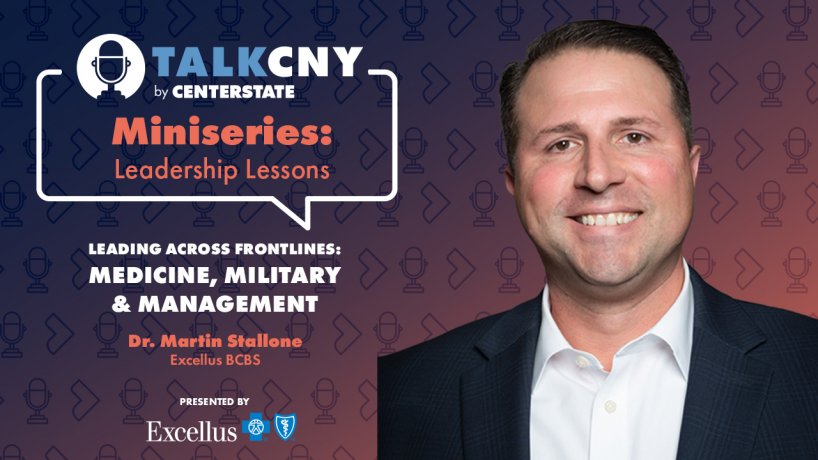
Welcome to the Talk CNY miniseries: Leadership Lessons, presented by Excellus BlueCross BlueShield. In this series, we speak with business and community leaders to discuss the lessons that have led them to where they are today and serve as a guiding light forward. Today's guest is Dr. Martin Stallone. He is the Executive Vice President and Chief Healthcare Services Officer for Lifetime Healthcare Companies, the parent organization of Excellus BlueCross BlueShield. A physician, military officer, and former healthcare system CEO, Dr. Stallone brings a rare combination of clinical insight, operational expertise, and mission-driven leadership to the role. For more than 28 years, Dr. Stallone has served in the New York Air National Guard, currently holding the rank of Colonel and serving as New York State Air Surgeon. He has served as a hospitalist, physician leader, and health system CEO. Today, Dr. Stallone leads healthcare delivery strategy across Excellus BlueCross BlueShield.
We're excited to welcome Dr. Stallone. Thank you for joining us.
Thank you for having me here, Brittni.
Oh, we're so excited. Take us back to the beginning of your leadership journey. Before you were a military officer, a physician or a healthcare executive, what really shaped your sense of purpose?
Sure. Well, thank you for the question. And again, thanks for having me here. I think back to high school as a time when I started thinking about how I'd spend my life and what was important to me. There was a couple of values that I had. I certainly wanted a career that involved service and kind of doing good by other people. Candidly, I really liked biology and science. I also was a social person. So being a physician scratched all of those itches, if you will. I thought that if I could take knowledge in medicine and biology and put it to good use and help people in times of need in a compassionate way, that would be a good way to spend one's career. Then on the military side, I wanted a physically oriented career. I wanted something where there was sacrifice to a mission that was greater than yourself.
And I had great examples in my life. My grandfather, as I've explained in other forums as a World War II vet, he was so admired by all of our family, and I think I aspired to be viewed similarly someday. Now, that's a hard measure to live up to, but in one's own way, if you could use your knowledge and talents for doing good, that was the ethos that my family instilled in me.
I'm sure your grandfather is very proud of you. You're doing great.
Thank you.
You're very welcome. Well, throughout your career, you have balanced medicine, business, and military leadership. What leadership principles have carried throughout each role, and how have they evolved in some senses?
It's a great question. I'll credit my military education early on, my ROTC curriculum that focused very carefully on what leadership really entailed. And in almost all circumstances, it involved commitment to a mission, a vision, some sort of principle, some objective to accomplish that candidly involved other people being involved and activated and inspired. That was always something I appreciated. If you were held accountable as a leader to accomplish whatever was at stake, I understood from an early age that you really needed to pay attention to the contributions of others that were essential for success. And so there was a certain amount of humility involved in that, realizing you can't do it by yourself and activating others is an art. And so that's something that I think I understood from a relatively young age. And that's transcended all of my settings from military to clinical medicine to medical administration and everything in between.
That's beautiful. It really does take a team to accomplish anything, great.
Undoubtedly.
Given your experience, how has it helped you approach critical healthcare challenges?
Sure. I mean, each of my experiences gives me a different tool to use for the problem at hand. I would say that the clinical experience that I have has taught me about agency, understanding that doctors are really there, not only advocating for their own situation, but also that of the patients who might not be able to advocate for themselves. So I mean, that was a critical early lesson. Certainly, the health administration experience has taught me about logistics and constraints, reality, sustainability, additional considerations that are brought to the situation. And then the military kind of taught me about the balance between collaboration and team, as we mentioned a second ago, but also, when necessary, executive action or command authority. So I would say each of those lessons I bring with me to current problems that are complicated. And then across all of them, again, a careful stakeholder analysis, being thoughtful about how decisions and plans impact the different involved parties, you might say.
Wow. That's amazing. Thank you for sharing that.
Sure.
So what really drew you to join Excellus BlueCross BlueShield, as well as Lifetime Healthcare Companies?
Sure. Lifetime is the parent organization that includes Excellus. And I had the opportunity of serving on the regional advisory board for Excellus in the CNY area. And so I got to know their nonprofit mission and admired it. I dealt with them from the provider side. So I had a little bit of a comparative experience between Excellus and the many other health plans, none of which are as good as Excellus. So I was drawn to their nonprofit focus. Not all health plans are nonprofit. Not all health plans approach providers as partners. Certainly, what appealed to me was bringing a balanced pursuit of what we call the quadruple aim, where you're pursuing quality and access, affordability, and experience. And then the fourth pillar is provider experience as well, so that it's sustainable for the people involved. I started to admire them more and more and realized that they're a company I might someday have a role in. And then I was given the opportunity to join this past December, and I'm thrilled.
Oh, I'm excited for you.
Thank you.
Now that you're in the role, what would you say is your vision as you look forward for Excellus BlueCross BlueShield, as well as your work with providers and partners?
Sure. I think Excellus needs to continue its balanced approach of shaping healthcare in partnership with health systems and provider groups. It really is an orchestrating organization. It's got an essential opportunity as the proverbial payer to direct payments, not only for the services that are being provided, but to support how the healthcare system transforms overall. So I think we have to be thoughtful. Going back to stakeholder analysis, we have to make sure that the vision we're painting works for patients and members in the region, works for sustainability for providers and health systems, but that it accomplishes affordability, quality and access, experience better than we have in the past. I think we have to be humble and realize we have to continually strive to do better, and there's so much opportunity. So to answer your question directly, I see Excellus as leading a complicated set of actors, all of whom are interested in a more effective health system for the betterment and the benefit of the residents in the region.
You guys are doing an outstanding job in the community.
Thank you very much. We're trying our very hardest.
Well, next, we are going to go into our Rapid Fire section.
Okay.
So I am going to hand you a list of cards.
Okay.
Now the goal is for you to read the question that is on the card and to answer it within 30 seconds, and then move on to the next one.
Okay.
All right.
I haven't seen these. All right. How do you continue to grow and refine your skills? Good question. I think I dive into new experiences. I think it's not so deliberate as one might think from this question. It's putting myself out of a comfort zone into a new environment. For instance, joining Excellus, having been a health system CEO for seven years, joining Excellus gives me the opportunity to work on things that I haven't worked on before, learn things that I haven't had exposure to before, and bring previous experiences and skills to a new environment and a new challenge.
Awesome.
Okay.
Was that within 30 seconds? You did excellent.
All right.
What accomplishment are you most proud of and why? So personally, I'm very proud of my family, my wife, and my six sons. They are wonderful people. All of my sons are well adjusted in doing well and are growing in their older age to respect my wife and me, which is I think every parent's dreams. On the professional side, having just joined Excellus, I won't talk about any accomplishments so far, but on my previous health system side, we tripled the size of our organization, which doesn't mean we tripled the price three times for the services we provided. We brought three times the original set of services under common control. And so I thought that was instrumental for the region to start thinking about how the different parts of healthcare delivery work together to achieve the quadruple aim. So I'm very proud of the growth we had at Centralis.
Both accomplishments are outstanding, personal and professional. I'm very happy for you.
Thank you very much.
You're welcome.
How do you set and achieve ambitious goals while maintaining balance? I think realizing that reward is inherently related to risk and not worrying so much about falling short and being comfortable with that. I think of a batting average, not kind of a no-fail situation. So some things can be very ambitious and come up a little bit short, but if you were earnest and worked hard, there's probably a lot of good that came in the process. So not being fearful of not achieving an ambitious, audacious goal.
Well said.
Thank you. How do you approach problem solving when faced with challenging situations? Problem solving is actually near and dear to my heart. I think there's a little bit of an analysis of what kind of problem you're solving. How much time you have to solve it. Do you have previous experiences or models that you can bring to the situation? But in all situations, if there's any amount of time, I think you want to think about a stakeholder analysis, which is a fancy word of saying, how are all the people involved in the problem going to fare in the solution we're putting forward? And so it's easy to solve a problem from your perspective, but that might not work for other people, and so it wouldn't be a durable solution. So I think stakeholder analysis and simulating your answer to make sure it works for everybody is key.
That was great. Thank you.
Thank you. What habits or routines help you maintain resilience and focus? This is going to sound a little bit odd, but I think of not identifying myself fully with the roles that I'm in. Separating myself from what I'm doing at the moment. Realizing that no matter how much you love the work you're doing and the role you're in, at some point, at some point in the future, you're not going to be in that role and that your identity can't be linked to that. And so I think that helps weather setbacks a little more. It helps you take risks, which we talked about a little bit ago, a little bit better. And to focus on the challenge at hand as a challenge that you're taking a crack at and that maybe other people are going to try it as well.
Dr. Stallone, thank you so much.
Oh, thank you very much for having me.
It is a pleasure having you on today. So throughout your career, you have excelled in high-pressure environments. What is your advice to other leaders who are navigating the same things?
I think it's important to focus on what you're trying to accomplish and not to think about the failure mode, if you will. Try to think about the benefit of the vision and the mission and the objectives you're trying to accomplish and think about the benefit that that is going to have on the people that you're working on behalf of. That's a lot of words that means don't make it about you and don't identify yourself with the work too tightly and that focus on being a servant leader, in my humble opinion, and focus on the impact that you're going to have, not your role in it necessarily.
Great again. Thank you so much, Dr. Stallone, for being with us today.
Thank you so much. Thanks for having me.
It was a pleasure. Well, if you would like some additional content, additional responses from Dr. Stallone, they will be available across Center State CEO's social media channels. Thank you for listening today. Have a great day, everyone.
It's why I love my job. It's literally the best benefit that Excellus has to offer where you can actually sit and talk to someone face-to-face. I've been studying this for two weeks now. I solved my problem in 10 minutes. I try to make it as simple as possible. I look at each member as if they were my family, and I would want someone to take the necessary steps to reassure them and not take up too much of their time. Come see us if you have a problem, and we will help you. And if we don't have the answer, we'll find the answer together.