

S4,E16 - Joan Royle, Emilija PostolovskaPosted on August 26, 2026 |
Image
|
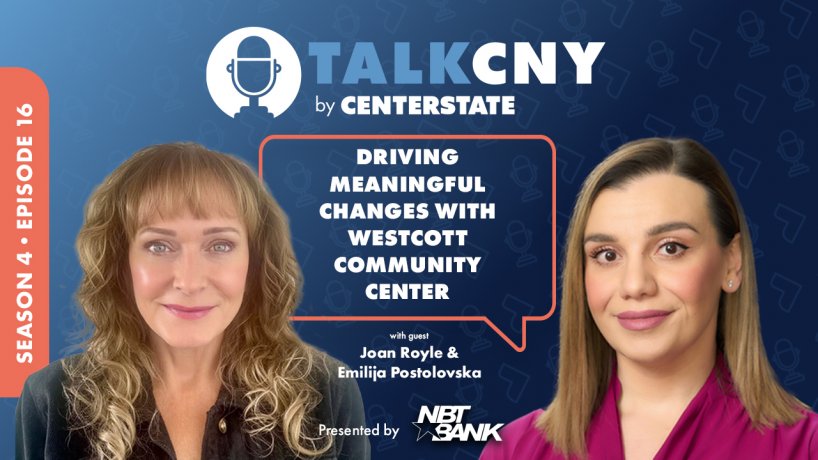
This is Talk CNY, a semi-monthly podcast by CenterState CEO, recording in the production studio at CenterState's INSPYRE Innovation Hub. CenterState CEO is Central New York's premier leadership and economic development organization. Join us as we meet the people and explore the projects driving the regional economy forward. This is Talk CNY, presented by NBT Bank. I'm Katie Zilcosky, Director of Communications at CenterState CEO and your host for Talk CNY. Partnership and collaboration are essential to so much of CenterState CEO's work. It allows us to be more creative and find more holistic solutions to some of the region's most complex challenges. And the Westcott Community Center has been a vital partner to CenterState CEO for years now, working to remove barriers to family sustaining employment. On this episode of Talk CNY, presented by NBT Bank, we're joined by Westcott Community Center Executive Director Joan Royle and CenterState CEO's Director of Workforce Innovation, Emilija Postolovska, to discuss a program that increases access to reliable transportation.
Joan, Emilija, thank you both so much for being here today.
Yeah, thanks for having us. We're happy to be here.
Thanks. Yes, very much.
I'm very excited to talk a little bit about Vehicles to Work, but for some of our listeners who might be tuning in and not exactly know what the program is, I just want to start with explaining a bit about what Vehicles to Work is, who it serves, what it does.
Sure, I can tell you. So it's a transportation barrier removal service, and that comes with both support in short and long-term goals for participants. We serve participants in skilled trades training programs such as Pathways to Apprenticeship in multiple counties and OC and BOCES skilled trades.
Emilija, from a strategy perspective, I know CenterState really does work to try to mitigate some of these barriers that people face when they are trying to find careers and meaningful employment. Can you talk a little bit more about what all it takes for folks to really gain access to jobs and enter the workforce?
Yeah. As we all know, transportation is one of the top barriers that prevents people from getting to their places of employment, but also even being able to access some of the training programs that will allow them to get this kind of family-sustaining employment in two of our highest needs sectors right now, like in manufacturing and construction. So we try to look at things from a more holistic systems perspective by not just the partners that we work with, but making sure that we are identifying the interplay between those barriers. So among transportation, you have challenges around accessing childcare, the healthcare, food insecurity, housing. A lot of things that we're seeing right now in our community really manifesting themselves and they all kind of come to a head when you're trying to find opportunities that will help alleviate some of those challenges that you and your family face.
Can you put the need a bit in perspective? Because it's not just a few people that you guys have assisted in helping find reliable transportation since Vehicles to Work has been active and helping people out. What does the need look like in our community for a service like this?
So I would say the need is exceedingly strong. I mean, there's a lot of people that need this service, but because we're working in very specific programs, we're not answering the need right now for the entire community, but aimed at those people who are on their way to getting a job in a specific skilled trade. But if you look at our data just alone this year from January to June, we served 385 individuals in these programs. And not everybody needs full assistance. Sometimes they need our ancillary services like our vehicle literacy services and help with some credit counseling. But of those 385, 192 people came into our program without reliable transportation that they could afford, and they left with that.
Wow.
So that's pretty strong need and a pretty good response to being able to serve them.
Yeah, definitely. I mean, what has it been like? I mean, you said that's just this calendar year so far, that 300 up to. I mean, what is it like for you guys to work with some of these folks who are really trying to gain access to a good job and get a car or reliable transportation to where they need to go and see them complete that arc?
Well, it's wonderful when they can make that progress.
And what I would say is there's a variety of need coming into this. Sometimes they might just need to have us pull their abstract and help them remove some tickets by working with legal help. Sometimes they've got multiple things going on, and it takes some time to get them from point A to point B. Sometimes there's car repairs. Sometimes there's knowledge about helping them find the best insurance. And then there's that car shopping experience to help them find a good, reliable used car. And I say that because we're not looking at brand new cars, but helping them do that. And then we learned early on that we need to deal and work with the whole person. So also because we're a nonprofit and we have food pantry and we have other supports, we can refer those students and those participants to those other supports, which helps.
And there's a lot of trust building that goes into this too. The kinds of conversations that need to happen are often things that a lot of people don't really like to talk to with a stranger no less. You're asking some sort of invasive questions on what's your financial situation? And some people might be embarrassed to really say what their full need is. Joan mentioned different access to services like the food pantry and things like that. The key is to continue to build those relationships at the speed that the client allows. And that's one of the biggest benefits of a program like Vehicles. It isn't a check-the-box or just a one-size-fits-all. It is very individually tailored. And the length of time that people are able to access these services really speaks to that. So it's not just like you only have six weeks for whatever length of time you're going through your training program, 12 weeks, whatever it is, then you're done and cut off.
You have an additional length of time in the front end and after you complete that training program to make sure that you are in a really good position to be able to maintain whatever work you were doing with the support staff at Westcott.
Yeah. And our parameters, we sort of look like an entire year.
And
Then we've had other people come back additionally after that point, but we really look at how long it might take. And if they need multiple services, it might take three months to clear up a license. But then after that, they still need services because they still need that reliable vehicle or that transportation. So that's really important. The other thing that's really important to note about this is that it doesn't just impact the person that's going through the training. It impacts their entire family because now they have a way to get around, and they have a way to go to other places in the grocery store and things like that that they need to do.
Absolutely. I mean, and you've kind of talked a little bit about it of all the different parts that go into purchasing a vehicle or obtaining reliable transportation somehow. What has been kind of the learning process for you both along the way for all of the kind of nuances that go into the process of getting someone a car that they need to go to a job that will help support their family?
It's been a lot of learning and a lot of growth and a lot of conversations back and forth on what's the best way to proceed with it. Early on, we realized that we couldn't just go in and help people with the things that we need. We needed to educate them on the process. So we run a full vehicle literacy series. We talk about what it means to maintain a license, how to get access to your MyDMV account, how to better understand that process. And then we walk them through it. But then also how to purchase a car. So we have a whole segment on what to do to purchase a car. And then additionally, how to take care of that car once you get it, because some people don't realize that the oil needs to be changed. Things need to take place in order for that car to stay reliable.
So we make sure that we do that. But then on the flip side, we now have our staff all certified as credit counselors.
Wow.
And we did that because it doesn't really help to just take care of a barrier. But if someone's getting a job and if someone's learning how to budget to not just pay for their car payment, but to pay for insurance and to save some money for possible repairs, they really have to know how to learn to manage their finances. And that part of our work is really critical.
That's a newer feature, right? That wasn't at launch. That was something you added.
Last year.
Oh, wow.
Last year we added that.
And how has it been since adding that? Have you seen a difference in the way people interact with the program or just the success of people needing less assistance after they get the car?
I think what it's done is it's really helped our participants from the beginning understand that this is a process that they have to learn about and that education piece has been really important. And yes, most people don't get taught how to make a budget when they're in school or when they're young. So this has been a critical component to the work.
And Emilija, how have the lessons that you've learned in ways from Vehicles to Work impacted some of CenterState's other programming?
Yeah. So a program like Vehicles that continues to grow in its scope and demand, it's really critical to understand that you are always going to have surprises that come along the way and that there is a huge need to be flexible and nimble and to address the challenges that are in front of you, while also it can be a little bit of a philosophical challenge, right? Address what's in front of you, but then also thinking about the long game. How can we continue to improve and evolve and adapt the program so that it can serve the people who need it most? But also thinking about what is the immediate need that's in front of us, making sure that we are able to address the community demand as it stands right now.
What are some of the goals for vehicles to work into the future? I mean, I'm sure that you, with working in two sectors that are very heavily in demand right now, I'm sure you are still seeing a need working with clients heavily. How are you guys planning to continue to serve those clients and potentially adapt your services to meet an ever-growing need?
We've talked a lot about that. I mean, obviously we think that there's a need to expand the program. I don't know if Emilia, you want to elaborate on any thoughts on that.
Yeah. We're actively looking at other kinds of opportunities to allow us to expand, not just in the scope, but across the region. What does that look like? Because we know that the need for transportation services is only going to exponentially grow as more activity happens. There's a lot of active construction that's happening even more around the corner. And then you need to get people into some of the additional manufacturing jobs and then in other sectors too. And so we're looking at this as a model that's been tested for a number of years now. And how can we continue to grow that and really lean in on that expertise that's been developed at Wescott and think of ways that we can get creative on sustainability for it. I think in the near future, we're hoping that we'll be able to expand to other parts of C, of course,entral New York and other potential programs.
But a lot of that, of course, is TBD as we're exploring what those models really look like.
And if someone is listening and wants to help out, wants to be involved with the program, what's the best way to do that?
They can reach out to either one of us. We're happy to chat and see what makes the most sense. Absolutely. Always looking for more partners because that's the only way that this kind of work is actually going to get done in a way that is truly impactful.
Yes. Well, we are going to take a quick break here. We'll have more with Joan and Emilija coming up. But first, a quick word from our presenting sponsor, NBT Bank.
At NBT Bank, we know that this day starts with this one. This day starts with this one. Because no matter how unforgettable the extraordinary days are, there's a lot of every day that leads up to them. You can count on NBT Bank to help you get started. NBT Bank, it starts here.
Welcome back. This is Talk CNY, presented by NBT Bank. I'm Katie Zilcosky, Director of Communications at CenterState CEO and your host for Talk CNY. I'm joined on this episode by Joan Royle and Emilija Postolovska. Thank you both for being here, for talking about vehicles to work and all that CenterState and Wescott have accomplished together.
Thanks, Katie. Happy to be here. Yeah.
I definitely want to talk more about the partnership between CenterState and the Westcott Community Center. It's been going on for a few years now, and I know that Beyond Vehicles to Work, you guys are working on other solutions to some of our region's complex workforce challenges right now. So can you talk a little bit more about other ways you've worked together and how it all kind of wraps into one whole picture for our community?
Yeah, sure. We started working with CenterState back in 2019 on the WorkTrain initiative, and then it was primarily recruitment and some case management. But as programs evolved, we started to think about other solutions for our community, and that's where Vehicles to Work came about. So we work with Vehicles to Work, and then there's another program. It's Bridge to Manufacturing. And now we're helping with the Syracuse Build Initiative.
Can you tell me a little bit about Syracuse Build and Bridge to Manufacturing? How those kind of work with Vehicles to Work?
Well, the Syracuse Build Initiative is the primary beneficiary of the Vehicles to Work services since they are working with people who are getting into the skilled trades. But our Bridge to Manufacturing program is a little bit newer. We've been running it now for about the past two years or so, and that is focused on helping underrepresented populations gain access to family sustaining employment in manufacturing by a lot of barrier mitigation and removal. And the primary goal is to help get them into a higher education degree program at Onondaga Community College called Electromechanical Technology that will help prepare people for those higher tech technician roles at places like Micron, Inficon, TTM, all those other big companies in the area that are primed and ready to go.
And Joan, what has it been like working with some of the Bridge cohorts so far?
It's been good. There've been some participants that have really needed help. So, interestingly enough, just our last cohort that just finished up and now graduated and did really well, there was a woman participant who was in Bridge. We helped her with Vehicles to Work services. She had been terribly taken advantage of from repair shops, gone to many, to the tune of almost $7,000. She paid and still did not have a working vehicle. And we were able to go in and help her contact and get to a reputable car dealer who could repair her car. And now she's got her car. She's able to get to class to OCC when it starts. She's able to have her car for her family. And so it's worked out really well to have these programs work in tandem.
I ean, that story is probably one of many that you guys hear of success throughout the Vehicles to Work history. What's that like to see someone kind of go from a moment of frustration or struggle and then be able to kind of take control of their life again and get to work, get to the grocery store, go to the doctor?
Well, I can tell you it feels great when you can do that. And I know our coordinator came and told me that he had had this conversation with her when he told her that he could approve. It was approved to get her car repaired and that we're going to do some additional work with her. She teared up. And I think it just speaks to the need. I think that people are really trying hard to make a difference in their lives. They just need someone to help them along the way and to know that someone's going to listen to them, especially if you've been kind of exploited prior to that experience. There's not a lot of trust there. So it's building that trust back up with people and letting them know that things can be okay.
I'll also add that one of the reasons why this is a success story is due to the fact that Wescott and the team at Wescott has been developing the relationships with other vendors and stakeholders in the community to build that trust. So forming relationships with other mechanics, dealerships in the area, explaining what the program is all about, having that bidirectional communication and trusted partnership so that they know that they can refer clients to these places and know that that situation where people are getting taken advantage of won't happen. So we've had a lot of really great luck, but it's less luck. It's more intentional work and relationship cultivation with these other community partners.
I mean, the work that you two have done since 2019, like you said, is evidence of the power that partnership can have. Why is partnership and collaboration so important, especially in your line of work, in workforce innovation and helping people navigate the systems? What power does partnership bring that maybe you wouldn't have been able to accomplish alone?
Well, I want to speak on the partnership very specifically with CenterState because for us at Westcott, what it's meant is that we're partnering with somebody that's really innovative. Someone that's allowing us to take a chance on a program, to try it a certain way and to see if it works. And that sort of freedom and flexibility to make sure that your program's going to be the best it can be is really invaluable. Being able to talk through things and to say, "We want to switch this. This doesn't seem to be the best solution. We need to try this approach." That's been incredible. And as a nonprofit, we don't always get that opportunity. Sometimes when you get a grant or something like that, you stick to exactly what you said you were going to do, and then there's not a lot of flexibility. This partnership has enabled us to make the best possible program because of that flexibility and that understanding.
And on that note, I mean, as much as we love to try to push the envelope and do things differently, look at longstanding problems through a different lens so we can actually get the results that we all want, you have to have partners who are willing to come along for it, even when it seems really squishy and nebulous and not like the normal day-to-day. I know there are some people out there who really like a set prescriptive way to do it, but we often operate in a little bit of a gray space and you need someone that's willing to come along for it to have trust in each other. And I'll say that Joan has not blocked my email or phone number yet. Well, no, that's always that. That's always a good step in the right direction too.
And what I will say is in all honesty, life is messy and our community has so many needs. If you're not willing to be flexible and to be a little bit innovative and to take some risks to help people, then it's not going to work really in the long run. You've got to be able to do that.
Yeah. With how complex and intertwined these challenges are and our respective partnerships and organizations, right? You have to be willing to partner and be open to it, look at things differently. You can't keep going down that same road and expecting different kinds of results if what you've done over the past 10, 15, 20 years or so is not getting you there.
And yeah. I mean, it is an uncomfortable space for some people. You say, how did you guys learn to be comfortable with it? How would you encourage others to kind of take that risk, be flexible, adapt so that we can find creative solutions?
Well, personally, I've always been comfortable with it. And I'm very fortunate because I have a wonderful board that allows me to be comfortable with it and that allows me to, and supports me in that decision. I think that it's really important to our community to have that.
Yeah, absolutely. Yeah. I've similarly always been drawn to a certain degree of organized chaos, I think. I'm not really a risk taker by nature, but when it's a calculated risk, knowing that the positive impacts and the good that can come out of said risk is greater than what you could potentially lose. And especially when it comes to improving our community and the really standing by what we at CenterState are always striving for, creating a place where all people prosper. You have to be able to be comfortable with a certain degree of risk and, honestly, ambiguity.
I'm wondering what you two have learned from each other throughout the years of working together. Is there something that. I'm sure there's lots, but if there's one thing that sticks out for the two of you that you are like, "Oh, I remember this and a light bulb went on for me in this moment."
So for me, because I can get more immersed in the daily, because that's the nature of the work we do. And yes, I do think big picture for my organization, but sometimes you get in there and you're just in the weeds. Working with Emilija, she's got the bigger-picture lens all of the time. I mean, that seems to be mostly her focus. So that's been a really good push and pull and partnership. Also, just I know that if I call her or if I text her or if I need something, she's going to pick up as well. She's not going to block my phone. So it's blocked in and no one is blocked.
No one's blocked. So it's worked out really well that way.
Yeah, absolutely. I don't know how many times I have either called or texted or emailed Joan. And the first thing that I say is, "Okay, this might sound crazy, but hear me out." And she follows along for the ride, and we figure it out. So yeah, she's always willing to take that call, try things a little differently. Again, go outside that comfort zone. And we've really been able to develop that trusted relationship, I think, that is key. And that's something that we try to always cultivate with other partners in the community as well. So that's, again, really the only way that this kind of work is going to be able to move forward in the way that we all want.
Well, Joan, Emilija, thank you both so much. It's been such a pleasure talking with you.
Likewise. Thanks, Katie. Thank you.
Talk CNY, presented by NBT Bank, is recorded in the production studio at CenterState's INSPYRE Innovation Hub. Talk CNY is available on all major podcast platforms or centerstateceo.com. Additional content and clips can be seen across CenterState CEO's social media channels. For new episode reminders, be sure to subscribe in your favorite podcast listening app, and don't forget to leave a quick review or five-star rating. Thanks for listening to Talk CNY, presented by NBT Bank.
Other
Talk CNY Main Series Transcripts
| S3,E3 - Nora Spillane | February 12, 2025 | |
| S3,E2 - Melanie Littlejohn | January 29, 2025 | |
| S3,E1 - Rob Simpson | January 15, 2025 | |
| S2,E24 - Kevin Schwab | December 18, 2024 | |
| S2,E23 - 2024 Highlights | December 4, 2024 | |
| S2,E22 - Tony Baird | November 20, 2024 | |
| S2,E21 - John Liddy | November 6, 2024 | |
| S2,E20 - Rob Simpson | October 16, 2024 | |
| S2,E19 - Dr. Juhanna Rogers | October 2, 2024 | |
| S2,E18 - Tylah Worrell | September 18, 2024 | |
| S2,E16 - Ben Sio, Dottie Gallagher, Joe Stefko: Part 2 | August 21, 2024 | |
| S2,E15 - Ben Sio, Dottie Gallagher, Joe Stefko: Part 1 | August 7, 2024 | |
| S2,E14 - Rob Simpson | July 24, 2024 | |
| S2,E13 - Dave Kavney | July 10, 2024 | |
| S2,E12 - Ebony Farrow | June 26, 2024 | |
| S2,E11 - Aimee Durfee | June 12, 2024 | |
| S2,E10 - Kristi Eck | May 22, 2024 | |
| S2,E9 - Nora Spillane | May 8, 2024 | |
| S2,E8 - Housing Taskforce | April 24, 2024 | |
| S2,E7 - Rob Simpson | April 10, 2024 |