

S4,E6 - Lindsay Mastrogiovanni, Kathleen Avery Connell, Jim ConnellPosted on March 25, 2026 |
Image
|
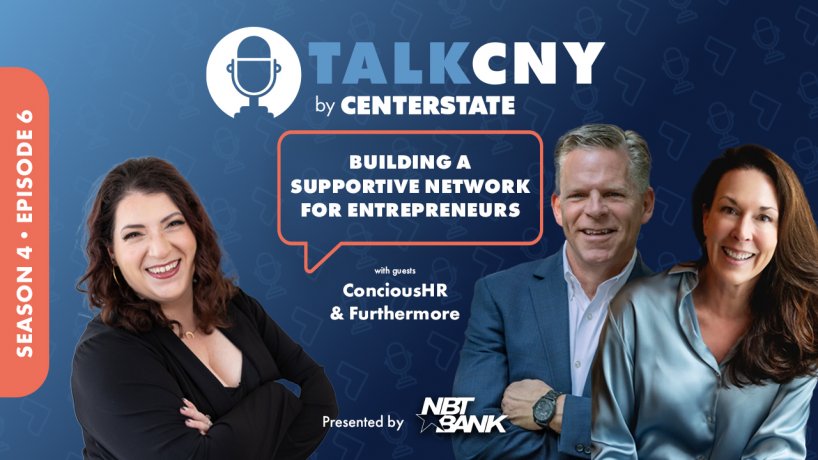
This is Talk CNY, a semi-monthly podcast by CenterState CEO. We're an independent nonprofit committed to creating inclusive, equitable, and sustainable economic growth in Central New York. Join us as we meet the people and explore the projects driving the regional economy forward. This is Tak CNY, presented by NBT Bank. I'm Katie Zilcosky, Director of Communications at CenterState CEO and your host for Talk CNY. CenterState CEO's membership model has evolved into a dynamic ecosystem of members and clients designed to meet businesses wherever they are, but it's the innovative organizations that make up the CenterState CEO Network that make its impact so powerful. On this episode of Talk CNY, presented by NBT Bank, we hear from two members of the network, Kathleen and Jim O'Connell, partners at Furthermore and Lindsey Mastrogiovanni, founder of ConsciousHR.
Kathleen, Jim, thank you both so much for being here today.
Good morning.
Thanks for having us.
So to start off, tell me a little bit about Furthermore. I mean, it really is not your traditional retirement planning service.
Furthermore is really about talking to clients and people approaching their post-career life about what they're actually going to do when they get there. Money's important, but it's only part of the equation. And so we've really spent the last three years putting together a program that we think brings people to a point where they're able to think more about it and not just go into the actual period of retirement unprepared.
We also give them some very specific tools for self-reflection as they prepare for retirement. We designed an online assessment tool that retirees can take, and it reveals to them the retirement persona, because retirement is so much about your relationship, not just to money, but your social connections, your individual purpose. Why am I getting up every morning? Family relationships, health and wellness. So this assessment kind of measures your capacity for all of those things so that you understand where you might have some challenges in that big transition and where the opportunities are. So we start with that assessment first and then build up this retirement plan from there.
Now that holistic approach, why was that so important to both of you when starting Furthermore? Was it something that you noticed was missing? Was it something you wish you had? So what was the ...
Yeah, really what was happening is I was coming home and talking to Kathleen about my clients transitioning into retirement. And I was surprised at how many people were struggling with the emotional side of it. So I was sharing with Kathleen things that my clients were going through, and she was sharing coaching tips with me so that I could go back to my clients and guide them, give them some tools to help them move forward.
It was so surprising to me to hear from Jim how many people had really a depth of financial resources. They worked so hard their whole lives. They had saved and saved and done the right thing. And in our culture, that's how we teach people to prepare for retirement. At the same time, really encouraging people to sort of feel less than or shaky or nervous about getting older. There's a lot of age bias. So you have these two things they intersect and suddenly people have all these financial resources at a time when they're not feeling entirely certain about their value or their worth or going out into the world and making big moves. So they're retreating, they're staying home, they're feeling lonely and isolated. And Jim is working so hard to try to get them to make those brave moves. And they actually have the resources to do it, but just not the steps or the tools or the way to do that.
As a financial advisor, it's easy to measure things from dollars, but when you see your clients struggling, I started to ask questions. And am I being effective if my clients are not having a happy, fulfilling retirement? And so that's really what brought about a lot of the conversations we were having.
What have been some of the reactions to your clients of Furthermore? I mean, when you approach retirement planning in this way.
Initially, pre-retirement, most people don't think that it's going to be them. Sure. They're like, "I just want to be done, and I'll figure it out when I get there." And so it can be a difficult conversation. I don't want to push too hard, but we do want to let people know what is the potential for the things that they're going to run into.
But then when we first started the workshops, we piloted them with Jim's clients who are all, they were pretty much in their 60s, 70s, they were retired. And without exception, every single person who took the workshop said, "I wish I knew this 10 years ago. You need to teach this to younger people. " So that's been one of the challenges we've had as we've launched the businesses, who is our target audience? Because until you reach that moment of transition, again, ageism is at play. It's hard to imagine yourself being in your 60's when you're younger. You think you're going to kind of own the aging process until you're in it and you're like, "Oh, I do feel a little vulnerable," or, "I don't feel like I'm welcome in every room." Or, "I devoted myself to my job and all my friends were at work and my meaning and purpose every day I woke up came from work." So it's a big shift.
And the more you prepare for it, the more you start to think about some of these things before that moment, the much easier it is in that transition. Just as an aside, the National Institute of Health has a study out on this, and the average retiree does not feel a sense of meaning and purpose in their life for five to seven years after retirement. So when you're 65, seven years is a long time. So that's one of the big goals of Furthermore is to shrink that window of questioning and wondering, why am I getting up in the morning? We want you to have a whole menu of options.
And I don't think we really would've recognized the problem 10 years ago because we weren't approaching retirement. And so we started to see it really relative to where we are in our careers.
Right. And also in our relationship, we just got married last year.
Oh, congratulations.
Being a 58-year-old woman trying on wedding dresses and thinking about a wedding and then moving to a new city and a new home, all those things that you would traditionally think of in your 20s or maybe your 30s, I was like, who am I and what am I doing? It forced me to challenge maybe some of my own internalized bias about age, too. So it was this perfect nexus of our conversations about his clients, where we were in our life, how we were feeling. And we're like, this is the beginning of our lives, not the beginning of the rest of our lives. And so to approach your 60s, 70s, and 80s as this really wonderful, exciting time is such a difference maker in terms of what's possible.
Right.
Yeah, absolutely. How long have you guys been working on Furthermore together?
We started talking about it almost four years ago, and I think it was just the accumulation of conversations. And then Kathleen really started, for lack of a better way of saying it, interviewing me and dragging information out of me so that she could really create the content and the structure for what we're doing.
I did. I came into his office on Sundays. I'm like, okay, tell me the stories. And I would just start writing all the narratives, the stories of all his clients. And then we organized all of the...the journey of each of his clients. And we found that there were by and large three general approaches to retirement. Then inside each of those approaches, we got more and more finite about these personas that we developed. And INSPYRE was actually super helpful in us developing the assessment tool.
Yeah. I mean, you mentioned INSPYRE, you guys are clients. We're so excited to be able to work with you. Can you tell me how you found out about INSPYRE's resources? How did you get connected into the space?
Well, we were just sort of trying to remember how this ... Because it happened so organically. It was just one meeting, one experience after another. I'm a huge proponent of continuing education. I always want to learn the next thing. And I had seen in Eventbrite, an opportunity to take workshops with Nathan Gold, the TED Talk speaker, I think it was last year or two years ago, having no idea that it was part of the GENIUS New York program, and he was helping all of those folks work on their pitches. So I was just in the room and I was like, wait, I'm in the middle of this cool thing. And also being new to the community. So I was just like, my brain was on fire for meeting Nathan, taking the workshops, finding out about INSPYRE, which is where I found out about it originally and all of the work that CenterState CEO is doing in the community.
And because we knew we were doing this assessment and we kept calling it the app, we totally didn't know what we were talking about, but we kind of knew what we wanted to do. Yeah. I was like, well, that's technological. Maybe we should talk to these folks and see if we can work with all of you to get the support and help that we felt we needed. As a coach, I know the power of business coaching and personal development coaching just to hold you accountable and to have that other set of eyes helping you see things you might be missing. So we met with Brandon and just began a series of really amazing conversations that have helped keep us moving forward. And then when we even needed to pivot, also giving us resources and tools and connections to help us build the business side of things.
Yeah. And Dr. Emad Rahim came out to the office to meet with us, and he really recommended that we have a little more structure in what we were doing. And so then we met with Brandon after that. And I think it's interesting when you already have a successful business, it could be really easy when things get tough to just stop the new venture because we don't really need to do it, but Brandon really helped us stay on track and kind of gave us some accountability.
The assessment tool that I've mentioned, the first couple passes, we found like we were just getting these general broad responses, but it was Brandon who connected us with a retired professor from Harvard who specialized in this. And we were really able to just edit and redesign the assessment and get really specific questions. And it was so helpful to us to just keep going. And even now in the heart of doing these workshops and letting the community know what we're up to, we're realizing that some things are really resonating and that we need to pivot again and change direction a little bit. And to just keep going with that, keep going with the flow. And Brandon's been so helpful to just help keep us going and turning when we need to turn and pivoting when we need to pivot. Yeah.
Yeah.
I mean, did you imagine you'd be starting a new business at this point in your life?
I certainly didn't. But that's part of, and I hate to say part of aging, but that's really a lot of things went through our minds at this age. And who are we to be starting a business at 58 years old? And I look online, and Kathleen pushes me to post more, and I don't see a whole lot of 60-year-old financial advisors posting. So those thoughts go through your mind as well, or at least through mine. And I think that it does matter. You need the encouragement that we've gotten from Kathleen and I working together, but also with other people like Emad and Brandon who have been kind of cheerleaders for us and pushed us in the right direction.
Yeah. Right. I mean, I think so much of what we're ... We want to model what we believe and live inside the philosophy of Furthermore. So we're always getting uncomfortable. We're always trying new things. We're always.
Always.
That sort of, what do they call the intellectual elasticity, like just keeping your brain active and always learning new things. I always say when I'm speaking or doing workshops, I will say very often to younger women when I'm working with them, it doesn't do you any good to imagine if you could go back in time to give yourself a piece of advice because the wisdom that I have today at my age is gleaned from all the mistakes I made, right? I wouldn't change that because it's made me who I am.
The helpful way to work with the SpaceTime continuum, yes, I'm a Star Trek geek, is to forward project 10 years into the future and imagine that version of yourself coming back in time and thanking you for all the hard choices you're making right now, the pivots, the intersections, the challenges that you face and overcome to create the future that you want. Imagine her or him in the future. So what I didn't realize when I would say that is like at 60, imagining myself at 70 like, oh wait, my future self. But that's what we're asking people and Furthermore to do is imagine your future self coming back and thanking you for this moment.
So how has being a client, being a part of the INSPYRE community helped Furthermore, helped it grow and change as a business?
I think there's really no track to run on for a new business, but having someone to meet with periodically, in our case, every two weeks, meeting with Brandon really gave us an accountability partner, somebody that not only was able to answer our questions based on his knowledge and experience, but also was willing to say, "I don't know the answer, but I'll find out for you. " And that brought other people to the table for us. The other thing about being part of INSPYRE is that it's not just the programs, but it's the proximity to people who are also building businesses and the proximity to the people who have their offices in the INSPYRE Innovation Hub. Those are people that we meet at events and then follow up with. So there's that constant interaction where if you're not here, you don't necessarily have that.
Right. It creates an outward focus, a connectivity. And again, I know from consulting and coaching, there are times when you have the best of intentions to get stuff done and then two weeks have gone by, and it's the night before and you have that email from Brandon going, "Oh, here's what we're going to talk about. " And I'm like, "Oh my God, that's what we're going to talk about. You need to get this work done and make it happen." And sometimes it's not pretty. You're just shoving it into your day and just keeping it moving forward. Jim's running a company, and he's devoted to all his existing clients. So finding time to do that INSPYRE's so helpful to just keep us on track and keep us moving forward.
Yeah. It's really helped us build faster and move along more quickly than we anticipated.
Absolutely.
Well, I'd like to thank both of you for joining us today for this episode. We will have more from members of our CenterState CEO Network coming up after a short break from our presenting sponsor, NBT Bank.
At NBT Bank, we know that this day starts with this one. This day starts with this one, because no matter how unforgettable the extraordinary days are, there's a lot of every day that leads up to them. You can count on NBT Bank to help you get started. NBT Bank, it starts here.
Welcome back. This is Tak CNY, presented by NBT Bank. I'm Katie Zilcosky, Director of Communications at CenterState CEO and your host for Talk CNY. I'm joined today by Lindsay Mastrogiovanni, founder of ConsciousHR. Thank you so much for being here with us.
Thank you for having me.
So ConsciousHR, tell me a little bit about it. What do you do? What are your goals?
Sure. So ConsciousHR is a small business HR agency. We really jump in for small businesses who don't have the support they would otherwise have internally. So we focus on things like employee relations, compliance, and just overall saving people money. And we do that all through a people strategy lens.
So you've been working through ConsciousHR for a little bit now.
Can
You tell me a little bit about how you got started? What made you want to start your own agency?
Sure. I have been in HR longer than I'd like to admit. Don't like to realize how old I am. But I kind of started through the traditional HR track. So I was a representative, I was a generalist, I was a manager, director, eventually made my way to an HCM company, spent three years as a consultant on the road with small businesses, the same types of businesses that we serve today. And I was able to really see the gap in the industry of what they really needed, a lot more business strategy and a lot more people strategy than what was being given to them through the compliance lens of HR. So being Lindsay, I went out of my way and provided that to them, but saw that there was just this giant gap in the market. So I also, on top of just doing the work for small businesses, was very passionate about changing the industry of HR as a whole and kind of what people think of when they hear the words HR.
So I went on the back end of that company and was able to deliver and create and train on a strategy for our HR people nationwide. So with that, direction changed in the company, and I was like, "You know what? I can make a huge impact locally and regionally if I do this, not on my own, but with a team, with me kind of at the helm." So I decided, like opened up a little side gig thing. My first soirée into entrepreneurship, I actually opened up a holistic wellness center in Liverpool. So I really got to see how you build community within a cause. Eventually ended up leaving there. They're still open and doing great. And I went full blown into the agency rather than just as an individual consultant. So we started doing our thing, and we've been rocking and rolling since.
Did you imagine yourself on this path in entrepreneurship? If you were to look at Lindsay 10 years ago, do you think she would see where you are now?
Yes and no. I think on my most delusional days, probably, yes. But having the people that I have on my team and seeing these people that otherwise ... I have been dreaming of these things for a very long time, but to be able to find people that truly believed in that vision too, and not even necessarily all people from the HR world. I have a team from different areas, different experiences, and we all are driving towards the same mission, which is to help small businesses do better, make more money, have better people. Everything we do is better people, better business, better communities. So everything starts with that people plan. How are you getting the right people? How are you keeping them? And then how is that translating back to profits or revenue for your business?
So you're a member of our CenterState CEO Network. Can you tell me a little bit about your first steps with Center State CEO? How did you find out about us? What made you interested in the first place?
When I was starting business, putting together my business plan, I knew that my vision was going to be more than just sitting individually with clients. So I was really looking for organizations where I could connect on a more regional or statewide basis, and CenterState was that. I could see the impact they were making, not just in Syracuse, but also throughout the state. I had a lot of connections with North Country, so I spent a lot of time there, had clients there, knew that I could make an impact there too, all within CenterState. I didn't really ... I was aware of CenterState, wasn't totally sure what the whole deal was or what could be done. I just knew it was kind of a growing organization within the state and then was approached by a member manager and he sealed the deal.
I mean, I'm wondering, for people who might be listening who are like, "What's the benefit of being a member of the network?" What was it that sealed the deal for you, and how did the network help you grow or become the version of ConsciousHR that you are today?
Yeah. I would say the connections was the biggest thing for me. And it was very important to me coming, especially in the HR industry, there are a lot of just individual consultants out there, and it wasn't necessarily like Lindsay being an individual consultant anymore. It was Conscious HR and this entire organization that has hopes to grow quickly. So I knew that I needed to get our name out there, explain to people really what our mission was, what our vision was, and being able to be in the right room with the right people to spread that word for me. So marketing and PR was a huge, not concern necessarily, but a huge focus for me. And I knew that CenterState would put me in rooms with people to at least get our message and our name out there, and the recognition that it deserves.
So some of the networking events and other events really helped you to make those connections that you needed to grow?
Yeah. We also, in 2025, were the Small Business Business of the Year award finalist, which was amazing. And that was something I truly never imagined can happen, especially in our first full year in business. And this year, I'm very excited to go support the 2026 finalists and award winners as well.
Yeah, I know that's coming up. I think we're just about a month away.
Yeah, a couple of weeks.
So tell me what it's like being a part of the small business community in Syracuse. What's your experience been like with other small business owners and really engaging and getting to know them?
I do my best to kind of talk about the opportunities that are available in Syracuse. I think you find kind of the larger companies who are involved in the CenterStates, the larger networking events, the fundraising events, those kind of things, but you have such a huge opportunity with these very, very small businesses. I call them micro businesses, usually like the three to 20 employee range. That's kind of our bread and butter at ConsciousHR. That's who we like to help. And they're so in it every day with the thing that they're good at. They don't necessarily know what the opportunity is for growth. So we get involved in those things. We can kind of take those people with us, whether they're clients or not. Community is the reason I do everything we do, even beyond Conscious HR, some of our other endeavors as well. So I think it's super important just to kind of spread that knowledge and introduce business owners, small business owners to opportunities they otherwise wouldn't be aware of. And if it's not through me, at least the information comes through me to a CenterState.
So what would your message be to maybe a small business owner or any business owner listening to this message who's wondering how to get more engaged, how to find those opportunities? I mean, what would you say to someone who asked you that right now?
I would say you need more people. You need more people to do the things that you don't have to do or you don't know how to do so that you can free up your time as a business owner or an operator, a high level leader to get out into these community events, to be able to introduce and shake hands with different people that you wouldn't necessarily be able to otherwise. You hear all the time, be on your business instead of in your business. It's true to an extent. I think the more out of the business you are, the less kind of aware you are of the things that are going on within your company. So it's super important that you kind of have a step in both, but you cannot do that without hiring help. And if you're not in a place to hire internally, you bring in outside help. That's where ConsciousHR comes in.
We're able to step in when you maybe don't have the resources for that internal support for your people, for leadership development, for employee relations, for compliance, for all the stuff that you don't know, but that's kind of the HR thing, like you don't know what you don't know. So we know it. You don't have to know it. Yeah. So we're just kind of a piece of the puzzle in the small business arena, and your business is nothing without your people. So you really have to get the right people in the door so that you can get out the door and grow your business.
So another what would you say question,
For someone considering membership or being a part of the CenterState CEO Network, what would you say to them? What would you say is the benefit?
The connections, for sure. I would say if you are not at a place yet where you want to be a member, just get to the events very quickly, you'll find out the benefits of being a member. I've had a lot of really amazing opportunities other than just being in rooms that you wouldn't otherwise be in. This, for example, the member management team has been amazing at making those connections when I can't be in the room. They're an extension of your voice. So I've had opportunities. There was a regional bank that was looking to expand. They were looking for advice on recruiting. That was a conversation I got to be a part of. So again, it was just kind of this more than local opportunity to share our knowledge, what we do, how we do it, and help another business grow.
So what are your goals for ConsciousHR? Where do you see yourself in a few years? Where do you hope you'll be?
We just want to take over the world. Just trying to save everyone's lives.
Perfect.
More realistically. We are a fully functioning agency and we serve nationwide really, but obviously we focus here locally and we do it through very like intimate handholding white glove service. I don't want that to change. I want us to grow. I want our footprint to expand, but I'm very passionate about keeping that boutique level service regardless of how large we get. So our plans are to continue to build outside of the local area and build these small dedicated teams for communities all over New York State, all over the United States, eventually. Five years, I don't know if we'll get there. We'll start with New York.
But, yeah.
That would be in my wildest dreams, but wilder things have happened. So we'll never know. We'll put it on the universe and see what happens.
Yes, exactly. Well, Lindsay, it was such a great time talking to you today. Thank you so much for being here.
Thank you. Thanks for having me.
CenterState CEO's podcast, Talk CNY, presented by NBT Bank, is available on all major podcast platforms or centerstateceo.com. Additional content and clips can be seen across CenterState CEO's social media channels. For new episode reminders, be sure to subscribe in your favorite podcast listening app. And don't forget to leave a quick review or a five-star rating. Thanks for listening to Talk CNY, presented by NBT Bank.
Other
Talk CNY Main Series Transcripts
| S3,E21 - Sara Broadwell, Rachel Pierce | October 29, 2025 | |
| S3,E20 - Rob Simpson | October 15, 2025 | |
| S3,E19 - Dan Straub and Erin Noto | October 1, 2025 | |
| S3,E18 - What to Know Before INSPYRE Innovation Hub's Grand Opening | September 17, 2025 | |
| S3,E17 - Ben Sio, Dottie Gallagher, Joe Stefko | September 3, 2025 | |
| S3,E16 - Emilija Postolovska | August 19, 2025 | |
| S3,E15 - Dr. Carlene Lacey | August 6, 2025 | |
| S3,E14 - Corporate Leadership Takeover | July 23, 2025 | |
| S3,E13 - David Kavney | July 9, 2025 | |
| S3,E12 - Jess Abbott and Jared Shepard | June 25, 2025 | |
| S3,E11 - Ryan Benz and Ben Lockwood | June 11, 2025 | |
| S3,E10 - Michelle Cruse and Keeli Manning | May 21, 2025 | |
| S3,E9 - Brandon Mastrangelo | May 7, 2025 | |
| S3,Bonus - Rob Simpson | May 4, 2025 | |
| S3,E8 - Rob Simpson | April 23, 2025 | |
| S3,E7 - John Liddy | April 9, 2025 | |
| S3,E6 - Ken Stewart | March 26, 2025 | |
| S3,E5 - Kara Jones & Manny Cerniglia | March 11, 2025 | |
| S3,E4 - Hope Knight | February 26, 2025 | |
| S3,E3 - Nora Spillane | February 12, 2025 |