

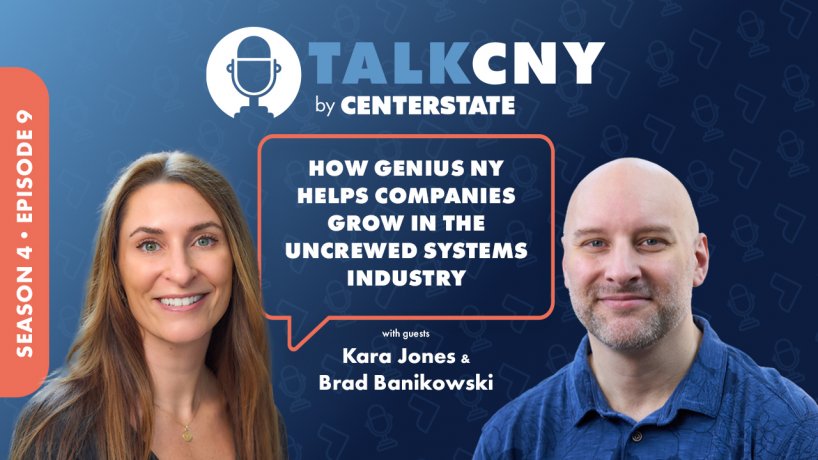
S4,E9 - Kara Jones and Brad BanikowskiPosted on May 6, 2026 |
Image
|
This is Talk CNY, a semi-monthly podcast by CenterState CEO. We're an independent nonprofit committed to creating inclusive, equitable, and sustainable economic growth in Central New York. Join us as we meet the people and explore the projects driving the regional economy forward. This is Tak CNY, presented by NBT Bank. I'm Katie Zilcosky, Director of Communications at CenterState CEO and your host for Talk CNY. The world's largest accelerator for uncrewed aerial systems, GENIUS New York is based out of CenterState's INSPYRE Innovation Hub in downtown Syracuse. The program is about to enter its 10th year, and a lot has changed since the launch of GENIUS New York. So on this episode of Talk CNY, presented by NBT Bank, we speak with CenterState's Director of Programs and Engagement, Kara Jones, and Investment Manager Brad Banikowski about how GENIUS is matching the speed of the industry.
Brad, Kara, thank you so much for being here today.
Thanks for having us, Katie.
Happy to be here.
So GENIUS, it's been going on for nearly a decade now, and the program has evolved, the industry has evolved. Can you tell me a little bit about how things have changed, both for the program and the industry that it works in?
Yeah. So like you said, we are almost on 10 years. We are actively recruiting for Cohort 10. We have definitely seen some changes since year one in 2017. I think the teams that we have applying are coming from all parts of the world. They aren't just ideation stage companies. These are higher-growth companies that are in the market, generating revenue. So just on a team front, we're seeing more diverse teams that are actively in the market.
I'll just mention, so I've only been here about three years now, just almost three years. I've seen changes in the market, changes in the stages of the teams, even since I've been here, but definitely the regulatory market and the commercial market are accelerating now because of many different reasons happening in the world. But it's been an exciting time the last couple of years.
Yea, how does GENIUS kind of fit into that when things are accelerating in the regulatory and commercial market and teams are changing? What does that bring to the program that's new and exciting each year?
Yeah, I think it's fun because we're actually starting to see some of these businesses and use cases out in the real world when we first started. You didn't see drones flying in the sky, and now you're seeing it used by public safety, by inspection. So just seeing it more and noticing that it's real and it's not fake. It's happening. It's real. And I think just being able to focus more on hardware companies and supporting them here has been big the last couple of years.
Commercial market has exploded. There's pilot projects going on in Texas, other areas of the country, Detroit. We're doing a lot here locally with trying to figure out how to integrate drones into the airspace around airports and commercial airlines. And we've also seen how it's changed in the defense market too with war out in Ukraine.
Can you tell me a little bit, as someone who manages the GENIUS portfolio, what types of companies GENIUS attracts? Who are those who are applying to the program and really getting the most out of what the region has to offer?
Yeah, really it's anything and everything. So we see applications from companies at different stages, in different markets, robotics companies, autonomous systems, pure software, hardware software, pure hardware. We have hardware platforms. We have hardware payloads that go on drones.
And what are payloads?
Payloads are the things that go on the drones or under the drones that-
So anything it carries. Yeah.
Yeah. Anything it carries.
GENIUS is also an accelerator and an investor in these teams. So can you explain how that shapes the program and impacts those who are involved with it?
Yeah. So you're right, Katie. The program is an accelerator, but we do take investment in these companies. So it's a one-year in- resident program here at INSPYRE. And our whole goal is to help scale these companies, get them to market and continue to fundraise. And I'll let Brad chat about the investment side.
Yeah. So not only are we trying to help them during the program, well, the acceleration phase, because we're an investor, we try to drive them to success after the program. So a lot of what we do is follow up with the portfolio companies, trying to help them find customers, find suppliers, find talent. And ultimately, we do a lot of follow-up meetings with companies over the time, over the years, at regular intervals, trying to assess what their needs are and how we can potentially help.
So I want to kind of dig deeper on both of those aspects of the program. I'm going to start with the programmatic, the accelerator portion. So Kara, can you talk a little bit about the program itself? What is core to the curriculum of GENIUS?
Yeah, that's a great question. Like Brad mentioned earlier, a lot of these companies are coming in at different stages, different industries, sometimes hardware, software. So it's not a cookie-cutter program. We really try and meet companies, see where their struggles are, figure out their growth plan for the year and work with them. So we have an amazing group of executive advisors where we have one-on-one meetings, and we set up milestones to really help these teams scale. We do that through lots of different things, but a lot of it's community building. It's bringing in speakers and workshops and professionals to help these teams get to where they need to go. It's fundraising support, it's go-to-market strategy, it's hiring, manufacturing. You name it, we have the resources. Sure. Yeah. But it is very individualized because companies are on different paths, and they have different needs.
So yes, there are commonalities, and we love to see that. And that's part of how we choose companies is they're collaborative and not competitive, but it's different every year because we have a different cohort every year.
I mean, the collaboration aspect of GENIUS I think is something that not only comes up when we talk about it as an organization, but also among teams. When you talk to them, that's like the thing that stands out to them a lot of the time, is that they enter the space, and they often have the opportunity to collaborate with other teams in their cohort. So, can you talk a little bit more about the intention behind that? Why is that so important and something that makes GENIUS special?
Yeah, it's really important. I mean, it's hard when you have ... I mean, they're all competing for a million dollars. We'll start there. So it is. Yeah. But if they're also competing for the same customers, for the same pilots, it does make our jobs harder. And we're finding that it's kind of happening organically when we pick these teams. They're starting to think about, well, wait, my payload could be used on your drone and for this use case, and we can use this airworthiness thing for it. So it's kind of all coming together naturally and organically. And yes, we do put some ideas in folks' heads, but it's amazing to see at some one-on-one meetings like, oh, we're working with this company now and we learned about this portfolio company. So it's kind of happening on its own, but we are intentional about not bringing in companies that are direct competitors, too.
Yeah. I'd say a lot of what we do, especially on the front end, is cohort construction and portfolio construction. So we're looking when we do take in applications, and we select the companies for each cohort, make sure they're not overlapping. Hopefully they'll be complimentary to each other. But then when we're planning the new cohort each year, we're looking at our portfolio saying, where are the gaps? Where is the market trending now? What types of companies do we want in this cohort? Who can they collaborate with both in the cohort and with the rest of their portfolio? So it's very intentional.
Can you talk a little bit about maybe one or two examples of collaborations, both maybe within a cohort or across different years, that stick out to you guys as a really either creative one or well-executed collaboration?
I mean, one that I can think of off the top of my head, current cohort company, Modovolo is working with- Drocopter. Dropcopter. So Modovolo is a drone platform and a payload provider is Dropcopter, where they drop seeds to pollenate.
Dropcopter was a former GENIUS team then.
Another former GENIUS team, and they're working together.
Yeah, there's so many examples. It's hard to pick just a few. I mean, just one of our current cohort teams, Lighthouse Avionics, is working with a past company. I just saw that Resilienx is working with Lamarr to do building scans and using their drones. It happens ... We can't even track all of it happening. I mean, TruWeather Solutions, managing micro weather data for drones, they're partnering with companies. So it's happening more than we think.
But also we have a good hand in that as well because part of what we do when we're having those follow-up meetings with past portfolio companies is, "Hey, we now have a company in the current cohort that we think you can work with. Would you be willing or interested in an introduction?" And we do a lot of that.
100%. Yep.
Yeah. We are on sort of the back half, end few months of Cohort Nine. We're getting ready for Innovation Night. So they're probably looking forward thinking that they are going to go from active GENIUS cohort member to GENIUS alum soon. So what does it mean to be an alumni of the GENIUS program? What does that follow-up look like? What do people or founders expect from us after they leave the year-long accelerator?
One thing we like to say is once you are a GENIUS New York client, member, whatever you want to call it, you're stuck with us. You're always going to be a GENIUS New York company. So when the program is over, it's not really over. Like Brad mentioned, we have an investment in these teams. We continue to meet with teams. We have quarterly meetups with our portfolio group. We want to make sure they're scaling. We want to help them. That's our job, right? So, whether it's an introduction to a new customer, to an investor, each year we have a New York City event that I think 12 past teams came to. We have a yearly retreat, so they are stuck with us, and it's working. We love catching up with teams. And as Brad said, as we bring in a new cohort, we're making sure that cohort is aware of our past teams and vice versa so that everyone's kind of connected.
Yeah. And we do the founder retreat every year for the last three years, I believe, which is really great. So one of the things that Kara built into the program is overlap between the cohorts so that the outgoing cohort and the incoming cohort get to meet each other, which I think is really important and sets off a lot of collisions for founders to chat and see where they can potentially work together. But companies that leave often reach back out to us and say, "Hey, I want to reconnect to GENIUS and the other companies." So we have those all-hands meetings, sometimes monthly, sometimes quarterly, but we're always hearing back from founders saying, "Hey, we're interested in either moving back to Syracuse or working with people around your ecosystem. So how can we get connected?" So we do a lot of that.
So, after a team kind of leaves the year-long accelerator, what does success look like? I'm wondering, what do you guys measure and track to make sure that these portfolio companies are doing well out in this very competitive industry?
Success can mean a lot of different things to a lot of different people. Kara and I often talk about what success means to us individually for these companies, but also what it means to them. So it could be just having a sustainable business that's growing, doing well, supporting jobs, but also growing jobs. We're an economic development entity after all. Our funding comes from ESD, which is the state's economic development agency. So helping grow the tax base and create jobs here, but also from an investor standpoint, is this company going to grow fast enough and potentially exit and provide a return to us so that we can invest in more companies? So there's a lot of ways to view success. We also take into account what the company wants to.
Yeah. Can you tell me about one or two portfolio company success stories that either stick out to you or are kind of underway right now?
Ascent Aerosystems, they were year one, year two. No, year one. Yeah. Long one. They were sold to Robinson Helicopter a few years ago and now they have just recently created Robinson Unmanned, which is a whole new sector for Robinson Helicopter as a brand. And we're just really proud of that company. We see them still at shows and catch up with them. Peter, their former CEO, led a talk at our founder retreat last fall. So it's great to stay connected, and he's mentoring teams as well. So it's nice to give back.
Yeah. Yeah. I love that he's giving back. Another one that jumped off to me is Cohort Seven company, Aloft, just got acquired recently by a company called Versaterm. So that was a quick turnaround from our perspective, but that company had existed for quite a while and worked really hard and shout out to Josh and John. Congrats to them, but it just goes to show perseverance can really lead to success, but you have to have grit as a founder.
Yeah. Those are just two acquisitions. I think I'm really proud of our current cohort. Two of the teams in our current cohort just closed large rounds, Flox Intelligence and Skyfire AI. So super proud of them too.
And the last one I'll shout out is Resilienx. They're one of our anchor tenants here at INSPYRE. They have the most employees here locally. So it's really nice.
It's great to hear all these success stories, and I can't wait to talk more, but we are going to take a quick break so we can hear a word from our presenting sponsor, NBT Bank.
I would recommend NBT Bank to any business. My name is Chris Polimino, and I'm the president of Atlas Fence. Chris had decided to purchase Atlas Fence from the previous owner. He had previous connections at NBT Bank. NBT Bank provided me equipment financing, doubling our entire production workforce. It's important to me as a business owner that the decisions of our banking relationship are made locally.
Welcome back to Talk CNY, presented by NBT Bank. I'm Katie Zilcosky, Director of Communications at CenterState CEO and your host for Talk CNY. I'm joined on this episode by Brad Banikowski and Kara Jones. Thank you both for being here today.
Thanks for having us back.
So we were talking about GENIUS companies who are in the region, success stories, all the good stuff before the break, but a lot of these teams, they're from around the world. They either choose to stay here, or a lot of them choose to come back. So what are some of the reasons that teams choose to do this, that founders choose Central New York as their home base?
A few of the things that I can point to are one, just quality of life here is really good. Cost of living is really low, which also means cost of talent is low. You can do more with your money, so cost of overhead here is cheaper as well. And then just the density of companies that we have in the UAS space, the talent that we have from aerospace, other big companies like Hidden Level, Saab, a lot of the ecosystem partners and the advisors that we have on our team. Maybe you can talk about some of the advisors.
Yeah, I was going to say too, I think there's a big attraction right now for U.S.-made products. So just in the last couple of months, we've heard from companies wanting to get back to Syracuse and get back to the U.S. to manufacture their product here. So I think that's another popular one that I've just seen in my inbox lately, which is exciting.
Yeah. I mean, just any international company, the U.S. is such a big market that most international companies have a really good or a real big interest in selling here. So having a place to land a good soft landing place is really important to them.
And we talk a lot, I think, internally about how good of an Uncrewed Systems ecosystem Central New York has, but what makes it so good? What are the parts of it that make it so holistic and easy for companies to kind of get their feet wet in the U.S. market?
I mean, we have Nuair here, who is an ecosystem generator. So, can you talk a little bit about what Nuair does and...
Sure. They work with a lot of our companies. So they have an office at the airport. They have a command center where I said, or I mentioned earlier, they're doing research on integrating the drones into the national aerospace here. A lot of our companies are helping them with their command center and there's a tech stack of, I think three or four, maybe even five former GENIUS companies that are helping them with that command center. We have a ton of expertise from former industry aerospace industry partners. Lockheed Martin is here. I mentioned Saab, Hidden Level, which is a large drone counter UAS company is local. Again, just the GENIUS network itself.
Yeah. I was going to say, I think to your question, I think the ecosystem is stickier, and we work every year to try and make it more stickier for teams to stay here, whether it's making sure they have access to the universities for talent and interns, setting them up with those manufacturing partners like TDO or Mackney or FuseHub. And I think our community's really small but big. I think people are excited to roll up their sleeves and welcome new companies to this community and help them. And as Brad was saying earlier, we have an amazing group of executive advisors that love to help these teams, but we see it all the time from just volunteers that want to help teams and make introductions and use their product and things like that. So
Are there recurring themes from the teams and founders that maybe are surprises or things they expressed to you that they were not expecting when they enrolled in GENIUS or started doing business in the region?
Yes, there are. I think there's a lot of themes that come up every year, but the ones that we constantly hear are just the community, just how welcoming it is and how nice this space is now that they can come in here and meet folks and really feel like at home pretty quickly. I think our staff and our community do a good job in making sure that they feel like this is their second home or sometimes it's their new home, right? So the relationships that they make early on with staff and other ecosystem players and our GENIUS portfolio teams that are here, it's important, and we're intentional about that.
Yeah. We're building trust here, and we're building relationships beyond the business side of stuff. We try to help them get to know the community. Kara hosts a lot of events and schedules a lot of things to try and help them see things outside of this building, right? And that is a thing that doesn't happen in many accelerators.
So GENIUS is wonderful. We know that, but it's a really competitive industry and it's a kind of volatile market sometimes. So there's going to be challenges for these teams. What are some of the common challenges that you see teams run into, and how does GENIUS help these teams get through the challenges and kind of find a new path to success?
Yeah, that's a great question. I mean, I think Brad and I can ... We have several, several examples. I think one big thing is just focus. I think teams are excited when they get into the program, and they have all these ideas and all these use cases, but sometimes it's just focusing them like, let's just focus on this market right now. So I think just focus, clarity, setting up those goals and those milestones and really holding them accountable and helping them through that is one area that I see a lot.
Yeah. I mean, program wise, just developing that roadmap, storytelling milestones, what's the next thing next three months or next month, three months down the road, six months down the road that you need to achieve to drive the company forward. You guys and the rest of the team do a lot of that. Some of the things that is always a recurring thing that every team needs help with in the program, after the program, before the program, always fundraising, talent, customers.
Customers,
Yeah. So those are the three things we really have focused the last few years on trying to help companies with.
Those are some heavy challenges. I mean, fundraising talent, customers, those are big lifts for founders and for any program trying to help those founders. So what are some innovative approaches that you guys are taking to make sure that the founders have the best access and resources to finding solutions?
Yeah, we love challenges, but I think in the last couple of years, we've really grown our venture capital network. We've met VCs where they're at. We go down to New York City every year. We host an AI summit down there and we're making sure our teams are ready for those introductions, ready for those pitches. And we have an amazing pitch coach that we use, so their data rooms are set up, we're on it more, and we're building those relationships with VCs. I think in terms of customers, we have found that teams are more likely to stay in Central New York when they have customers in Central New York. So we're making a bigger effort to not only introduce folks to customers, more pilot programs, but also working with CenterState's MBX team and what members are at CenterState that want to be early adopters to some of these technologies.
We just did an event with Lamarr.AI that does building scans, and we invited different companies and they were interested. It was a great first event, and we will probably do more to hit those customers locally.
Yeah. And I'll just add on top of that great answer. It is driving what we're doing here at INSPYRE at CenterState. So not only are we taking advantage of the resources that CenterState offers, membership, but it's also helping us develop our own roadmap internally of what kind of programs can we offer to offer value to our customers, which are our portfolio companies and our clients and our tenants. We now have a resource pool. We have a resource pool manager that helps our startup companies find resources, legal, accounting, what have you, to find those in the community or through our membership network. We have a mentorship network that just rolled out that Greg is working on to help companies that need mentorship in different areas, different industries. And we just started, or we're rolling out a fractional C-suite to help fill gaps in teams that may not have a CTO or a CRO or other positions.
So we're developing our roadmap to be able to serve our clients in the most valuable way as possible.
So before we wrap up, I can't leave out that we are currently recruiting for GENIUS New York Cohort 10. The application deadline is at the end of May. So what would you say to someone who's considering applying?
Apply. I feel like I get this question a lot. I'd say if you're ready to take your company to the next level to scale, if you need that support, if you need that accountability, if you want to do that in a region that's going to roll up their sleeves for you, you should seriously consider GENIUS New York. And Brad and I can sit here all day and talk about how great the program is, but I always encourage applicants to look at our portfolio page, look at some of those teams, talk to those teams, talk to them about their experience. And yeah, this is a good time to be in the industry, and I'm excited to see what kind of new companies are going to apply this year. Yeah.
And I'll just say from my perspective, if you are at an inflection point with your company, you're serious, you want to come work, you want to grow your company, you need some validation points to raise your next round or make the next milestone, apply to GENIUS. We will help you.
And where can you go to apply?
You can visit our website at GENIUS New York.com. You can find us on social media. You can probably stalk Brad and I on LinkedIn. We are always willing to take calls with folks. We'll probably have an information session at the towards the end of May for folks that have additional questions, but you can find us. We're easy to find.
And we'll get back to you.
Yeah.
Brad, Kara, thank you both so much for your time today. Looking forward to all that's up for the next GENIUS cohort. Thanks, Katie.
I'm excited.
CenterState CEO's podcast, Talk CNY, presented by NBT Bank is available on all major podcast platforms or centerstateceo.com. Additional content and clips can be seen across CenterState CEO's social media channels. For new episode reminders, be sure to subscribe in your favorite podcast listening app. Don't forget to leave a quick review or a five-star rating. Thanks for listening to Talk CNY, presented by NBT Bank.
Other
Talk CNY Main Series Transcripts
| S4,E19 - Rob Simpson | October 7, 2026 | |
| S4,E18 - Craig Marcinkowski | September 23, 2026 | |
| S4,E17 - Nora Spillane, Craig Witmer | September 9, 2026 | |
| S4,E16 - Joan Royle, Emilija Postolovska | August 26, 2026 | |
| S4,E15 - Dave Kavney | August 12, 2026 | |
| S4,E14 - Carrie Large | July 29, 2026 | |
| S4,E13 - Corporate Leadership Team | July 15, 2026 | |
| S4,E12 - Dr. Carlene Lacey | June 24, 2026 | |
| S4,E11 - Jared Shepard and Jess Abbott | June 10, 2026 | |
| S4,E10 - Sara Nozkova | May 20, 2026 | |
| S4,E8 - Joe Nehme | April 22, 2026 | |
| S4,E7 - Rob Simpson, Ben Sio | April 8, 2026 | |
| S4,E6 - Lindsay Mastrogiovanni, Kathleen Avery Connell, Jim Connell | March 25, 2026 | |
| S4,E5 - Jess Abbott & Honora Spillane | March 10, 2026 | |
| S4,E4 - Sara Broadwell | February 25, 2026 | |
| S4,E3 - Brandon Mastrangelo | February 11, 2026 | |
| S4,E2 - Ryan McMahon and Rob Simpson | January 28, 2026 | |
| S4,E1 - Rob Simpson | January 14, 2026 | |
| S3,E24 - Sharon Owens, Ben Walsh, Rob Simpson | December 17, 2025 | |
| S3,E23 - Tanika Jones | December 3, 2025 |