

2026 Q4 - Ken EntenmannPosted on November 2, 2026 |
Image
|
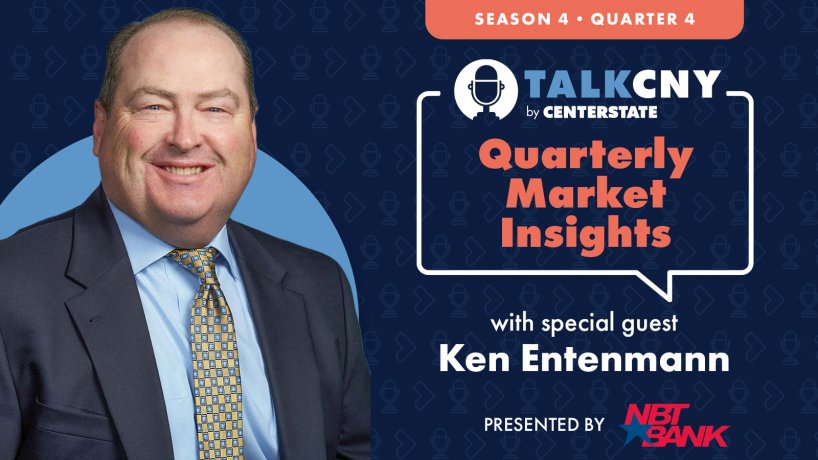
Welcome to CenterState CEO's Quarterly Market Insights, a Talk CNY podcast, presented by NBT Bank, featuring NBT's chief economist, Ken Entenmann. For those who are new to the pod, this is our quarterly evidence and data-based look at the economy and its impact on businesses and communities across Syracuse and Central New York. I'm Kevin Schwab, your host. And Ken, we have a lot to talk about today. I'm not sure we're all going to fit all of this into one episode.
It's great to be here, and yes, there is a lot going on.
As you know, I like to make the occasional movie reference when we do this show, and right now our economy is feeling a bit like Speed. Not sure who's Keanu Reeves in this or Sandra Bullock, and I sure don't want to know who's Dennis Hopper in this comparison, but I'm certain that we can't let the bus drop below 50 miles an hour today because we have so much to cover. So let's start with some of the national pressures that we're seeing right now. Inflation continues to tick up 3.7%. Oil has recently been as high as $110 a barrel, much higher than the last time you and I sat down to talk about this. Gas is over $4 a gallon. Diesel is over $6 a gallon. U.S. Treasuries crossing the 5% threshold. There's definitely some good stuff happening too, but it seems like there's a lot of pressure on the U.S. economy.
What concerns do you have when you hear a list like this, Ken?
Well, they're all legitimate things to worry about. In fact, the University of Michigan's Consumer Sentiment Index, which has been around since 1946, is lower than 99% of the time of that index since 1946. So it really speaks to how negative people are and for some good reasons, so most of what you just cited. However, when we look at the macro data on the economy, the numbers are pretty good. The Fed's Atlanta GDP now is calling for 3.6% GDP growth in the third quarter.
That's impressive under any circumstances.
Correct. Well above historic trends. Unemployment at 4.2% is considered full employment. And anecdotally, just traveling around, I was in Pittsford, Massachusetts, on Wednesday. I stopped to buy gas. There was a "help wanted" sign. I stopped to buy lunch. There was a "help wanted" sign. I went to the event where I was speaking, there was a "help wanted" sign. Even today driving in on 690 from Auburn, there's a "help wanted" sign by Crucible Steel by the Fairgrounds. I am seeing help wanted signs everywhere. And for small businesses which dominates the Central New York economy, the number one problem continues to be finding qualified workers. So what worries me, I think the biggest thing is the economy is being driven by the consumer and by AI spending, business investment. And anything that would slow consumer spending or slow the AI trends would, I think, have a big impact on the economy.
The good news is we haven't seen it yet.
Well, and it's funny because much as we started with the list of things that are quite concerning, we've got a list of things that are really good, and the top one on the list is the U.S. consumer. I mean, setting records.
Yes. And there's kind of a misnomer. Now, clearly inflation is problematic and food prices are higher, as are energy prices. But I would suggest that the culprit is really energy prices because it filters into everything when diesel and energy costs, but it's specifically diesel fuel. It's everywhere. Every truck that delivers food, every tractor that harvests the food, you go down the line, it's very concerning. However, the economy has proven to be remarkably resilient in terms of dealing with those energy costs. I think partly it's because we're more energy efficient. You think back to the 1970s when cars were getting eight miles to the gallon, and now, depending on the size and type of the car, it's anywhere from 19 to 50 miles to a gallon. We use more renewable energy in terms of the total portfolio. So while energy prices are a problem, and I think they will remain a problem until we get, and I'm being cute with this, a reasonable resolution to the Middle East.
I don't know what that means. I don't know what it looks like, and I don't know when that's going to happen. And certainly, frankly, I'm a little surprised it's lasted as long as it has, but I think oil prices are the sticking point in inflation. When we look at core inflation up until last week's readings, core goods were down in the last four months, and they popped up again last month, but that coincides with the rise in oil prices. So lots to worry about, but the overall trend in the economy is actually much better than the sentiment.
And again, I've got a list of some things that are actually pretty encouraging, but on that list of concerns, there were a couple of things that I wanted to do a little bit more of a deep dive on.
Sure.
Diesel. I mean, six bucks a gallon is scary, particularly when you think about the historical importance of diesel to our economy. So many of our goods across this country are delivered by tractor trailer. Our agricultural economy depends on diesel. Is this the same impact though, that it would've been a generation ago, at least the way you see its impact on the broader economies?
Well, again, well, it's certainly a negative impact, but not near... This rise in oil prices, if it occurred in the 70s and 80s would be debilitating to the economy. We'd almost certainly be in a recession. Today, not so much. We're still powering through this. Whether that becomes eventually a straw that breaks the camel's back remains to be seen, but I think we're pretty far from that. We made reference to miles per gallon in a car, well, the amount of acres plowed in a tractor is far greater than what it was, and we're more efficient in terms of handling it. And I think that's why the economy has proven to be as resilient. That being said, diesel is the core component. We measure the barrel of oil, West Texas Intermediate, and domestically and Brent International, but nobody uses crude oil. It has to be refined. I do think there's a lesson here, which is we haven't really built any refineries since 1979 in the United States.
If you look at regions of the country, diesel prices are far higher than they are in other regions. When I look at California, they've closed every refinery they have, and it's resulting in energy costs that are the highest in the nation. New York isn't far behind. We're in the bottom decile of states when it comes to cost, and you think of closing Indian Point, a nuclear power plant, and just the lack of willingness to do it. And you look at all the fury around data center building, try building a refinery. Part of the problem we're running into is here in the United States, we don't have refining capacity, and therefore we became somewhat dependent on places like Russia, and that's been cut off because of the Russia-Ukraine war. So there's a lot of factors other than just the war in the Middle East.
Some of it is self-inflicted, and that is we don't have enough refining capacity.
On a personal level here, I will put in a shameless plug for plug-in hybrids, by the way. When you're getting 70 miles to the gallon on a personal level, this doesn't have the same impact that it would've had. And I think you spoke to some of that, but certainly the broader impact of diesel, still a thing, but I think it's important to note, not debilitating, not at a point where it's driving us into a recession.
Correct.
I think that really does speak to how our economy has changed over the last couple of generations. Something that has changed, probably not for the better though, U.S. debt. And when we talk about the pressures from the current level of debt and how we're seeing the bond market react to that, what are your concerns when you see that?
I think the recent rise, so we started the year about a hundred basis points lower than where we are today on using the 10-year Treasury note as a proxy. So what's driving that increase in yield? And not all of it's bad necessarily. So one, I think we've lived the last 15 years of our life in an abnormal interest rate environment. We first went to 0% interest rates coming out of the financial crisis in '08, '09, and then we went back there again in the COVID environment. Now, when I left my office this morning to come over here, the 10-year Treasury is at 510. The 50-year average is 750.
Really?
Yes. So it's not -
Well, I would've failed that trivia question.
You're looking at rates that are higher than historically really low rates. What's driving that? So one, we have a strong economy. The economy has recovered. It's taken a while, but we still talk about COVID and its impacts on economic activity. And I think there's a return to normalization, but a stronger economy, all things being equal, would suggest higher rates, and I think we're getting that. That I think is partly behind the Fed increasing the Fed's fund rate in September. So the Fed's raising rates, and that's kind of the base of it. So that's going to generate higher long-term interest rates. What else is driving long-term interest rates? Well, clearly inflation. If I'm a long-term bond investor, inflation eats away at my principle that I'm going to get back in the future. Exactly. So I'm going to demand a higher rate of return or an inflation premium, and that is being built into the marketplace.
Third, we have enormous demand for capital. When you look at the amount of AI spending and the amount of debt that's being generated in the AI space, it's pushing $4 trillion. Well, that's competition for capital that didn't exist not too long ago. If capital is in high demand, the price of that capital goes up. So that's basic. The last thing, and this is a global problem, not a U.S. problem, is there are fiscal strains from fiscal policy, not only here in the United States, but across the globe. So when you look at the violence occurring in Germany and in France and Italy and the UK, arguing over the same topic, lots of debt and demands for greater services, but you don't have enough money to do it because your fiscal policy is so out of whack. Specifically here in the United States, you're right, Kevin, we have $40 trillion in debt, over a trillion dollars a year in interest expense.
That's pretty meaningful. There's really no end in sight because we're running $2 trillion deficits. We can debate which party is more responsible, but the answer is neither party's very responsible. And that deficit, which if you think about it, every time we spend on a deficit and it's $2 trillion on a $7 trillion budget, that's a big number. And there doesn't seem to be any willpower. We're right in the midst of an election season. I am not aware of any ad suggesting we want to cut spending. It doesn't happen during a political election season. So I think the market both globally, because long-term interest rates have gone up in just about every developed market in the world and it's happened here. What I do find interesting though, and so I very much am concerned about the lack of fiscal responsibility on the federal and on many state levels, but we're still the best game in town.
So when you look at this recent last month, we had a major run up in rates where the 10-year note went from 470, 480 up to as high as 434 I think was the peak. Well, today it's down to 510. Why? Because you have all the things that we're talking about, all this nervousness, and there's still a flight to quality to U.S. bonds. And that I think buys us some time, but in my mind, the debt, the deficits, the interest expense is a ticking time bomb.
Sobering, I want to move to some of the more positive things right now that we see. And we've touched on some of this. U.S. consumer spending, absolutely driving an awful lot of our economic growth that we're seeing in GDP. U.S. is leading the world in the development of AI, and AI spending is an incredibly powerful economic engine for us right now. Jobs and productivity, right? Jobs are up, productivity continues to rise. Even if the job growth isn't at the clip that it was a couple of years ago, it's still solid. Unemployment, I think the most recent number is 4.1 and the markets remain strong. If I had said those without talking about the things that we've already covered, we would be sitting here talking about why aren't we throwing a party?
Yeah, it's quite interesting. If you asked me in the beginning of the year and told me the 10-year Treasury would go up from 4.20 to 5.10, and if you told me that the war in Iraq would still be unsettled and Russia, Ukraine would be unsettled and we would be having violent protests throughout the developed markets, I think anybody would be hard-pressed to say you would be trading near record high levels, which we are. The S&P 500's up even after the recent selloff in the last week, and it's kind of reversing out in the early days of this week. It's remarkable the market's still up 14%. So what's driving it? I go back to macroeconomics, C+, I plus G, consumer business investment and government. As we just touched on, the consumer continues to spend. If you ask them how they feel, they tell you horribly, but then they leave and go to Disney World.
Exactly.
And we've seen no sign of abatement in consumer spending on all income levels because there's a notion that we have a K-shaped economy where, and it makes sense that the lower-income people spend more on food, spend more on energy, so it hurts them more. But when we look at credit card data, and we look at spending on the lower-income categories, it's still going quite well.
So Ken, you're actually touching on the question that I have about this list of things that look very positive in our economy. Are you concerned about their sustainability, their durability?
Yeah. So let's take C plus I plus D. So the consumer, quite frankly, it's unemployment. That's what drives our economy. And when we have high employment, whatever the event is that is the catalyst for it, think of the financial crisis or a dotcom bubble or an Arab oil embargo, whatever the catalyst is, if it has a significant increase in unemployment, that's when the consumer really clamps up. It's the old joke that when your neighbor gets laid off, it's a recession. When you get laid off, it's a depression.
It's a depression. There you go.
Yeah. The reality is very few people are getting laid off, and there is this dearth of hiring that is really critical for small businesses that dominate our economy. So unless unemployment goes up meaningfully, I think the consumer is going to hold in there. In addition to that, particularly when you get into the higher income categories, their stock portfolios are at record highs, their home prices are at record highs, and their liabilities have gone down over the last five years in the post-COVID. So there's a lot of leverage to spend there. Think of the Baby Boom generation as they're retiring, as the wealthiest generation. They are the key spender in this. So I think the C is okay. The I is business investment, and it's off the charts. Think about the amount of money Micron is spending to build this plant up in Clay.
We're not talking about tiny numbers, right? And I think the prep work, if I can call that, is largely done. And I think Kevin, when we were talking about it, we're expecting what, 2,000 workers on site?
By this time next year.
That's remarkable. And that's business investment. So I don't see that going away anytime soon. And then lastly, it's the G, and we're spending $2 trillion in money we don't have. So C plus I plus G, we're firing on all... And I think that's why the macroeconomics are so good. What would it take to really upset that apple cart? I think it would be one, something that drives unemployment up more substantially than it is. I don't know what that could be, and there's always surprises there. And two, which maybe we're having a debate, we're starting to have a debate about AI and what its prospects are. The promise of AI that it's going to significantly enhance productivity is great. The cost of it is being debated, whether we're in frontier models or macro large language models, or are we using smaller language, more specific models, that's all in a debate.
And I don't know where we're going with that, but it's important because the AI trade, if you would, in the market in the last year or so, 67% of the price increase is directly related in the S&P 500 is directly related to AI. 58% of the corporate earnings in the S&P 500 directly related to AI, and 81% of all capital expenditures is directly related to AI. So we are really in the need of AI continuing its trends.
That's both exciting and scary.
Correct. Exactly.
And you've hit on some of the things that when we talk about C+ I plus G, that we can absolutely see translating into the strength of our local and regional economy here. Certainly, when we talk about government, we've talked about some of the real impacts that we've seen in the changing nature of conflicts in places like Ukraine and Russia and Iran and much of the Middle East. Drone technology, incredibly important to our regional economy with roughly between drones and microelectronics, about 20,000 employees in that space in this region, and now incredible government demand for what they do. And we've seen significant new contracts come into companies here in the region. We've seen private investment going into companies here in this building at the INSPYRE Innovation Hub, driven a lot by some of those technological imperatives. We've talked about Micron. Right now three, 400 people out on the site.
Micron has spent upwards of a billion dollars already, and it's funny to think about it, but that's about 1% of what they're going to spend out there. 30, 400 people a year from now, 5,000 people working on that site as they start to go vertical. I-81, right? We're all living that project right now. It's a headache right now for driving just about anywhere in the region, but that's a $4 billion investment here. There are about 1,500 people working on that project right now. To your point on small businesses and the growth opportunities and the need for talent, we recently celebrated our members' impact on the economy here in the region in the past year. Collectively, without talking about things like the 81 Project or Micron, collectively, they've added 3,700 new jobs, more than a billion and a half in capital investments. That's pretty darn impressive when you put it togethe,r and we're seeing housing starts rise here.
You hear all of that. What do you think about the outlook for our economy right now, particularly relative to the national economy and potential bumps there and where you see us headed?
Well, I think it's hard to believe that between the macro projects, Micron, they're happening whether we like it or not. And so the economic impact is going to happen. Now whether Micron builds plans three, four through eight remains to be seen, but one and two are going to be built. And the road 81, that project is going to come to fruition. So that is a driver of our economy that's going to be here for a while. I think there's kind of a, if you build it, they will come. The demand longer term because of Micron for housing and infrastructure, et cetera, is real. And I think you're looking at home builders and real estate developers looking at it and saying they're confirming that the long-term view is optimistic. And that is not something we see across the board. Then lastly, one thing that you and I talked about, Kevin, that I would add is you think about physical policy and physical health, and we've talked about kind of the national level, but on a local level, whether it's the city of Syracuse or Onondaga County, financially we're far more responsible and in far better shape than even our colleagues in places like Rochester, Utica, Albany, where they're grappling with some pretty serious deficits that they have to fix.
So I just think between the macro drivers, the general health of our smaller businesses, the infrastructure build-out, which should improve productivity and the relative health of our local governments, there's a lot to be optimistic for. I would hope that also perhaps some relief in terms of some of the more heavy handedness from a state government in terms of permitting and regulation and generally high taxes, maybe that can be fixed too. But I think the pros outweigh the cons here for Central New York.
Ken, as always, your insights are incredibly valuable. We appreciate you and the entire team at NBT. Thanks so much for joining us for this episode of Talk CNY and our Quarterly Market Insights.
Other
Talk CNY Quarterly Market Insights
| 2026 Q3 - Ken Entenmann | August 5, 2026 | |
| 2026 Q2 - Ken Entenmann | May 4, 2026 | |
| 2026 Q1 - Ken Entenmann | March 6, 2026 | |
| 2025 Q4 - Ken Entenmann | December 24, 2025 | |
| 2025 Q3 - Ken Entenmann | October 6, 2025 | |
| 2025 Q1 - Ken Entenmann | May 2, 2025 | |
| 2024 Q4 - Ken Entenmann | December 11, 2024 | |
| 2024 Q3 - Ken Entenmann | October 9, 2024 | |
| 2024 Q2 - Ken Entenmann | July 17, 2024 | |
| 2024 Q1 - Ken Entenmann | April 3, 2024 | |
| 2023 Q4 - Ken Entenmann | December 18, 2023 | |
| 2023 Q3 - Ken Entenmann | October 1, 2023 | |
| 2023 Q2 - Ken Entenmann | July 6, 2023 | |
| 2023 Q1 - Ken Entenmann | March 6, 2023 |