CenterState Signal: The Planning Trap
Posted On |
Image
|
CenterState Signal Q3 2026
Economic headlines in 2026 have ranged from Federal Reserve rate hikes and inflation to rising prices at the pump and the impacts of artificial intelligence. Despite frequent unpredictability, the American consumer remains resilient, and many areas of the U.S. are experiencing low unemployment. At the same time, rates of job growth are slowing across the country.
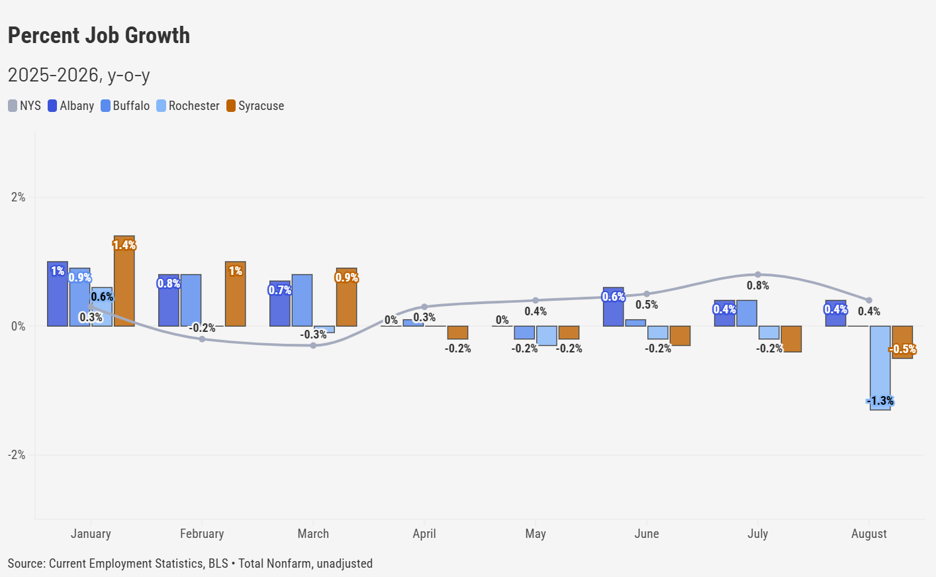
Syracuse is coming off a period of record year-over-year (YoY) job growth, but the region is not immune to national trends. Like many other U.S. metro areas, Syracuse’s job growth appears minimal. Data tracked by CenterState CEO shows the metro area’s year-over-year job growth has tracked negatively since May of this year. However, this slowdown isn’t the only economic reality for the region. Central New York has strong forward indicators that signal greater growth is just on the horizon: Micron construction hiring is expected to increase exponentially in 2027, and new housing permits are being issued at decades-high levels. So even as national economic trends appear to wane, it’s imperative that planning for a growing economy continues.
To better understand Central New York’s entire economic picture, it’s important to look at how national job data affects the local economy and what factors differentiate the region from other parts of the country.
A Tough Comparison After a Strong Year
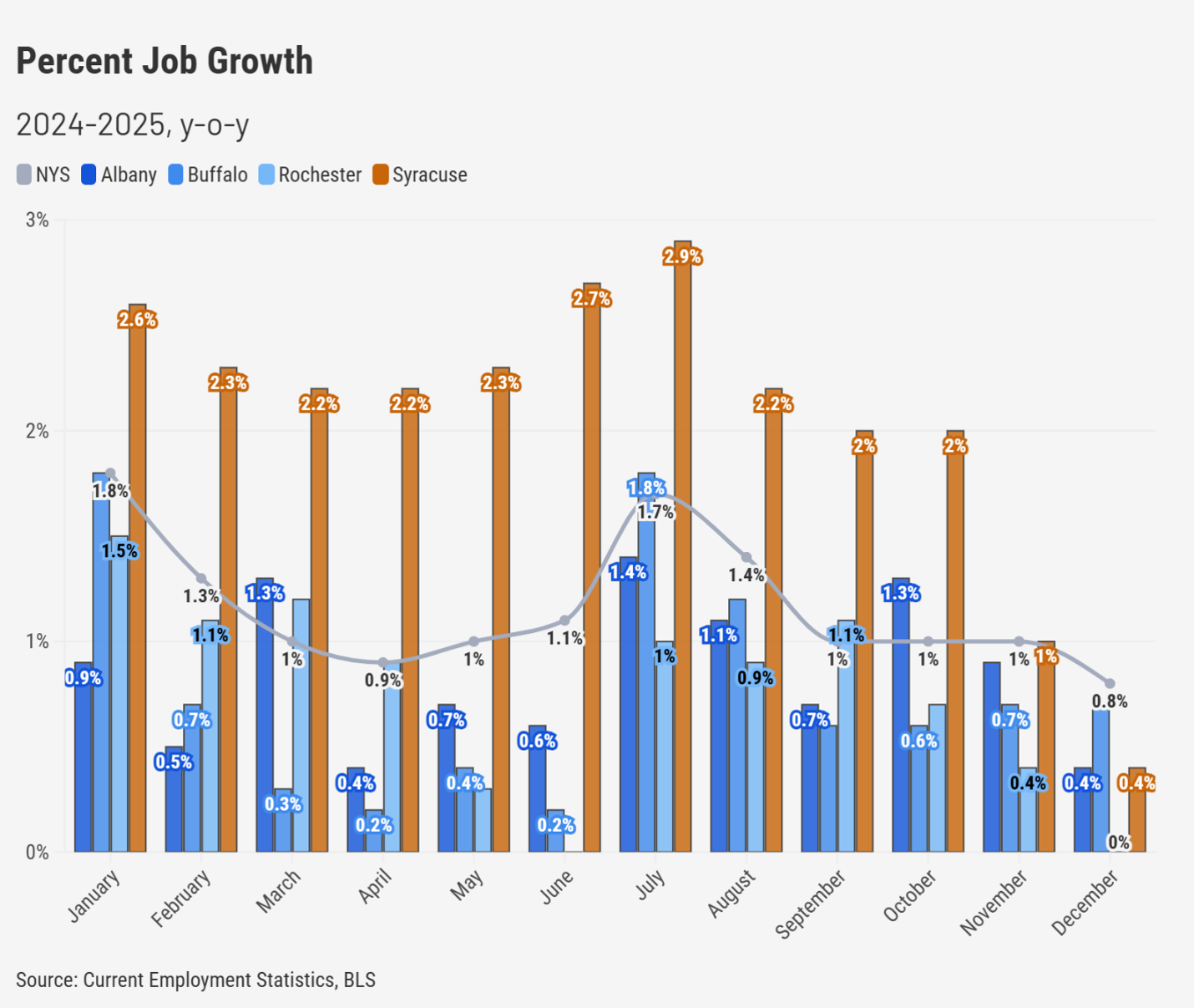
Year-over-year employment growth compares each month with the same month one year earlier. That makes it useful for filtering out normal seasonal swings, but it also means that an unusually strong year creates a difficult benchmark for the next one. Syracuse spent most of 2025 growing at more than 2% YoY, surpassing rates of growth in many of its Upstate peer cities. Growth peaked at 2.9% in July 2025, eased late in the year, but remained positive.
By comparison, Syracuse began 2026 at 1.4% growth, slipped below zero in April and remained slightly negative YoY since then.
The National Economy is Part of the Story
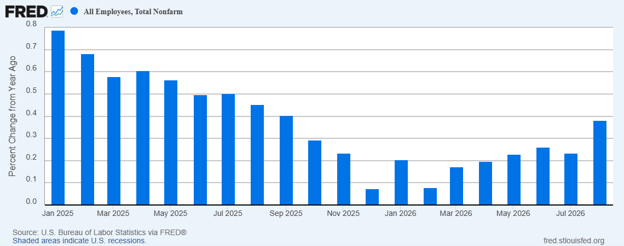
Central New York is not moving in isolation. National year-over-year job growth fell sharply through 2025 and remained weak in the first half of 2026 before improving somewhat in August. New York state followed a similar pattern, moving from growth of roughly 1% during much of 2025 to about 0.4% by August 2026. Albany maintained modestly positive rates, while Rochester and Syracuse were negative.
That broader slowdown produces subdued data. So even as cranes, construction equipment and traffic around Micron’s White Pine site make the longer-term investment visible, local hiring decisions, consumer confidence, financing conditions, and demand throughout the supply chain are all impacted by national economic trends.
The Micron Employment Wave Has Not Peaked
Current regional estimates, adjusted for the project's schedule, can help explain why 2026 may appear quiet even as the project advances. This first year of the project will have a relatively small employment effect. That’s expected to change starting in 2027, with thousands of Micron-related jobs in onsite construction, supply chain employment, jobs supported by day-to-day spending and Micron operations being added to the region annually through 2031.
Micron is here; there’s been a groundbreaking, construction is clearly underway, and yet the population growth isn’t yet. In fact, we’re even hearing about population loss. Adjusting strategies to this slower moment risks dulling the region’s momentum, however, because job growth is about to kick in.
If businesses and public agencies wait for jobs to appear in backward-looking data, they'll react after demand has arrived. Contractors need workers and equipment. Employers need recruitment and training pipelines. Communities need roads, utilities, services and housing. Preparation work must precede the employment spike.
Housing Permits Point Forward
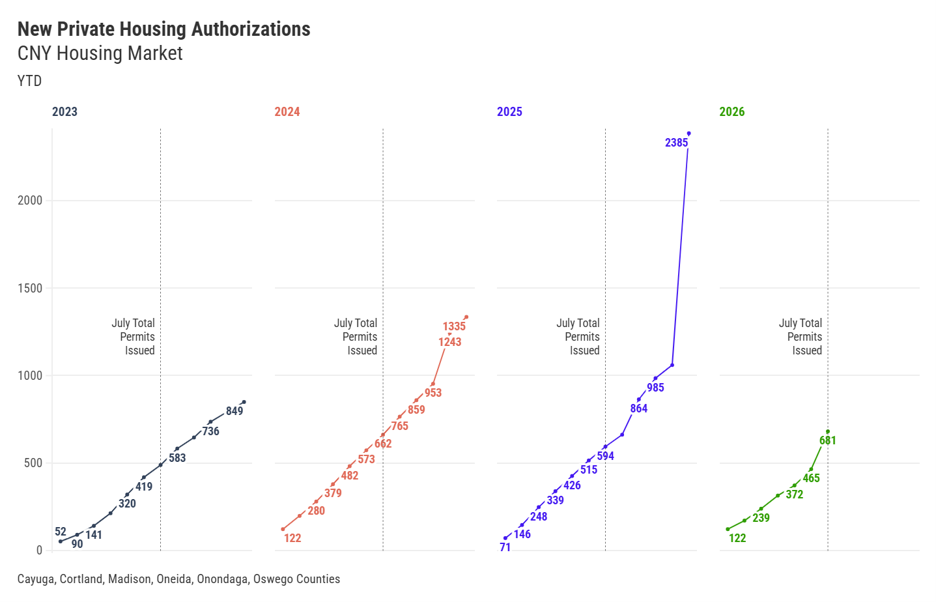
Housing permits offer one indication that the region is already responding. Across Cayuga, Cortland, Madison, Oneida, Onondaga and Oswego counties, 681 housing units had been authorized through July 2026. That was about 15% more than at the same point in 2025, 3% more than in 2024, and 17% more than in 2023.
The broader trend is also notable. The six-county region authorized 2,385 units in 2025, compared to 1,335 in 2024 and 849 in 2023. Permits are volatile, particularly when a large multifamily project lands in a single month, and an authorization is not the same as a completed home. Still, the sustained increase is meaningful. Developers are responding to current shortages and anticipated demand before those pressures fully show up in population or employment estimates.
As more workers move to our region for major projects, the increase in housing supply must continue. Every added worker needs a place to live, and every new household creates demand for stores, childcare, transportation, healthcare and local services.
Prepare for the Next Phase
The strongest signal in the Syracuse economy is the gap between what current employment data show and what the construction schedule and permit pipeline suggest is coming. The near-term picture appears soft as the region is no longer posting the exceptional YoY gains of 2025, and national conditions remain a constraint. But the evidence does not point to a regional growth story that has ended. It points to a transition between the first burst of momentum and a much larger investment cycle.
The practical question is whether Central New York uses that interval well. Housing approvals need to become completed units. Training programs need to reach workers before employers compete for them. Local firms need a path into construction and supplier opportunities. Infrastructure and services need to scale before demand becomes a crisis. The risk is not simply that growth arrives more slowly than expected. It is that the region mistakes a lag in the data for an absence of demand and waits too long to prepare.
CenterState CEO and its partners continue to push forward strategic initiatives that directly address the preparations needed to fully benefit from this investment:
-
Housing: Through CenterState’s Central New York Housing Dashboard presented by Erie Materials, housing development can be monitored at a regional level to identify key insights into the area’s residential landscape. CenterState CEO also convenes key stakeholders for strategic conversations around housing in Central New York through its ongoing Housing Work Group.
-
Planning for the Future: CenterState CEO’s Board of Directors gathered for a board retreat this year to discuss key issues facing the region such as artificial intelligence impacts, placemaking, infrastructure and develop strategies that will the community navigate opportunities.
-
Workforce Development: ON-RAMP CNY is training community residents for in-demand career fields such as construction and advanced manufacturing as CenterState CEO’s Workforce Innovation team works with local unions and construction firms to ensure training programs are in line with the needs of the job companies are trying to fill. Participants learn skills they’ll need on the job, connect with future employers, and help to increase capacity of the local talent pipeline.
Help us better understand what you are experiencing in your industry or business by taking the 2027 Economic Forecast Survey. The survey should take about 10 minutes.
Other
CEO News

CEO News | 09/29/2026Future-Proof Your Organization Against Cybersecurity and AI ChallengesHear real stories and solutions from industry experts on rapidly evolving cybersecurity threats, accelerating technology changes and the growing impact of artificial intelligence at the Future-Proof Your Business, Cybersecurity, Technology… |

CEO News | 09/11/2026CenterState CEO Chief Executive Officer Rob Simpson Receives Upstate Medical University’s President’s Award for Distinguished ServiceThe award recognizes Rob’s longstanding service to Central New York and his commitment to building strong, collaborative partnerships across the region. |