

S4,E1 - Rob SimpsonPosted on January 14, 2026 |
Image
|
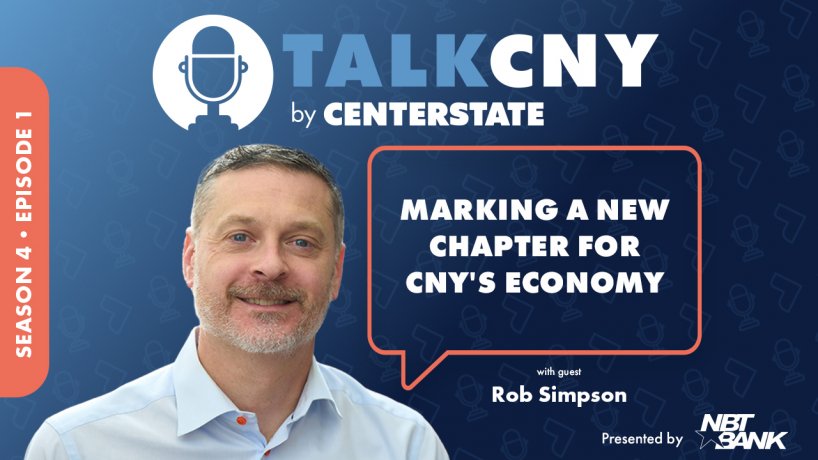
This is Talk CNY, a semi-monthly podcast by CenterState CEO. We're an independent nonprofit committed to creating inclusive, equitable, and sustainable economic growth in Central New York. Join us as we meet the people and explore the projects driving the regional economy forward. This is Talk CNY, presented by NBT Bank. I'm Katie Zilcosky, Director of Communications at CenterState CEO and your host for Talk CNY. Happy New Year and welcome to season four of Talk CNY, presented by NBT Bank. We have a lot in store this year, from Micron's groundbreaking to the redevelopment of 1300 South Salina Street as the future ONRAMP facility. There's a lot to tackle. So on this episode of Talk CNY, presented by NBT Bank, we are joined by CenterState CEO's President and CEO, Rob Simpson, to discuss what's in store.
Rob, happy 2026. Welcome back to the podcast.
Thanks. Great to see you, Katie. Hope everyone listening had a wonderful holiday, and a Happy New Year.
Happy New Year. You are recently back from the other side of the world. You, before the holiday, were in Japan meeting with semiconductor supply chain companies. You were with some of our partners at Empire State Development and Onondaga County, telling the story of Central New York. What were some of the highlights of your trip? Can you tell us a little bit more about it?
Yeah. First of all, I'd just say it's such a rewarding experience to be on the other side of our planet. Talking with companies in a critical industry sector, partners of Micron, supply chain partners of the semiconductor industry, talking to them about our little corner of the world and being able to share with them the story of what has happened here in Central New York over the course of the last decade and a half, transformation leading up to Micron's major investment. I think I'm coming back from Japan with a lot of enthusiasm. We had some great engaged conversations with chemical companies, with gas supply companies, with logistics companies, folks that are critically important to Micron's operation and to the operations of semiconductor companies around the United States of America. I think one thing I want our listeners and viewers to understand is that Japan is a deeply market-based economy.
And as such, I think they clearly recognize, the companies that we spoke to clearly recognize that there is sufficient production coming online in the United States in the next three to five years, that they need to invest in the United States in order to support those companies, supply raw materials or finished products to American domestic fabs. What a remarkable opportunity for our country. For a supply chain that has moved essentially mostly offshore over the course of the last 30 years, this is our chance to recapture some of that production investment jobs and bring them back to communities in the United States. It is going to be a fight. Every community in America that has a major fab, whether it's Austin, whether it's Phoenix, Columbus, Syracuse, all of those communities are going to be chasing these supply chain investments. And our job, working with our partners at Onondaga County, with Empire State, our federal representatives and beyond, our job is going to be to showcase for them why this location in Central New York is the best place for them to be.
And to make it as easy as possible for them to invest capital and hire people here in Central New York.
Now, of course, like you said, a major reason for that, Micron. And maybe we buried the lead a little bit here, but we have some really exciting milestones coming up for Micron. I mean, they're about to break ground in just a few days.
Yeah. Well, what a great way to start 2026. I know there's been skepticism, right? Those of us who've lived in this community for a long time understand this is a little bit like Missouri, the Show Me State. People here want to see it before they believe it. I get that, but here we are launching the brand new year, a new economic cycle. And we know in just a couple days time there'll be shovels on the ground, trees will be cleared. At some point this spring or summer, foundations are going to start to be poured for Micron's first fabs. What a remarkable thing to see this project that we have been working on for the better part of five years, that the public in Central New York has known about for now more than three years.
Great.
Finally, start to see the economic impact. We'll have construction laborers out at the site. Our small businesses will have more people walking around with money in their pocket to buy sandwiches and to go to car washes and to rent or buy homes.This is a remarkable windfall for the Central New York economy, and I am just so excited that we get to start 2026 fresh with this exciting news, exciting announcement, and the start of truly a new economic era for Central New York.
It's time to grab shovels, right?
It is absolutely time to grab shovels. Let's go.
So all of this attracting of semiconductor supply chain companies, Micron's project in and of itself, it's all super energy intensive. We are really lucky in Central New York to have a lot of carbon-free energy resources, but we know that we will need more to support not only the projects, but the people that live and work in these communities. Late last year, you and a number of leaders from upstate New York called for an all of the above approach to energy creation. Can you talk a little bit about what that means? What is an all of the above approach, and why is it so important in this moment?
Yeah, I think a couple things come to mind here. The first is that we do have this remarkably clean energy grid. 92% of the electrons that come out of the socket when you plug your phone in here in Central New York are carbon free. That is the cleanest electric grid in the United States of America. That's a huge advantage. And honestly, I think it's a reason why Micron chose Upstate New York. That said, Micron is one of the most energy-intensive projects on the planet. We have other projects around Upstate New York, here in Central New York, but also throughout Upstate that are also hyper energy-intensive. There's a lot of talk now about data centers and how data centers are consuming so much electricity. The point being, the projects that are happening in the United States right now tend to be more energy-intensive, a lot of advanced manufacturing, and that is putting a new strain on our electric grid.
Yes, there's some strain today, but what is happening, organizations like the New York ISO, the Independent System Operators, have been putting out report after report for the last couple of years, helping shed light on the fact that a moment of concern is coming down the road, right? Just over the horizon, a couple of years, the point where we have sufficient and reliable energy to accommodate our economic needs, along with the growth that we anticipate in our economy, those are coming to a point of tension and conflict. The only way to resolve that is to reduce that rate of growth or to add generation to the system. I don't know about anyone else in New York State, but I have no interest in reducing the rate of growth that we have. Upstate New York, where I've lived my entire life, has suffered economically. The people who have lived here have suffered through economic trauma.
We have fought for and earned this moment of growth. I have no interest in handing that back. So, our opportunity from my perspective and what we worked with leaders around the state to talk about is to responsibly increase energy generation across our state so that we can meet the future growth needs of our communities. Doing so in ways, in ideal ways that are carbon free and renewable, but understanding that we must have sufficient energy for not only our economic growth, but maybe as importantly, more importantly, for the homes that people live in and for the businesses that people already operate. Not having enough power is not an option. It's not an option for us. It's not an option for any elected official. And so what we have called for is effectively all hands on deck to ensure that we are building more power. We are creating not only new carbon-free generation, but that we're also continuing to invest where necessary in legacy systems, making sure that we have natural gas as a backup heating system, making sure that we have redundancy, that we have a reliability.
And also keeping in mind in the beginning of 2026, the number one thing on everyone's mind is affordability. How do we keep prices down? We keep prices down through competition and through maximizing the number of options we have. So I think that's the message that some of us in the business community and civic leadership across Upstate New York are trying to communicate. It's a message that we've heard the governor and many in the legislature also echo, and we know that 2026 is going to be an important year. Big decisions will need to be made. One of the priorities that we are chasing here in Central New York, that is mission critical to us for lots of reasons is trying to cite a new nuclear reactor up in Oswego County. As you know, they're already home to three, and we believe there's a huge opportunity to bring tens of billions of dollars in new investment to Central New York to create thousands more jobs and to do our part to contribute to the state's energy goals going forward.
I mean, can you kind of put the nuclear picture in Oswego into a broader picture for folks? I mean, in Central New York, I'm sure they know, but maybe if they don't, it's a really important, not only economic driver, but like you said, energy engine for our region. So adding another nuclear plant, how would that impact us?
I mean, it's thousands upon thousands upon thousands of construction jobs. The most recent nuclear reactors built in the United States, down in Atlanta, they took years and years and years to build, right? So think effectively permanent construction jobs for five to 10 years as a reactor is being built, lots, hundreds of permanent construction jobs to maintain the facility after it's been built. And then I don't know how many exactly with a new reactor, but hundreds, if not thousands of new permanent jobs to operate the facility as well. That's massive economic impact, especially up in Oswego County, which is the county in our regional footprint here at CenterState that has the highest unemployment rate of any of the counties in our region.
There's a very special place for economic development in Oswego County because it is a place where people need opportunity the most. The community up there welcomes the nuclear production. It's been a staple of their community for decades, and they have learned and understand how to live and interact with a nuclear power plant in ways that are demystified and feel completely safe and normal. And I think that is what we want to do. We want to support our partners up in Oswego County. We want to bring more economic growth. And in so doing, we want to create opportunities to generate power here in Central New York to use that power, but also to export that power to other parts of our state that are also experiencing growth. Anytime we are exporting goods or services that is revenue coming to our region that is coming from somewhere else that helps grow our GDP and make us more prosperous and successful.
We will have more with Rob coming up in just a moment, but first, we have a quick word from our sponsor, NBT Bank.
At NBT Bank, we know that this day starts with this one. This day starts with this one, because no matter how unforgettable the extraordinary days are, there's a lot of everyday that leads up to them. You can count on NBT Bank to help you get started. NBT Bank, it starts here.
Welcome back to Talk CNY, presented by NBT Bank. I'm Katie Zilcosky, Director of Communications at CenterState CEO and your host for Talk CNY. I am joined on this episode by CenterState CEO, President and CEO, Rob Simpson. Rob, thanks for being here.
Absolutely. Love it.
We have a lot to look forward to in 2026. Things are already off to a fast start. I mean, earlier this month, we had the historic inauguration of Syracuse Mayor Sharon Owens. I know that you are on her transition team as a co-chair. So, can you tell me a little bit about the vision and the first priorities of the Mayor Owens administration?
I think, listen, first of all, let's acknowledge the historic nature of the moment.This is a big deal. It's a big deal for our entire community. I'm proud of the fact that we have a mayor who is breaking barriers and an electorate in Syracuse that is allowing that to happen. It probably should have happened a long time ago, but the reality is we're here today. And Sharon is a remarkable leader that we've had the privilege of working with for a long time, not just the last eight years during the Walsh Administration, but prior to that in her other community leadership roles. I'm really excited about supporting her and the job that she is going to do. She's been very intentional about the fact that she wants to run a human-led administration that focuses on solving the problems that humans face. Some of that includes helping them get access to jobs and to workforce development training, but it also impacts the neighborhoods that they live in, the social services they receive and everything in between.
The transition committee has been a really interesting process. There are five committees that are working now, everything from economic development to one around the next generation of leaders in Syracuse, a fiscal sustainability committee, and they are in the process right now of generating recommendations. They're meeting as committees, they're doing some public engagement, and they're going to fold up to the co-chairs and to the mayor-elect... Or I'm sorry, to the mayor. They're going to fold up a list of recommendations that we will have a chance to organize and curate, that will become a starting point for Mayor Owens' administration. I think that you're going to see some exciting things come out of that. I think you're going to see some bold things come out of that. And I'm proud of the role that we're playing in helping to partner with the administration.
It goes back to what we've talked about on this podcast and in so many other forums. As a community, when we work together, we win. And the inclusive nature of this transition committee process has been something that I think gives me great confidence that we are working with an administration that wants to collaborate. They want to collaborate with businesses, civic organizations, and refugee communities. They want to partner with our housing authority, so many opportunities to improve life in Central New York. We have a lot to be excited about here at the beginning of 2026, but there's still a lot of work that we need to do.
Definitely.
I have great confidence that Mayor Owens is going to help lead us in the right direction.
For those who haven't had the chance to meet Mayor Owens yet or haven't worked with her in the past, what can you tell them about her strengths and how they'll help us move Syracuse forward?
She is first and foremost a person of her word. She has tremendous integrity. She takes deep personal pride in how she shows up and her work product. And I think that that is, I think, a testament of a true public servant when they see themselves as a vehicle to deliver improvement for the lives of the people that they serve, that's just who she is. She's a person of faith. She is a person of deep resolve, and she is also deeply unafraid.
And I, for one, love that. I do think sometimes in Central New York, we spend too much time thinking about the things that have gone wrong over the last 30 or 40 years, and not enough time being bold and planning for what we want to go right. And one of the things that I was really impressed with Mayor Owens during the campaign is that she was willing to speak hard truths and willing to put big ideas out there. Listening to her talk about her vision for this community when Interstate 81 comes down is a beautiful thing. And I think a big reason why this community came to the decision to bypass 81 around Downtown Syracuse was because of the opportunity it created for residents and businesses alike within our city and within our region. I'm really proud. I'm really excited. There's a lot of work to do.
Speaking of more work to do, we have acquired the 1300 South Salina site, which will be the future home of ONRAMP, but right now, it needs a little bit of love. People probably know it as the Sears building. They've seen it driving down South Salina, but that redevelopment process is starting this year for us.
It is.
It's exciting. It's a lot of work, like you said, but can you give us a little bit of insight into first steps, what the community can see from the outside of the building as this redevelopment process gets underway?
Yeah. Talk about being unafraid. You have to be a little unafraid to take on a project like 1300 South Salina. It is an iconic building. It's a building that my dad, when he was a kid growing up in the 1950s here in Syracuse, my dad went shopping in that building with my grandmother. Most people my age or older in Central New York have a story that they can tell about the Sears building themselves or one of their parents or grandparents. And it has sit virtually vacant, at a minimum, underutilized for the better part of the last 30 or 40 years. Think about that. An entire generation and a half, if not two whole generations of Central New Yorkers have never known that site to be anything other than an eyesore and an abandoned building.
We are about to transform that building into a home of one of the most modern workforce training centers in the country. We're going to turn it into a place where people can walk in the door and get themselves on a path to a job at Micron or another advanced manufacturer or a job in the construction trades to do work on 81 or on Micron or on any of these other exciting projects that are happening. Being able to bring that type of investment to a part of our community that has seen wholesale disinvestment over the last 50 or 60 years means a lot to me personally. It means a lot to our entire team. And I'm excited. That project is going to be torturously difficult. The building is a mess. You can imagine what 40 years of neglect has done to it. There was water in the basement.
The inside is completely destroyed. There's trash everywhere. The building needs to be completely cleaned out. We're starting with the bones of a building, and we'll be building inside and around it. And I think what's maybe most exciting about that redevelopment project is that the way that we're doing it, partnering with the City of Syracuse, which owns the lot immediately south of the old Sears building-
Which is a parking lot, right now.
Which is a parking lot right now. We're going to be able to put together over four, almost five full acres of real estate on the South Side of the City of Syracuse to turn into a master redevelopment that we will use ONRAMP as the anchor commercial tenant for that project, but we want to see other things built on there. We're in the process right now of talking to developers and trying to find a partner to work with us on redeveloping that entire five-acre site. Shortly before the holidays, we put out a master developer RFP. We had a number of responses that came back right before New Year's. We had a committee meeting just recently and within the next couple of weeks, we will have selected a partner to work with and we will start in earnest on thinking not only about how that site accommodates the future home of ONRAMP, but what else we can accomplish for Central New York and specifically for the Southside community with that redevelopment, be it housing, retail, commercial, or other types of activities.
A lot of work to do, a lot of public engagement that's going to happen, a lot of resources that are going to be needed. But when we are done, mark my words, that property will be something that our community and the South Side can be deeply proud of.
In the meantime, the ONRAMP team is already fast at work in their temporary location on West Genesee Street. Can you tell us a little bit about what's happening at ONRAMP right now? Their first steps, and how people can get engaged?
Yeah. So right now, down on West Genesee Street, that facility is open. We have Pathways to Apprenticeship program trainings that are taking place in the building. Starting earlier this year, we're going to have additional trainings that are taking place in the advanced manufacturing space. It's also an opportunity and a location where we expect to have various service providers who are going to be co-located with ONRAMP so that when job seekers come and they need language training or legal supports or other types of things to transportation supports to not only get but maintain employment, that they will have partners in the building that they can just walk down the hall and get supported in one very specific way. I just think this is the way that we need to go about doing workforce development in the future. And ONRAMP is not meant to be all things to all people.
Right now, it is very focused on the two very pressing areas of need, construction labor and technician jobs for advanced manufacturing. Super high demand. These are areas that are growing very rapidly right now in our region, and I'm really fortunate to have Dr. Lacey and her entire team at ONRAMP, who are leading the charge, and ensuring that as we are creating economic development and economic opportunity in these two sectors, that our community has a very clear pathway to tap into and benefit from that opportunity.
So lots of work ahead in 2026, but I want to know, is there anything else that you're looking forward to this year, whether it be at work or even personally, that you're kind of hoping to accomplish or working towards throughout this new year?
Yeah, I think I want to continue to see our organization and the leaders inside our organization continue to grow. I think one of the beautiful things about coming off my time away at the end of last year is I am thinking differently about how I show up in the workplace, not only what projects I'm taking out and how I'm spending my time, but what more I can be doing to support the other incredible leaders inside this organization. And I've been very privileged and fortunate to step into a leadership role at a pretty young age, and I've had a great run. I love this job. I love the work. I don't want to stop doing it. I do feel maybe a new urgency or calling to spend more time supporting and building others up to reach their full leadership potential, too. And I'm excited about that.
I love being in a position to support others. It's not a piece of leadership that I necessarily anticipated when I started doing this work that I would gravitate towards, but the longer I've done it, surrounded by other great people who have incredible skill sets, being able to work with them and push each other is something that I've really enjoyed, and I'm really looking forward to in 2026.
Well, Rob, thank you as always for joining us here on the program.
Thank you.
I look forward to the new year with you.
It's going to be amazing. And thank you to our Talk CNY sponsor, NBT Bank has been a great partner for us in making this podcast available.
CenterState CEO's podcast, Talk CNY, presented by NBT Bank, is available on all major podcast platforms or centerstateceo.com. Additional content and clips can be seen across CenterState CEO's social media channels. For new episode reminders, be sure to subscribe in your favorite podcast listening app. And don't forget to leave a quick review or a five-star rating. Thanks for listening to Talk CNY, presented by NBT Bank.
Other
Talk CNY Main Series Transcripts
| S2,E3 - Kara Jones | February 7, 2024 | |
| S2,E2 - Dan Kolinski | January 24, 2024 | |
| S2,E1 - Rob Simpson Q1 | January 10, 2024 | |
| S1,E24 - Andrew Fish and Kate Hammer | December 27, 2023 | |
| S1,E23 - Jared Shepard | December 20, 2023 | |
| S1,E22 - Alan Rottenberg and Donna Gillespie | December 6, 2023 | |
| S1,E21 - Ben Sio | November 22, 2023 | |
| S1,E20 - Tim Kennedy | November 8, 2023 | |
| S1,E19 - Rob Simpson Q4 | October 18, 2023 | |
| S1,E18 - Joe Nehme | October 4, 2023 | |
| S1,E17 - Jonathan Link Logan and Andy Obernesser | September 20, 2023 | |
| S1,E16 - Shawni Davis | September 6, 2023 | |
| S1,E15 - Kelly Fumarola | August 23, 2023 | |
| S1,E14 - Nancy Kern Eaton | August 9, 2023 | |
| S1,E13 - Rob Simpson Q3 | July 26, 2023 | |
| S1,E12 - David Kavney | July 12, 2023 | |
| S1,E11 - David Mankiewicz | June 28, 2023 | |
| S1,E10 - Ryan Benz | June 14, 2023 | |
| S1,E9 - Kevin Schwab | May 24, 2023 | |
| S1,E8 - Maria Hudson | May 10, 2023 |