

S4,E19 - Rob SimpsonPosted on October 7, 2026 |
Image
|
This is Talk CNY, a semi-monthly podcast by CenterState CEO, recording in the production studio at CenterState's INSPYRE Innovation Hub. CenterState CEO is Central New York's premier leadership and economic development organization. Join us as we meet the people and explore the projects driving the regional economy forward.
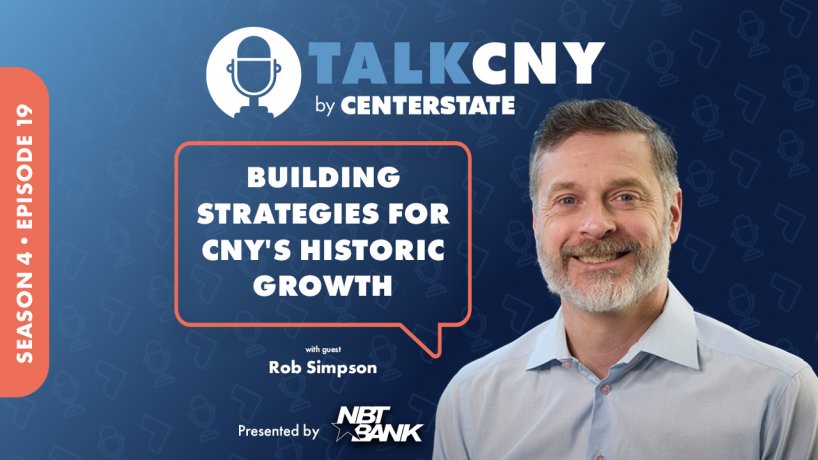
This is Talk CNY, presented by NBT Bank. I'm Katie Zilcosky, Director of Communications at CenterState CEO and your host for Talk CNY. On this episode of Talk CNY, we catch up with CenterState CEO Chief Executive Officer Rob Simpson to discuss the latest on the Micron project and other regional strategies that are supporting recent investments. Rob, thanks for being here today.
It's great to be here.
To start, I want to talk a little bit about some of the physical progress we're seeing up at White Pine for the Micron project. When you're out in the community, how does the physical project, the physical progress, things people can see, how does that change the conversations that you are having and the attitudes people have about the changes that we're going through?
I think there is a growing realization that this project is real, that it's happening, and that it's going to have profound implications on the Central New York community. I think it's impossible to drive up 481 or 81 now and not see a long line of trucks that are moving back and forth to the Micron site. I know that that is probably painful for some of our community residents who are experiencing disruption. It also signals the single greatest economic investment in our region's history. And if you go out and look at that site today, there are 300, 400, maybe 500 pieces of heavy equipment that are physically staged out there, hundreds of people working out on that site. What I think is notable to me as we see the first signs of physical progress of this project, what's notable to me is actually what's about to come.
A year from now, we won't have three or four or 500 people working on that site. We'll have close to 7,000. So the pace of change, if you think about what we saw from January of 25 to January 26 or here as we are in the end of 2026, the pace of change over the next 12 months is going to be more rapid than the pace of change we saw in the last 12 months. And I think that that is something that our entire community needs to be conscious of, aware of, hopefully excited by, but certainly needs to be front and center for our community conversations.
I know you've been up to the site just past it. Can you kind of paint a picture of what it looks like? You mentioned the heavy equipment and the folks who are coming into work, but I mean, if you're driving past that area now, what do you see if you look out a window?
You see a giant, giant construction site that is going to be home to some of the most sophisticated manufacturing processes in the world in just a couple of years. It is remarkable how flat the site is now. The trees are gone. The site is in the process of being cleared and cut. There are roads, there are holes in the ground for the foundations and the subfloors for the first fab. There's additional activity and geotechnical activity taking place in other parts of the site preparing for the next fab and the next fab and what comes after that. Micron and their partners, both Gilbane and Bechtel are moving as expeditiously as they can. And you can understand why. If you look at Micron's stock price, if you look at what's happening in the memory and semiconductor market as a whole, there is unprecedented demand and every single chip that is planned to come off of a Micron factory line in the next two years is spoken for.
So they need to build these fabs as fast as possible to meet the demand in the marketplace, which puts, frankly, Central New York in position 1A in the global economy. I think that is the piece that I hope folks who are watching in Central New York really internalize that we are literally working with a company that is at the leading edge of the global economy.
So the site in Clay is well under construction, but that is not the only visible sign of progress that we're starting to see as some of these things ramp up. So another one is we are starting to welcome other businesses to the area that operate along Micron's supply chain. We are in the early stages of that still, but those companies are starting to take interest now that shovels are in the ground.
Absolutely.
So can you talk a little bit about what are the companies we're seeing here early on and who might we see down the road?
Yeah. When we think about the Micron supply chain, we think about it in a couple of different categories. I would say the first movers have been the professional services companies, the folks that are doing construction, the folks that are doing engineering, architectural design, the MEP contractors. We've seen a lot of new interests from companies that either had a very small presence here or had no presence in Central New York. I know there was a story recently about a company, McFarlane & Johnson, opened an office here in Central New York. I think we recently were doing some research. There are no fewer than 20 or 25 of those companies that have opened an office in Central New York over the course of the last four years since Micron announced. Collectively, they are employing hundreds of people in the Central New York community. The next wave of companies are going to be folks that are selling product directly to Micron, and think about companies that are supplying chemicals and gases and tools and some of the consumables that'll be used inside that plant.
And there are a lot of conversations going on with Onondaga County, with New York State, with other partners around the Central New York region, with private developers about how and where we might site some of those projects. And I would say the pace of those conversations is picking up considerably. Since Micron started pouring the foundations in July, conversations have meaningfully changed, and that makes sense. Anybody who is going to think about making a multimillion dollar, in some cases hundreds of millions of dollars of investment in our region needs to have certainty over Micron's timeline and what their business relationship is with Micron. So as those items begin to get more mature, the conversations begin to get more serious. I fully anticipate that between now and Q1 of 2027, that we'll see a couple more significant supply chain deals that'll be completed, hopefully announced and give people some additional things to be excited about.
After that, I expect that the conversations will continue to grow and expand down the supply chain. And I think it's important for us to always keep in mind that Micron offers us opportunities to build out additional economic development in two directions. It is the downstream supply chain partners, the people that are providing inputs into the Micron supply chain process, but there's also upstream opportunities. People that need the output from Micron, need the high-bandwidth memory that's being produced, whether it's projects like advanced semiconductor packaging or the actual OEM end users of those memory chips. Those are opportunities too. And in some cases they are even more high-value opportunities. I'm really hopeful that as we continue to talk about supply chain development here in Central New York, we talk about it bidirectionally. We talk about the inputs, we talk about the outputs, and we really build out as much robust economic growth around Micron as we can.
All these new businesses, all these new people, they will need things from the community, roads, energy, water, all that infrastructure...
Houses.
Houses. All that infrastructure planning is also stuff that CenterState CEO is engaging in, trying to make sure that when folks come here, and the people who have been here for generations, all have what they need to make their lives meaningful and good. What are some of the strategic conversations we're having around those key pieces of infrastructure to ensure that life in Central New York stays at the quality that we've all come to know it?
Well, I mean, I think there are conversations going on around every aspect of that. On the transportation side, a lot of discussion right now around the airport and airport not only just being passenger traffic, how do we get direct nonstop service to the West Coast, which is very important, not only because so much of the thought leadership around semiconductors and microelectronics happens to be in the Silicon Valley and the Bay Area, but also because San Francisco is a really important hub to get to Asia, which is where a huge amount of the existing semiconductor supply chain operates. Conversations around additional cargo capacity at Hancock International Airport. Some of the tools that Micron brings in can only be brought across the ocean on 747 and increasing our airport's capability to land and park and disembark those planes to have onsite specialty storage for those tools and for other components of the semiconductor manufacturing processes is really important.
And so the airport's embarked on a long-term capital plan. It's expensive. We're going to need to put over a billion dollars into our airport over the next decade, just to give you a sense of the scale of some of those infrastructure investments. But our vision is to empower and position Syracuse Hancock International Airport to be the Northeast semiconductor cargo logistics hub. We really believe that this part of Upstate New York stretching from the Hudson Valley where IBM is through the capital region, global foundries, the Mohawk Valley with Wolfspeed here, obviously with Micron, we have every reason to believe that Upstate New York is going to be a globally competitive semiconductor manufacturing hub. And in order to do that, we need to not only have companies and supply chain partners, but the infrastructure to serve them, and there's no better airport that is better positioned to serve them than Syracuse Hancock International.
There's a lot of effort and activity underway. And then we talk about housing and other infrastructure. We are finally starting to make a little progress on housing. The number of permits issued over the course of the last 24 months is up considerably over 2,000, pushing 2,500, which is right around where we need to be. Permits are different than constructed units and units that people can move into and put their head on a pillow, but it's a meaningful step in the right direction. Yet at the same time as we are beginning to make progress on housing issues, interest rates are going up. And as interest rates go up, we know one, developers are less interested in building housing because the economics are less favorable. And two, individuals are less willing to buy a home or a condo because mortgage rates make that cost prohibitive for many families.
So we're always tracking both these macroeconomic conditions and our efforts on the local community side to try to figure out how we make as much progress as we possibly can given the economic circumstances around us.
I know that energy has been a big conversation as well.
Sure has.
Can you speak a little bit to what CenterState CEO has been engaging in and trying to push forward to ensure that we are well positioned well into the future?
Yeah. I mean, on the energy side, obviously a lot of conversation over the last few years around new nuclear and the governor's taken a huge leadership position, not only around the state, but across the country and championing, bringing online as much as five gigawatts of new nuclear power. We believe that Oswego County is perfectly positioned to serve as one of the host locations for those facilities. It's a community that has 60 years of experience at hosting nuclear power, coexisting with nuclear power and benefiting from the economic investments that those power plants bring to our community. And there's been a lot of effort working with Constellation and partners in Oswego County to not only apply for and compete for one of those sites, but ultimately a lot of activity that our team has done in particular, our partners up at the Greater Oswego Fulton Chamber of Commerce, Sarah Broadwell and her team really worked overtime to try to help ensure that if we're going to build new nuclear power, that we're also building coalitions to develop workforce solutions with the educational institutions up in Oswego County and the workforce development partners and our business partners and the trades.
So a tremendous amount of coalition building has been undertaken, applications to various funding opportunities are being submitted. We want to be ready. If an announcement lands that Oswego County gets to host one of these new nuclear facilities, we want to make sure that the residents in Central New York are in a position to benefit economically from employment at a company where jobs pay really great and the benefits are incredible for Upstate New York.
There are definitely a lot of moving parts here and nothing can be done alone. I think that CenterState's CEO knows that better than just about anyone. We need partners in this work. So to businesses listening to individuals listening, what would be your one piece of advice or your ask to help us all maximize this moment and make sure the benefits can reach all of our neighbors in this community?
Yeah, I think there's never been a better time for business leaders or community residents to frankly get involved in the future of their community. I will say that we recently hosted at CenterState CEO, our board of directors, their board retreat, which we do every two years. And one, the participation, the level of participation in that retreat was really high. Almost most of our board showed up. The conversations were deeply engaging, conversations around the physical future infrastructure needs, like we were talking about at the airport or with energy, conversations around what our civic infrastructure needs to look like, what kind of place do we want to be? If we are now positioning ourselves to be home to a globally competitive semiconductor and microelectronics cluster, what does our place need to look like so that we are equally competitive globally with our arts and our cultural and our recreational amenities for the people that are going to come and work at these leading-edge factories?
I believe that this is an opportunity to level up our community in a dramatic way. And I'm a huge believer in the fact that we will get the future of Central New York that we demand for ourselves. And so part of my message to our board of directors is that no one is going to deliver to Central New York a community that is more vibrant or more robust or more resilient than what we ourselves ask for. And that's just the reality. This is our community, and we have a responsibility to lean into shaping its future and to articulating very clearly to our leadership and to our public policymakers and our philanthropy and our funders and our major corporate partners to be very clear about what we want and what we need in this moment, and then to hold ourselves and to hold them accountable for making sure that we are building a community that is as robust and as globally competitive as the economy that we are also building.
We'll chat more about the board retreat in just a moment, but we are first going to take a quick break for a word from our presenting sponsor, NBT Bank.
At NBT Bank, we know that this day starts with this one. This day starts with this one because no matter how unforgettable the extraordinary days are, there's a lot of every day that leads up to them. You can count on NBT Bank to help you get started. NBT Bank, it starts here.
Welcome back to Talk CNY, presented by NBT Bank. I'm Katie Zilcosky, Director of Communications at CenterState CEO and your host for Talk CNY. On this episode, we are joined by CenterState CEO Chief Executive Officer Rob Simpson. We are talking about all things Q3.
All things Q3.
Before the break, we were chatting a little bit about some of what was discussed at the Board Retreat, placemaking and infrastructure, but that's not all that was covered. It was an all-day event with really great attendance and lots of voices and strategies being discussed. Can you chat a little bit more about what else was covered during that day?
Yeah, I think there were a number of other critical elements I think that are on the mind of our business and community leaders. Certainly, AI is a conversation that is front of mind for a lot of people, not only what is happening with data centers, but I think there's a general recognition that AI is reshaping certain industries. It is having an impact on employers and workplaces. It has profound potential benefits for productivity and breakthroughs and research and science and also some potential significant disruptions to certain industries and certain employment levels. We had a really robust and honest conversation about that. CenterState CEO right now is involved in a project with the Brookings Institution and a couple of national foundations, part of what we call the AIR lab, the AI Readiness Lab. We have team members that are constantly working with five peers across the country to develop an AI readiness strategy, understanding which of our industries are most likely to be disrupted, how might they be disrupted, what can we be doing to help small businesses get access to AI tools that might help them be more competitive in the marketplace, and how might we think ahead and prepare for some of the economic disruptions or dislocations that might occur?
It's almost impossible to predict the future. Sure. Maybe AI will get better at that someday, but for the time being, we have to use our best judgment and think about how we can prepare our community and the people and the citizens who live in our community for what we know is going to be a broad wave of technological change. A lot of conversation around that. A lot of conversation about workforce development and how we make sure that we are ready for this moment. It's absurd, absolutely absurd to think that one construction site is going to have 7,000 workers there for multiple years in a row. And then as soon as that project is over, the next one will start, and the next one will start. Put that in context. That 7,000 employees would be the second largest employer in Central New York. And that's a near-permanent fixture in our community today.
We have an opportunity to get people in our community, in our backyard, in Central New York, jobs on those construction sites, but we know that Micron and Bechtel and the partners that are delivering that project, they're going to need to hire workers, and they will bring people in from outside if necessary. We want those economic opportunities for people who live here in our region to the maximum extent possible. So, a lot of really great and robust, thoughtful conversations, not just at the intellectual level, but really drilling down to where can the business community's leadership, where can the business community's money, where can the business community's advocacy help move the needle to ensure that this moment, this Micron moment as we call it, is the most productive, the most effective, the most equitable it can be for the future of Central New York. And honestly, it was really great to see so many incredible leaders, presidents of universities, CEOs of companies sitting around tables talking to each other and leaning into these difficult issues.
It gives me great hope and confidence for the future.
Being able to get folks into a room for these conversations is sometimes half the challenge. People are so busy, so those conversations are important, but we also take a lot of what we hear at the board retreat and then try to put that into strategy and action going forward, guiding our work. So how are we kind of capturing what was talked about on that day and using it moving forward? And what have been some of the past examples of how board retreats have impacted our work in the past?
Yeah, so we've captured the notes from the meeting. We're actually engaging another element of our membership here in just a couple of weeks. I think next week we're going to have an opportunity to... Actually, two weeks from now, we're going to have an opportunity to talk with our investor members and sort of share with them some of the high level takeaways from the board retreat, get their perspective. We want and need as many people bought in to the strategies for Central New York as possible. I can't overstate this enough. The level of resources required to execute in this moment and the level of change that's coming to our community is unlike anything that any of us have ever seen before. And I can promise you that if our community is not aligned, if our business leaders don't have a shared set of requests from our public policymakers, if the business community and the public sector and the philanthropic sector aren't aligned about what we want to achieve and what's achievable and what resources are needed to achieve it, we will never make the kind of progress that we could make in this moment.
And so driving that alignment I think is really critical. And the nice thing is we've done this in the past, right? We have had many retreats like this that have generated real tangible outcomes. I think back to 2012 when we were watching our first, as we sit here in the INSPYRE Innovation Hub, we were watching one of our first homegrown startup companies get a Series A venture capital round, and that venture funding wasn't from Central New York. It was from Kansas City and New York City, and within 12 months that company had been picked up and relocated. There was a lot of frustration in the room at the time that we had spent our community resources incubating companies, trying to start those companies up, supporting them in their growth. And then when they reached that point that they were going to scale, they moved elsewhere.
Some people wanted to pull back, maybe we should do less entrepreneurial work. Other people said maybe we should actually think about building a capital pool so that companies that want to grow have access to capital here in our own region. And that's ultimately what we did. We helped launch Armory Square Ventures with the leadership of Syracuse University and a number of other leading businesses here in central New York. And now Armory Square Ventures is on its third fund, and they've raised over a hundred million dollars in the last decade, and they're deploying that in support of startups across upstate New York. What a remarkable testament to tangible outcomes that can emerge from these strategic conversations that can pay dividends for our community in the long run.
You mentioned INSPYRE Innovation Hub, where we are. We just celebrated the one-year anniversary of this building. It's kind of hard to believe.
It is.
But can we reflect on that for a moment? I mean, how does it feel to now be a year in this building that was once just a vision, is now a space that people are physically occupying and building their future companies in?
I mean, first of all, every time I walk into this building, I smile. I mean, it's an involuntary reaction. I don't even know I'm doing it, but I recognize that it's happening most of the time. It's a beautiful building. Our team did a remarkable job at not only envisioning a future space that would be a beacon for entrepreneurs, that would highlight the region's innovation assets, that would be a useful community asset, but then they did the hard part, which is turn that into execution and delivery. And there is not a week that goes by that I don't get feedback from folks. When we host supply chain partners and other economic development prospects at the Marriott downtown Syracuse, which happens on a regular basis, almost weekly basis, I will almost always get a question from someone in the room, "What's that building across the street? That looks super innovative." And it's like, "Huh, interesting. It's our innovation incubator and accelerator." So it's really satisfying to see that other human beings, not only people who are here in Central New York who see it for what it is, which is an entirely new level of support for our entrepreneurial community, but people from outside of our community notice it immediately too, and notice that Syracuse and Central New York are a place that is willing to invest more than $30 million in building a physical asset to support innovation. That is a statement of our values. And you've all heard me talk about this more than once, but one of the measures of our success going forward is going to be whether we start more companies than we lose year after year after year.
I hope that this building will forever remind not only our team at CenterState, our entrepreneurs who want support to grow, but I hope it also serves as a reminder to our public policymakers that it must remain a pillar of our forward-looking strategy if we're going to succeed into the 21st century.
Now, before we wrap up, I would be remiss not to mention that we have one of our signature events coming up, our Economic Champions Celebration. Can you just give folks who are listening a preview of what to expect from the day, and why they should look forward to attending?
Economic Champions is a really rewarding event. It's our opportunity as a staff to say thank you to our members and to the businesses that drive the Central New economy day in and day out. Every year we get to recognize somewhere between three and 400 businesses who have added jobs and who have opened a new location, made a big capital investment, had a big milestone anniversary, like a 50 or a hundred year anniversary and beyond. It's really a beautiful thing. Our business community does so much for our region. They employ our neighbors and our residents. They volunteer. They contribute philanthropically to our nonprofit institutions and make our community vibrant. This is our chance to say thank you to them. I think what you'll find this year is a really robust celebration. A lot of companies have been growing over the course of the last year, a lot to be excited about, and we'll certainly talk a little bit about what the future looks like as we start to make the pivot into thinking about 2027, which feels hard to believe, but here we are at the end of the year.
2027, I think, is going to be one of the most robust and one of the most dynamic years in Central New York's economic history. That's my prediction.
That's big.
It is big.
So to hear more about that, if you haven't gotten your ticket yet, where can you go to register for Economic Champions?
Go to centerstateceo.com, and you'll find information how to register, get tickets. It sells out every single year. Every year, the week of the event, we get frantic calls and questions from people who waited to buy their tickets only to find that it was sold out. So if you have any interest in going, please go to our website and sign up in advance.
Well, Rob, it's always great to have you on. Thanks for being here.
Thanks for having me.
Talk CNY, presented by NBT Bank, is recorded in the production studio at CenterState's INSPYRE Innovation Hub. Talk CNY is available on all major podcast platforms or centerstateceo.com. Additional content and clips can be seen across CenterState CEO's social media channels. For new episode reminders, be sure to subscribe in your favorite podcast listening app, and don't forget to leave a quick review or five-star rating. Thanks for listening to Talk CNY, presented by NBT Bank.
Other
Talk CNY Main Series Transcripts
| S4,E18 - Craig Marcinkowski | September 23, 2026 | |
| S4,E17 - Nora Spillane, Craig Witmer | September 9, 2026 | |
| S4,E16 - Joan Royle, Emilija Postolovska | August 26, 2026 | |
| S4,E15 - Dave Kavney | August 12, 2026 | |
| S4,E14 - Carrie Large | July 29, 2026 | |
| S4,E13 - Corporate Leadership Team | July 15, 2026 | |
| S4,E12 - Dr. Carlene Lacey | June 24, 2026 | |
| S4,E11 - Jared Shepard and Jess Abbott | June 10, 2026 | |
| S4,E10 - Sara Nozkova | May 20, 2026 | |
| S4,E9 - Kara Jones and Brad Banikowski | May 6, 2026 | |
| S4,E8 - Joe Nehme | April 22, 2026 | |
| S4,E7 - Rob Simpson, Ben Sio | April 8, 2026 | |
| S4,E6 - Lindsay Mastrogiovanni, Kathleen Avery Connell, Jim Connell | March 25, 2026 | |
| S4,E5 - Jess Abbott & Honora Spillane | March 10, 2026 | |
| S4,E4 - Sara Broadwell | February 25, 2026 | |
| S4,E3 - Brandon Mastrangelo | February 11, 2026 | |
| S4,E2 - Ryan McMahon and Rob Simpson | January 28, 2026 | |
| S4,E1 - Rob Simpson | January 14, 2026 | |
| S3,E24 - Sharon Owens, Ben Walsh, Rob Simpson | December 17, 2025 | |
| S3,E23 - Tanika Jones | December 3, 2025 |