

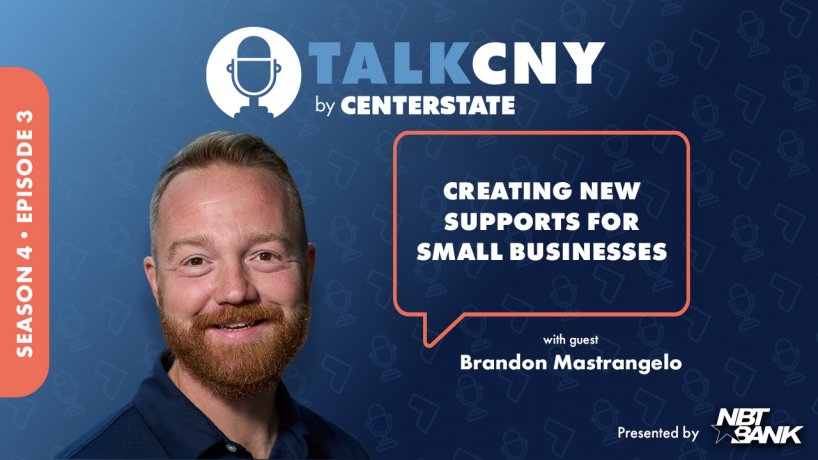
S4,E3 - Brandon MastrangeloPosted on February 11, 2026 |
Image
|
This is Talk CNY, a semi-monthly podcast by CenterState CEO. We're an independent nonprofit committed to creating inclusive, equitable, and sustainable economic growth in Central New York. Join us as we meet the people and explore the projects driving the regional economy forward. This is Talk CNY, presented by NBT Bank. I'm Katie Zilcosky, Director of Communications at CenterState CEO and your host for Talk CNY. Eighty-four percent of business leaders who responded to CenterState CEO's 2026 economic forecast report said that they see themselves as beneficiaries of the anticipated growth from Central New York's emerging technology sector, meaning most respondents see how projects like Micron, TTM, and the Tech Hub's designation will impact them. But we also know that small and mid-size businesses face a unique set of challenges that may keep them from capitalizing on this moment of opportunity. To ensure that all parts of our economy are able to benefit during this moment, CenterState CEO is finding new and intentional ways to help those businesses. On this episode of Talk CNY, presented by NBT Bank, we're joined by Senior Business Advisor Brandon Mastrangelo to talk about the resources that we're providing to the community.
Brandon, thank you so much for being here today.
Absolutely.
INSPYRE Innovation Hub has had its stores open in the community now for a few months. It's been very busy, kind of moving into a new building, relaunching programs there. But can you take a moment here to just reflect on it a little bit? What's it been like to be in a new space to operate programming out of there and to see new people and new faces in INSPYRE Innovation Hub?
Absolutely. Well, thank you, Katie. I appreciate the opportunity to chat with you this morning.
Yeah, it's always good.
Yeah. We opened our doors on October 1st. We moved in 35 companies. They're considered tenants of the building, which means they have private offices. So the first month was just getting them oriented to the space, to their offices, to how we open the doors and close the doors and all of that good stuff.
The app and everything.
That's right. Exactly. And just making sure that they felt comfortable, they had everything they need to do what they needed to do. And then to start to build rapport and a relationship with those 35 companies.
In November, around November 15th, we opened up to our other clients, which are coworking clients, so they have access to the general coworking area, booking conference rooms and things like that. Then it was about onboarding them. So similar information. How do you get access to the building? How do you book conference rooms? How do you book advising sessions if you're looking for a little bit of support? A lot of it has been learning the right ways to communicate with this group of individuals. We're using Slack. We're using email. We're using in-person, posting kind of analog, posting things around the building to make sure that everyone is aware of what's happening in the space and what they can tap into. But we're finding people get information in different ways. So we're having to communicate via multiple different channels to ensure that everyone's getting the message that we want them to get.
So it's been a lot of understanding that. Again, how are we going to collaborate, work together? It's been a lot of understanding how to build community within this space. I think that is something that everyone, meaning our clients, are really yearning for. And one of the things that they wanted, and I think one of the main reasons why they wanted to come into this ecosystem and into this beautiful building, is to be around a community of entrepreneurs. But what we are finding is that at times it can be challenging to kind of pull them out of their office and away from what feels like urgent matters in their day-to-day business to have these opportunities to connect with one another. We are finding that we have to be creative. We have to continuously kind of come up with ways that we can invite them to come together and just start to build rapport.
When it does happen. It's magical. I remember the very first day we opened, we had two companies where I got to introduce them in the hallway and within five minutes, they realized that they could do business with each other.
Within the next hour, they were signing agreements with each other and getting ready to do business. So those types of collisions are exactly what we're looking for and what we believe this space can be all about, but we are finding that it's going to be a little more, I don't want to say challenging, but it's going to take a more concerted effort for us to continue to, again, find ways to bring these groups of individuals together. It's been exciting to be in the building. The building is beautiful. It's inspiring.
Yeah.
For lack of a better term.
I'm racking my brain, what's a better word than the name of the building, but it truly is. And it creates excitement. So we have to continue to build off of that because the building in and of itself creates a bit of energy and momentum. And what we're finding is we're going to have to work hard to keep that momentum going.
You guys are managing it wonderfully, and I think it's off to a great start.
Thank you.
But I do think it's worth a reminder that INSPYRE is intentionally broader for the community. We are welcoming new types of businesses in, new in reference to the former iteration of INSPYRE, the Tech Garden, which was tech-startup focused. INSPYRE is looking to invite all members of the community in. And I think that in the rush of doing all those other things, sometimes we forget to tell everyone like, "Hey, you are all welcome here." So I kind of want to just start the building blocks from the bottom and just start with who can come into INSPYRE? Do you have to already have a business? Do you need to have a business idea? Who are you welcoming into the space? Who can you help?
Absolutely. Thank you. There are two things that were extremely important when we embarked on the renovation of what was The Tech Garden. One was that we were going to be a place that represented the diversity within our community. We really wanted to make sure that this building and our programs and our services were inviting to all. So we are working hard to communicate and educate our community that no matter your race, ethnicity, the color of your skin, your gender, your socioeconomic status, there is opportunity for you here at INSPYRE. We do a monthly open house, the last Thursday of every month, and I start every talk with that message. That everyone is welcome here. If for any reason we can't provide the direct service that you need to move or to take the next step, to move forward or take the next step, we have a resource partner that we can connect you to.
So that is extremely important. The building was designed in a way. The way that the entrance is facing down South Salina was intentional to say our doors are open to this community. So far, we're seeing great success. We've brought together what was historically our small business services, which worked with a lot of underserved individuals and disadvantaged communities, people of color, and we were providing support to those individuals, but we weren't doing it within this building or this ecosystem all in one place. And now we are saying, "You are welcome here. We want to work and serve you here." And it's been amazing. It's like the folks that have come in, when we show them the building, and we say, "You have access to this, " the look on their face is just like, "Oh, I can come here. I can be here." And it's really phenomenal to see.
We just want, again, this building, when you're in the building, for it to feel like you are in the city of Syracuse, which again is a diverse community.
We're working really hard to change the perception of who belongs there, and there's work to be done, and that's going to take a lot of storytelling on our part, a lot of humanizing the work that we do, more profile pieces about who we are serving, and how we're helping those individuals. So it's an exciting new chapter. There is an intentionality and I, for one, am excited and one of the reasons why I wanted to join this team and work to make that change, but there's going to be an ongoing effort to make sure that people in the community understand what they have access to, how they can participate. So that's one thing that was extremely important in the renovation of the building. The second was we wanted to be a place where someone could come no matter where they are in their entrepreneurial journey.
So again, historically, The Tech Garden fit in what we would call the validation stage of a business. I have an early product or service, I have a minimum viable product. It's out in the marketplace. I have maybe one or two early customers, and maybe I have a pilot program going on, and I'm starting to sense that there's a there there. I'm like, "Okay, there's product market fit. I think there's something that I can scale now." It was all about, okay, how do we now take that next step and operationalize this business in a way that you can take on these other opportunities and scale the business?
Yep.
We still serve those businesses, but now we also have created programs and services to fit in four entrepreneurial stages that we felt like kind of captured the entire entrepreneurial journey. The first stage is ideation. I have an idea, but I don't know what to do next.
We have a program called Start It. It's a 10 week business basics program. You walk away with a really solid business plan. The next stage is formation. I have a good business plan. I feel confident in taking a risk and pursuing this business or maybe it's been a side hustle for three or four years, but now I have the confidence to say, "I'm going to go at this full-time." In this formation stage, we have, again, a program called the Upstart Accelerator, and we have services, our resource pool that can connect our clients to service providers in the community, where we help them set up their bail team, which stands for their banking relationship, accounting relationship, insurance, and legal. So it's really about, do you have everything in place to really operate this business, right? It's legit. You've got all the right paperwork, everything's on the up and up, right?
Right. And then we have the validation, which we've talked about, and then the fourth stage is growth. And this is an opportunity to, I think, continue to support businesses that have historically kind of fell into our CEO membership. So these are more established firms in the region. These are businesses that have probably been around 10, 15, 20 plus years. They're probably, they're doing okay, but they may be experiencing some stagnation, maybe revenue is growing very small year over year, a couple percent. You're starting to sense that the customer needs are changing, the market that you operate in is evolving and changing, and you're kind of thinking, what's next for us to maintain our relevancy and what is going to keep us around for the next 20 years? And so we have designed programming and services to help those types of companies kind of think about what is the next iteration of my business that is going to, again, keep me around for hopefully decades more to come.
A big component of that is this fractional C-suite program that we're designing to provide executive-level expertise and knowledge to these companies at a very affordable price point and at a time commitment that makes sense for them.
Most of these companies at this point still don't necessarily need a full-time chief financial officer or a full-time chief revenue officer, whatever it may be, but they could benefit from working with individuals that have that knowledge and experience at certain points throughout the year. So at the beginning of the year, maybe I want to work with the CFO to do some strategic financial forecasting and planning, deciding whether I should make some investments, whether that's investments in people, investments in equipment, investments in real estate, but you have to play those scenarios out. Financially, how does that impact the business? If I buy this piece of equipment, how does that impact my bottom line? What opportunities does that create?
So being able to work with someone at the beginning part of the year to kind of do that strategic planning could be extremely valuable for someone. But then you can say, "Okay, I'm good the rest of the year. I don't need that right now." So again, just to kind of summarize what we discussed here is, there are two key things that were important in the renovation. One, that we are a place where everyone in our community feels welcome, seen, and feels safe. Two, that we can support entrepreneurs no matter where they are in their journey.
Yeah. I think what we've been calling it, that's clientship, is that we, of course, have our set programming, like you mentioned, Upstart, Start it. We have the Cleantech Accelerator, we have GENIUS New York, of course, but this is an opportunity for people in the community who have an entrepreneurial idea or who have been in business for a bit here now and are in that stagnation stage, like you were saying, they can become a client and for a very affordable price, come in and receive all these services, access to the building. I mean, can you talk a little bit more about clientship, what it means to be a client and why that felt like such an important part of INSPYRE?
Absolutely. So it's important to know that we made a transition over the last year and a half to adopt the term client and that was intentional and the reason we did that was we already have members of CenterState, and we wanted to find a way to, in terminology to differentiate who we're engaging with at the INSPYRE Innovation Hub by CenterState and who our member team is working within the community. And so yes, we have our CEO membership, but then we have clientship at INSPYRE. There are three tiers, client tiers that someone can fall into to gain services and access the building. The first is called Propel. It's $150 a month. It's really a coworking play. You can come into the building Monday through Friday, nine to five, use the coworking space. You can book the conference rooms if you need private meetings. You can use the makerspace. You can use the production room. You can tap into our Perks program. We have partnered with an organization called Global Venture Network to open up, I think, over 150 perks.
Wow.
These are things like get 75% off of HubSpot in the first year, get $20,000 in merchant fees discounted on Stripe. There's everything from like CRM tools to financial tools like Gusto and Xero, and to more operational-type software to CAD software like SolidWorks.
There's a huge perks list that our clients can tap into that I think is really valuable. And we just launched this in November, and I think there are only maybe six or seven clients that have activated perks to date, but those six or seven clients have received over $350,000 in value from those perks that they activated. So we're excited to kind of keep pushing that and getting more and more people to participate in that program. So again, at the Propel level, it's $150 a month. Again, you can come in, use the facility, really the building amenities. We have two break rooms. One on the first floor. One on the second floor. We have eight conference rooms that people can book. Again, maker space production room, the coworking area, et cetera. The next client tier is called Accelerate. It's $350 a month. You get all the building amenities that I just described, but you get access to the building 24/7. You can come and go as you need throughout the days and the weeks and months. In addition to all the building amenities and the perks program that I mentioned, at the Accelerate Tier, you can also tap into some more of our direct client services.
And those are things like you can meet with a business advisor.
Like yourself.
Exactly, like me, in which we focus on helping clients map out their 12-month business goals and objectives. We have a format and a template that we use to walk people through this process. So again, at the Accelerate Tier, you can tap into business advisement. You can meet with our investment manager. He can review your pitch deck. He can look at your data room, which is where you store all of your documents that you would send to an investor. He can help make some connections to local investors. So you have access to those direct client services as well. And then the third and final tier is called growth. We haven't launched this one publicly yet. We are getting ready to shortly. This is for those more established companies in the region. This is not necessarily about a space play. These companies probably have offices already, but maybe they could use some overflow space or maybe their staff or team would love just to kind of work out of a new environment every once in a while to meet some more people, have these collisions, create opportunities.
But this is really going to be more about the direct client services. So again, working with a business advisor, investment manager, doing more comprehensive strategic planning, getting really clear with how, as a leader, how they communicate to their team and how communication needs to change as the business evolves and grows. What worked when you were a 20-person company may not work when you're a 150-person company. And so as leaders, we have to change and evolve the way in which we lead and communicate. And so having conversations around that, what does that look like for you? What are the stumbling blocks? Where does it make you uncomfortable? What are new frameworks that you can use to try and get across the vision and the goals and objectives for the company? And that Growth Tier is $1,000 a month, so you can do that. And then again, a huge component of that is what I mentioned earlier, which is the fractional program.
And so you get four hours of fractional support every month under this tier.
Wow.
Yeah.
So we're going to have a lot more with Brandon coming up in just a moment here, but we're going to take a quick pause for a word from our presenting sponsor, NBT Bank.
I would recommend NBT Bank to any business. My name is Chris Polimino, and I'm the president of Atlas Fence. Chris had decided to purchase Atlas Fence from the previous owner. He had previous connections at NBT Bank. NBT Bank provided me equipment financing, doubling our entire production workforce. It's important to me as a business owner that the decisions of our banking relationship are made locally.
Welcome back. This is Talk CNY, presented by NBT Bank. I'm Katie Zilcosky, Director of Communications at CenterState CEO and your host for Talk CNY. I'm joined today by CenterState's Senior Business Advisor, Brandon Mastrangelo. Thank you for being here.
Thank you for having me.
We talked a lot about the services that INSPYRE and CenterState offer to this small, mid-size, larger business community, but I'm wondering, like big picture, what would you say is the INSPYRE approach? How do you guys see yourselves fitting into the small-business provider ecosystem and helping businesses in a unique way?
Yeah, thank you for that question. I think a lot of people are familiar with how we run programs. There's a lot of, maybe not a lot, but there's more awareness around, again, the accelerator programs that we run and how those operate. I think what's one thing that we do that's very unique that isn't talked about enough, but is also fairly new is how we do one-on-one advising consultation on an ongoing basis with clients. And it's a very customized approach. So the way that it would work is someone applies to be a client, they decide, yes, this is what I want to do. They're accepted in. One of the first things that they will do is sit down with one of our business advisors. This is for us to better understand, what are your goals and aspirations for this business? What do you want this business to do for you both personally and professionally?
What do you believe are some of the limitations or challenges that you may experience in trying to move this business forward? Whatever that next step is? Then we, again, put together a customized plan for the year on the work that they would do to achieve the end result that they want. We get really clear on, here are the things that we're focused on. I think that's really important. Many entrepreneurs that I come across, a lot of the strategy, especially early on, it's kind of living in your head. It's very reactive. Where's this opportunity? Oh, this came up. Let me explore that. Oh, now I have this new opportunity. And we're just looking. We're kind of grasping for where are things really kind of jelling and clicking and making sense. And that needs to happen, right? Because when you start a business, you have a hypothesis, right?
But you have to test that out. You think you understand what a client is looking for, what a customer may need, but once you get into it and you have more interactions with those clients or customers, you start to understand like, "Oh, okay, we kind of were hitting the mark here, but we were missing it here." So, there's a lot of adjusting, assessing and adjusting, right? What I think we do is really help people get clear on - this is where we should focus our time and energy.
Then part of our process is to meet with our clients on a monthly basis. And this becomes kind of an accountability check-in, right? "Hey, let's touch base. Okay, you said you were going to do these two, three things from last month to this month. How are we doing? ""Oh, I didn't get that done. Why not? What happened?" We have a conversation, but just having that accountability is really important for people because they show up, they know someone's going to be asking. And without anyone asking.
Clients respond to this. Yeah.
Yeah. Well, and in general, a lot of, when we go into business, it's like, "Oh, I'm my own boss. I don't have anyone checking in on me. " And so there's this kind of blissfulness to some degree, probably around I can just kind of pivot and move as opportunities arise and when I see things or feel things, and that's all well and good. But at some point when you're starting to grow the business, and you have other people involved, employees, having a real clear strategic direction is extremely important because otherwise people are struggling to understand, like, "Wait, we were doing this, and now we're going over here, and why are we going over here?" So it can feel a little disjointed. So I think we are able to really help people create a clear plan for the year, work towards it.
We set milestones. So, like at certain points after three months, four months, we may say, "Hey, if we haven't at least achieved this milestone related to this goal, let's reassess the goal. Maybe it needs to change." And this whole process is iterative. So we're not saying that, "Hey, when we create this plan on September one that we're just going to run it for 12 months," It's always going to be looking at what's working and what's not working and making modifications. So the goal is to teach business owners the importance of doing this planning, to set time aside, to work on the business, not in the business.
That it's okay when things don't go according to plan. The key thing is to then just reassess, what do I need to change? Okay, I wasn't expecting this to happen. I lost a big customer that I wasn't planning on losing. That's affecting my revenue projections. So my goals are going to be off now, and we just need to recalibrate. Having someone like a business advisor at INSPYRE that you can come to and say, "Hey, I wasn't expecting this, but I lost a key employee, or I lost a big customer or contract that I wasn't anticipating losing." You have someone to kind of say, "Okay, well, how do we recalibrate and kind of get another plan of action moving forward?" I think that is something that's unique that we offer, and I think it's extremely valuable because otherwise this work becomes really isolating and lonely.
We're trying to come up with these strategies by ourselves. A lot of entrepreneurs are operating under the mindset that other people are looking for me to find all the answers and kind of move this thing forward. I think it's a real great opportunity for entrepreneurs to collaborate with our advisors, create a solid plan of action for the year, understand how to adjust when it needs to be adjusted.
Yeah. I mean, ultimately, it's a support.
It's something that when you're starting your own business, you don't have to do it entirely alone. You can still lead, but not be the only person thinking about it. And I think that for a lot of businesses, this moment of great momentum in our region is definitely something that brings up a lot of questions for them of reflecting on how do I make the most of this opportunity? Will I be given opportunity in this moment? I'm not a technology company. There's a lot of questions probably that small, mid-size existing businesses are facing right now as we change and grow as a community. So I'm wondering what your advice to them would be. What would you say to a small business who comes to you that says, "What do I do in this moment?"
Yeah. I think one thing that CenterState is doing and will continue to do is to help people become aware of what the opportunities are. So there's an awareness piece that we have to help educate the community on. And then there is a capabilities conversation. So now I'm aware that there's an opportunity to maybe feed into the Micron supply chain, but I have to assess my capabilities to participate in that. Do I have the equipment? Do I have the people? Do I have ... Whatever it may be. Can I participate? If not, what needs to change so that I can go after these opportunities?
So it's helping them have a conversation around their capabilities and bandwidth. I think all of that is just entrepreneurs having a willingness to continue to come in and ask the questions. I think that's a big piece of it is oftentimes it's hard to slow down and say, "Where do I get this information? How do I know these opportunities?" And it's not just on them, it is on the rest of our community to make sure that we are putting this information out there in an accessible way. But I'm hoping that INSPYRE and CenterState can continue to be a conduit for that type of information to share what opportunities exist. I think just being part of our ecosystem, being connected, being on our newsletters, being in our Slack communities, and following our social channels and just being tapped into the organizations and the people that do understand what opportunities are emerging so that they can then receive that information too.
That's a big piece of it is just being tapped in to understand and be aware of what opportunities exist. And then I think working with our team in the way that I just prescribed to understand the capabilities that you have that either fit into this opportunity or what capabilities may need to change for you to be able to participate in these opportunities.
So it sounds like INSPYRE Innovation Hub is a great place to start.
That's right.
That's right.
Well, thank you, Brandon, so much for your time today. It's always great to talk to you.
Thank you, Katie. Appreciate it.
CenterState CEO's podcast, Talk CNY, presented by NBT Bank, is available on all major podcast platforms or centerstateceo.com. Additional content and clips can be seen across CenterState CEO's social media channels. For new episode reminders, be sure to subscribe in your favorite podcast listening app, and don't forget to leave a quick review or a five-star rating. Thanks for listening to Talk CNY, presented by NBT Bank.
Other
Talk CNY Main Series Transcripts
| S4,E19 - Rob Simpson | October 7, 2026 | |
| S4,E18 - Craig Marcinkowski | September 23, 2026 | |
| S4,E17 - Nora Spillane, Craig Witmer | September 9, 2026 | |
| S4,E16 - Joan Royle, Emilija Postolovska | August 26, 2026 | |
| S4,E15 - Dave Kavney | August 12, 2026 | |
| S4,E14 - Carrie Large | July 29, 2026 | |
| S4,E13 - Corporate Leadership Team | July 15, 2026 | |
| S4,E12 - Dr. Carlene Lacey | June 24, 2026 | |
| S4,E11 - Jared Shepard and Jess Abbott | June 10, 2026 | |
| S4,E10 - Sara Nozkova | May 20, 2026 | |
| S4,E9 - Kara Jones and Brad Banikowski | May 6, 2026 | |
| S4,E8 - Joe Nehme | April 22, 2026 | |
| S4,E7 - Rob Simpson, Ben Sio | April 8, 2026 | |
| S4,E6 - Lindsay Mastrogiovanni, Kathleen Avery Connell, Jim Connell | March 25, 2026 | |
| S4,E5 - Jess Abbott & Honora Spillane | March 10, 2026 | |
| S4,E4 - Sara Broadwell | February 25, 2026 | |
| S4,E2 - Ryan McMahon and Rob Simpson | January 28, 2026 | |
| S4,E1 - Rob Simpson | January 14, 2026 | |
| S3,E24 - Sharon Owens, Ben Walsh, Rob Simpson | December 17, 2025 | |
| S3,E23 - Tanika Jones | December 3, 2025 |