

Leadership Lessons S4E5 - Bryan BlairPosted on August 19, 2026 |
Image
|
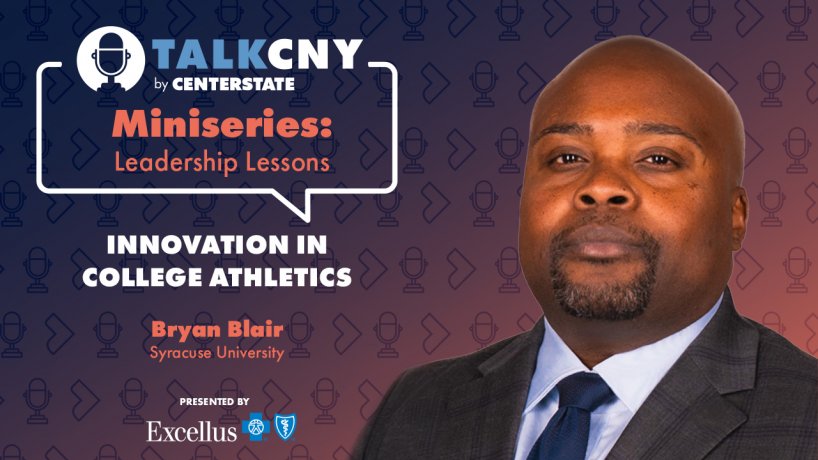
Welcome to the Talk CNY miniseries, Leadership Lessons, presented by Excellus BlueCross BlueShield. We are recording in the production studio at CenterState CEOs INSPYRE Innovation Hub. Today's guest is Bryan Blair, Syracuse University's new athletics director. He is widely regarded as one of the most creative and accomplished leaders in college athletics. Welcome, Bryan. Thank you so much for joining us today.
Thanks for having me. I'm excited to be here.
We are really excited. Bryan, you have built a reputation for finding new and creative ways to grow revenue, to grow programs, as well as create experiences for students to connect to their surrounding communities. When you are pursuing new ideas or new initiatives, how are you able to see boundless opportunity, whereas others may see challenges or roadblocks?
Yeah, and I appreciate you saying those nice things. I really think it starts with surrounding myself with really good people. If there's something I have a knack for, it's identifying and surrounding myself with really good people and keeping them close. Whether that be coworkers or individuals I get to hire, or it may just be mentors out in the field that can make sure I'm at my best and give me a dose of reality when I need it. So to me, it always starts with the people, getting the right people around you. And make sure those are people that can be honest with you too. I think that's sometimes hard to find in leadership positions. I think relative to perspective, I don't know. I guess I've just had such varied experiences. I mean, from where I grew up in the small town to the journey I've been on and where I've become, I've had a chance to see the highs, the lows, and everything in between of almost every situation.
So I think when you walk into a new environment, you can pull on all those experiences kind of like a recipe. I mean, you got a little bit of this, a little bit of that, and it paints the full picture. I think even coming into Syracuse now, I see the little pieces of Toledo. I see little pieces of South Carolina or my time in Texas or Washington State out in the Pac-12. I pull on those experiences to kind of craft and shape what I think is possible. But the great thing is I've been through a lot of adversity both in life and in career. And I think when you've gone through that adversity and come out on the other side, nothing seems impossible anymore. And I think that perspective that I walk into every day in life is based on that idea that I've gone through a lot and done a lot of really cool things together as groups.
So there's nothing that we can't do going forward.
I love that you're able to draw from your strengths and your past experiences to really propel you forward. That's beautiful.
No, I think you either have wins or you have lessons. And so I try to approach it from that standpoint of, hey, if this didn't go right or this didn't play out the way I thought it would, what do we gather from that situation? How do we make it better going forward? Early on in my career, I developed, when I first got my first iPhone, and they had the notes app. And so I started on that notes app. I have an athletic department lessons tab. It's got to be like 50 pages long now as I scroll from start to finish. But it was all the things I noticed from the early moments of my career till now of things I thought were just universal truths or lessons I needed to learn. Every once in a while, if I'm on an airplane that didn't have wifi or if I'm bored, I'll go through that list and think about, okay, here's what 24-year-old Bryan was thinking or seeing about the world of college athletics. Here's what he's seeing now. A lot of changes in the environment, but there's a lot that's remained the same.
I love that. That's a great tip.
I appreciate that.
So as you're trying to develop new ideas, how do you determine which ones are best to pursue?
Yeah. I mean, I think it starts by, okay, what is your mission and your purpose? I think you have to start there. Why do you exist? What is the purpose of your organization? What are you trying to accomplish? Do you serve a broader mission or purpose? In my case, I'm in an athletic department. The athletic department is never the most important thing at a university. Is it the brightest light? Is it the sexiest topic? Is it things that people love to talk about? Absolutely. Does it bring people together unlike anything else? Absolutely. But at the end of the day, we're there to serve a broader university mission in terms of educating young people or serving the broader community of the state or whatever have you. So in my mind, we've always got to connect what we're trying to do to that broader mission as a starting point.
And so you start asking the question in the case of Syracuse Athletics, what does Syracuse Athletics being great mean for you? So I'd ask that question to you and then you'd say, "Hey, these things help us in our mission. And here's where we see those collisions happen." Because those collisions represent opportunities for teamwork. And I think the opportunity to go further together only happens when you've got not only a shared vision and mission of what you're trying to do, but a plan that intersects what you're trying to do, what I'm trying to do, and how it makes it a mutual win for both of us. And so I think you can certainly pick and choose things to do on your own and run off solo, but you'll never go as far as you can together. And so I think teamwork is a superpower. And so many times I had an old basketball coach, not old basketball coach, a basketball coach in my previous institution, Toledo, Ginny Boggess.
She would always say, "Out-team the other team." And that resonated with me so well because yeah, we can try to do a lot of innovative things. We can think outside of the box, all these different pieces of the puzzle, but the ultimate superpower is always going to be teamwork. And if you get the massive amount of people pulling in the same direction, unlike anything ever before, you can do something that's never been done before.
I love that. The CEO at CenterState CEO, Rob Simpson, always talks about how we're so much stronger when we work together. And that's really one of the secret sauces of Central New York: is people really being able to come together at the table and work together. So I love that you said teamwork.
Well, I mean, teamwork is oftentimes it's like the easiest thing to say. It's a simple phrase, and we've heard about it our entire life. But when you really boil it down to everybody's got to put a little bit of stake in the game to get to this ultimate goal, that means all of us have to have a little bit of shared sacrifice along the way. Sacrifice our own little individual goals for the greater collective, that's really, really hard to do. And you've got to inspire people. You got to be consistent. You got to show and prove. You got to motivate. You got to do all those things. And Rob and CenterState, I think are perfect examples of what it means to be better together.
I love that. So as we keep talking about the teamwork, the Syracuse University Athletics Department, or even other athletics departments that you've led, can you talk about turning a mighty ship to implement change? That takes a lot of vision, that takes a lot of courage, that takes a lot of working together. So can you describe for me what your approach is to leading change?
Different and change is scary, right? Because it's the unknown oftentimes. I think you've got to paint a clear vision of what that looks and feels like, again, for each individual on that journey and then what role they play on that journey and why that journey is worth it on the other side to get to where we're trying to get to. I think in my current capacity, I'm in the first seven, eight weeks of this journey. And I'm working on, one, starting with the people and listening and learning first. You have to listen and then learn before you can actually lead. And I think sometimes we try to skip steps and jump out and do initiatives or, Hey, I know where we need to go. Let's just go do it. That's not really leadership. The lead, you got to be a good follower. I heard this last night from one of our individuals with our football program.
And I think for me, it's so often spending time with the key individuals around it, understanding who they are, what they're about, what they're trying to do. And then I'm trying to understand the organization. And again, find those intersections. So earlier today I spent time with our law school dean and you'd be like, well, why is the AD of a Division I program spending time with the law school dean? That doesn't make sense on the surface. Well, those deans at our institution are oftentimes the most valuable individuals on our campus because they dictate that student experience on a day-to-day basis. And the university does not exist without the students. So by virtue of that, those deans are critically important. And certainly we talked about our law program and the like, and I met with our men's rowing coach, and we talked about our men's rowing program, and I saw his facilities.
But more than anything, I get a greater sense of who Syracuse is from all these varied perspectives. And I'll probably have 200 to 250 of these type of interactions or meetings over the next month or so. And by this end point, I should gather a lot of data on what makes this place special and really what are our strengths, our weaknesses, our opportunities, and also what are those threats to our future that we need to build upon so then we can start building together a plan.
I know a great plan is on the way. Yes.
Yes, indeed.
So how has your background as a former division one athlete really informed you and helped you as you've led athletics departments?
Yeah. I mean, I think what I learned about sports in college, kind of walked into it just saying, "Hey, I love football. I want to keep playing." That's where I arrived. What I figured out, though, really quickly is that experience changed my life forever. And I think sports at any level does this, but I think when you get to a level of college, you walk out, you're all-state, all-region, all whatever out of high school. And then you show up for that first day of practice, and you probably get your head knocked in a little bit where you have to realize, oh, I'm no longer the king of the hill. I'm starting back at the bottom. And for many of us, if you were talented grumming up, you were never really at the bottom of the hill. You were always kind of a little bit better than some others.
And then you get to college and like, oh, this feels and looks different. And I've got a decision to make. I can go right or left. I can continue to fight and say, "Hey, I'm going to get back to the top of the hill." Or I can say, "Hey, this is too hard. I need to try something else." And everybody makes that decision, not only in college football, but life. And then we run in those. So it changed my life in terms of hitting that adversity early on, figuring out I had way more in the tank than I thought was possible and having to pick myself up. And I was somebody that came into college football, first game of the season, wasn't expected to play, got thrown into the fire and didn't perform really well. Kind of bought my time the next couple of years, earned a starting position over a spring, was rolling, thought the world was mine.
I was high on my horse. I got knocked down. I got humbled really quickly. And then I had to make a decision for that senior year. Do I want to go back out and try to be a starter, want to be a leader on this team, want to do something special? Or am I just willing to cash it in and just say, "Hey, I got a chance to say I played college football, just fold." I reflect on those journeys, that locker room, those lessons day to day because there's nothing that I do on a day-to-day basis that's as physically or emotionally taxing as what that four-year experience was. So if I have to walk into a hard meeting or have a hard conversation or try to fight through adversity here on the job, it pales in comparison to what I did those four years as a college football player. That mentality, I think, feeds a certain amount of positivity, but it also feeds a can-do attitude of, "I can conquer anything."
Those are great learning lessons from your experience. Thank you for sharing. I know you mentioned that you are in the process of currently speaking with a number of key stakeholders across the university. Please feel free to share as much or as little as you prefer to. But in terms of your vision for SU's college athletics, what is your current vision?
Yeah. I came here because this is one of the most storied brands in all college athletics. It is the only Power Four program in the great state of New York. We've got great proximity to not only ;an amazing community in Central New York, but also if you look four hours to our east, you got the nation's media and business capital in New York City. So you've got all these different attributes that are around. And then we've got a history and tradition of having been to the mountaintop before. And certainly we want to get back to that, but we've got that muscle memory. So as I think about my vision for Syracuse Athletics, I want us to be a Top 10 athletic program in the entire country, a top 10 brand. I would argue our brand is already flirting with Top 10 and never faltered. Certainly, we've got to make sure we get back in a hurry to make sure that persists.
But being a top 10 brand, certainly in your revenue-driven sports, you want to be successful. But also holistically, we want to generate an amazing student-athlete experience across all 20 of our sports that serves our greater campus in a major, major way. So what does that mean, or what does that feel like? I think one, we want to get back to national relevance, particularly in men's football and men's basketball. It's been a while since we've been there on the basketball side. Five years since we've made the tournament, if we're being honest, we've got to get that back. That is synonymous with Syracuse Athletics. And then Fran had an amazing year two years ago, top 25, 10 wins, people felt how good that felt. Obviously, last year had some injuries that knocked us down. I'm confident we're going to get back to where we need to get on that front.
We want to use the Dome, frankly, as a weapon. I've used that phrase, weaponize the dome, in multiple ways. I want to generate a fan experience, unlike anything you can get in the entire country. This should be the loudest venue in America. The loudest venue in America. We control every facet of your experience in the dome from the time you walk in, what you see, what you smell, what you feel, we control. I'm not depending on Mother Nature for anything relative to once you walk into those doors to the dome. And so how do I create and manufacture an experience where you say, "Hey, I could watch this game on the couch in February when it's snowy and cold, but I don't want to miss what's happening in the dome. I want to be a part of that action." I think that's one piece of it. I think for our student piece, certainly institutional higher education, we're trying to enroll and retain more students than ever before.
Well, that experience in the dome should be a cornerstone of your student experience. You get a great degree from one of our storied programs. You have a great social life and enjoy all that Century New York offers. And oh, by the way, you have amazing life-changing experiences in the Dome and say, "I was in the Dome when X happened. I was in the Dome when we beat Tennessee and stormed the court. I was in the Dome when Jerry McNamara had his final game and all of Scranton bust up." I want to be and build those types of experiences for our students. And then thirdly, we need the dome to be a competitive advantage, unlike anything in college athletics. We talk about being loud, but how can our fans be active to make this the hardest place to play in the entire country? I want to be an opponent's head as we think about, you see Denver Broncos, they put signs about the elevation everywhere around the stadium because they want to remind anybody of that team when the dolphins come in, "Hey, it's too high for you. You won't be able to breathe." They get in your head psychology, right? We need to do that same thing from a decibel standpoint. How do we remind people this is the loudest place in college athletics, and this is going to be unbearable to want to come play and be a part of? And you never want to come to Central New York to play in the dome. That's the kind of atmosphere we want to create on that front. Third, we want to lean into our academic advantage. We have amazing programs at Syracuse, top to bottom across the bow, but you started to highlight a couple. You look at Falk College of Sport. The only program of its kind in the country. The ability to tap into those students, those professors, that expertise that's literally right down the hill is an amazing attribute that frankly builds a competitive advantage that many of our other counterparts can't come close to replicating.
Other schools in the ACC can't just overnight stand up a Falk College of Sport. So we've got this unique competitive advantage. How do we lean into that? From a communication standpoint, we've got the best communication school in the entire country in Newhouse. How do we lean into that? And you go down the list, you got Maxwell, you got Whitman, you got all these. I mean, go down the list. How do we lean into those students to make them a part of our journey, but also allow us to navigate this modern college athletics, maybe in a way that others can't keep up with, because we can scale via our students in a different way than anybody else in the country. And so we're going to be really intentional about that piece. And so certainly we want to weaponize the dome. We've got to get football and basketball back to national relevance.
We want to lean into our academic advantage. And then lastly, we've got to modernize our operations. In the simplest terms, we've got to make more money than ever and spend more than ever, but we've got to spend it more efficiently than ever before. You need to know how to operate and run a P&L, and know what that looks like and what you spend needs to have a clear ROI. So we're going to lean in to that front. We've been able to recruit some really talented staff members. I think they're going to help us on that resource allocation front. One, from what we do throughout the department, how we spend on facilities with the hope of generating more revenue, particularly around philanthropy and corporate support to be able to do what we're trying to do. And so if we could knock out those four prongs, I think we're going to be really proud and certainly better than a Top 10 program nationally.
Well,
I see your vision. I'm excited for you. I am really excited for you. I will be in the dome cheering. I'm very excited.
I love that. Well, it's one of those things that's going to be a process. We're going to listen and learn. We're going to lay out a strategic plan and be really clear about what we're trying to do. We're going to invite a lot of people onto that journey, CenterState included, on how we come together and build this strategy together. And then how do we execute it again as a team? So you're going to hear and see a lot from us over the next year on what that plan looks like, what role people can play in that plan. Because Syracuse Athletics being great is not only good for the department or good for the coaches or even the university. I think it's good for all of Central New York. I think people walk a little taller and puff their chest out a little bit bigger.
Syracuse Athletics is rolling. And so this matters in a great way. And we can pull the economic impact reports and the like, but I would lean back to what did it feel like when Jim Boeheim led us to a national championship? Or even more recently, what did it feel like when Fran won 10 games? And what will it feel like when Jerry McNamara has us in the tournament, and we're knocking off opponents and advancing to the round of Sweet 16? Those things, that muscle memory is still here in Central New York. That brand is still strong, but it's going to take all of us to move that needle and take us to that next level where we all want to be.
We'll be there.
I love it.
We will be there. All right, so our next round is our Rapid Fire question section. So what I'll do is I'll ask you a series of questions. The goal is for you to answer it within 30 seconds, and then we'll move on to the next question. Okay. All right. So the first question is, what personal values guide you as a leader?
Yeah. Family, passion, integrity, curiosity, servanthood. Those are the values I live by. Family, number one, most important passion. Go full speed at everything I do. Integrity, never going to embarrass my kids, curiosity, growth mindset. And then lastly, servanthood. I live to serve others.
Beautiful. Well said. I appreciate
That.
Well said. When challenges arise, what is your problem-solving process?
Yeah, I think approach it with a positive mindset first of what's the good in this situation? How do we learn from it? Who needs to be involved in the conversation? We got Felicia Legette-Jack in our office, one of the most positive human beings I've ever been around. I seek her energy out because it makes me happier and a better person. I seek those people out. So we encounter a problem where we just get to work and build a plan. But the plan has to start with who needs to be in the room and who are the right problem solvers, the mentality around you to get to the other side.
I love it. Coach Jack is awesome too.
Coach Jack is awesome. Yeah.
What strategies do you use to prevent burnout and maintain high morale?
Yeah. I mean, I think the high morale one is we've got to make sure we love each other. And I think sometimes leaders say that, and it feels a little hokey, but I oftentimes end my all staff meetings with, "Hey, go out and love each other" because I mean it. All of us bringing a version of ourselves to work that's not the full version, no matter where you are. You may have gotten a flat tire, you may have gotten into an argument with your spouse, your kids may be getting on your nerves. You bring a portion of yourself, but you also bring that other weight with you to work. We want to be in a situation where we are empathetic to each other, but we also love each other and care for each other as human beings. I think that's first and foremost. And then certainly I love barbecuing, growing up to South Carolina, living in Texas.
I got a big smoker up on the way as the moving trucks load up.
What strengths do you rely on most as a leader?
People around me. I'm nothing without the people around me. It starts with my wife and being a sounding board, a truth teller for certain, she will keep me humble at all times. I want positive can-do people that want to do something greater than themselves. It's always got to be more about the we than the me. If you got those people around you, you can be successful at anything in life. If you got people that all they do is take, take, take or talk about what's not, or all they're focused on is their personal journey. You can't be successful because you can never get the teamwork. If you can never get the teamwork, you can never be the fullest version of whatever that organization is trying to do. And so I think my superpower, my strength, or what I rely on the most is the people around me.
Well said. All right. Now as we prepare to close, one of my final questions for you is what advice would you give to someone who wants to ensure that when they see challenges, they're able to look at them as opportunities?
Yeah. Start with reflecting on how much you've already gone through in life. I think so often we look at challenges. I don't know if I can do that, or do I want to do that? Do I want to encounter that? All of us have been through adversity throughout life, no matter who you are. We've all had adverse situations, and we've all come out on the other side of those things, either with a win or a lesson to learn from it. That should give you the courage, no matter what you're facing, to get to the other side of it. But you also know you're never in it alone. You're never in it alone. So lean on those people outside of it. If you're a person of faith, certainly lean on the man above. But use those people, those resources around you to get to the other side of that hard situation.
Wonderful. Well said through and through. Thank you so much, Bryan, for joining us today.
No, thank you for having me.
If you'd like to catch more in-depth responses from Bryan, they'll be available across CenterState CEO's social media channels. Thank you for listening to Talk CNY, the miniseries presented by Excellus BlueCross BlueShield. CenterState's podcast Talk CNY is recorded in the production studio at CenterState's INSPYRE Innovation Hub. Have a great day, everyone.
It's why I love my job. It's literally the best benefit that Excellus has to offer where you can actually sit and talk to someone face to face. I've been studying this for two weeks now. I solved my problem in 10 minutes. I try to make it as simple as possible. I look at each member as if they were my family and I would want someone to take the necessary steps to reassure them and not take up too much of their time. Come see us if you have a problem and we will help you. And if we don't have the answer, we'll find the answer together.