

Leadership Lessons S4E6 - Marie MorelliPosted on September 20, 2026 |
Image
|
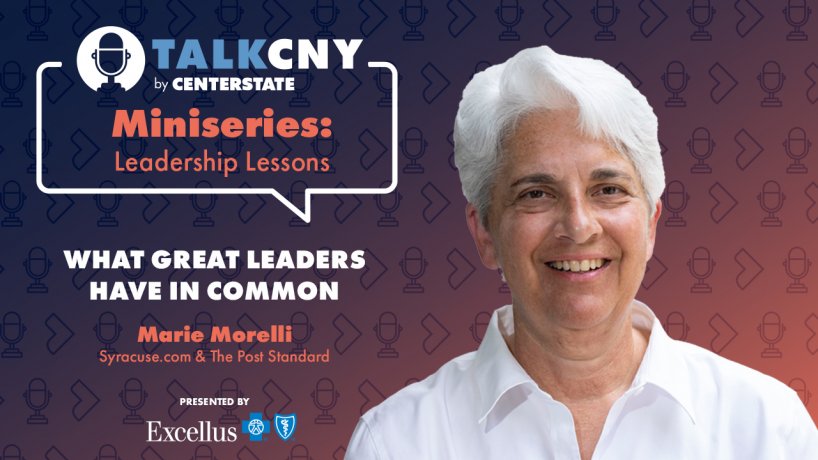
Welcome to the Talk CNY Miniseries: Leadership Lessons presented by Excellus BlueCross BlueShield. Center State CEO's podcast is being recorded in the production studio at CenterState's INSPYRE Innovation Hub. Today's guest is Marie Morelli, an award-winning journalist who currently serves as the editorial opinion lead for syracuse.com and The Post Standard. In addition to her editorial responsibilities, Marie writes a weekly column called Conversations in Leadership. Welcome, Marie.
Thanks, Brittni. I'm glad to be here.
We are so happy to have you with us today. So let's dive right in. Throughout your career, you have interviewed countless leaders. When you talk to them about their current roles and responsibilities, what daily habits or disciplines do they practice to help them really perform consistently at a high level?
Well, they all seem to be able to deal with the day-to-day things and also keep their eye on the future. They reserve time to focus, and they are always looking ahead to the horizon. I know in my own work, sometimes I get bogged down in the day-to-day crises, but they all seem to be able to look ahead. They also operate from a place of integrity. I think that's very important and they model that for the people that they lead. They're hungry for knowledge. They're always reading, talking to others. They also invest in themselves, whether it's being with family, being outdoors, exercising, hobbies, or working in the community in a volunteer capacity. They do whatever fills their cup because it's hard to be a good leader if you're depleted yourself.
Now, anything great happens with a full team. So when you're talking to these leaders, how are they able to empower, build, or even recognize their teams?
They rely on people with expertise. They don't feel like they have to be the leader. The leader has to know everything. The leader can rely on others to know things, and they can let them shine. They also look for leadership qualities in other people. Even qualities that they may not see in themselves, and then give them stretch assignments to develop those qualities and make them into leaders in the future. And they trust their people to do the right thing. There's a lot of trust between employees and their managers that allows them to succeed, both of them. And when people do well, they recognize them. They make it a point to recognize them.
That's beautiful. They're able to really see the greatness in others.
Yes, and bring it out in them.
Yeah. In John Maxwell's book, Success is a Choice. It talks about that leadership begins really when a person believes in not only themselves, but their mission. So how have you seen that really be integral to people's success?
Well, the people that I interview are entrepreneurs, CEOs, they're also nonprofit leaders, or they have just interesting work in the community that I just want to know about. And they're deeply committed to their work and to their people. I think they all share that, and they're passionate about it. I can't tell you how many people have said, "You must follow your passion when you're looking for a career path." And they seem to have taken their own advice.
Oh, that's beautiful. Following your passion. Thank you. So every meaningful vision eventually runs up against some type of obstacle. So what type of strategies have you seen leaders really put into practice when they're faced with, whether it's a setback, uncertainty, or even failure?
Well, they all have an unshakable belief in themselves that helps carry them through adversity, but sometimes you do have doubt. And so it's important to have mentors that you can turn to and advisors who you trust that you can go to for support and for advice to help you through those rough patches. Uncertainty is a given in any industry, in any job, in any career, but a lot of people I talk to are already risk takers, and they're wired to keep trying until they get it right.
Very cool. So as people go through, when you've done all of these interviews and you talk to people, what's something that you've learned or perhaps surprised you about what people have perhaps misunderstood about leadership?
Well, I often come back to something that Dr. Steven Thomas, the Upstate infectious disease doc told me in one of my earliest interviews. Now he had a career in the army before he came to Upstate, and the Army is all about leadership. And what he said about that was that sometimes you have to send your people into danger and in order to do that, you must inspire them. You can't just order them. They have to believe in the mission. You have to convince them. And the quote from him is, "It's helping people discover their courage so they can do things that they didn't think they could do." And I think that's very inspiring to those of us whose jobs and our problems are very small compared to the life or death decisions that are made in a hospital or on a battlefield. It really is perspective that has benefited me in my life.
So Marie, earlier you described that a lot of leaders often do things outside of work hours in order to fill their own cups. So what is something that you found that helps you fill your cup as well?
Well, I like to putter in my garden, which is very restful for me. It's good physical labor, but it's also making things grow and making things beautiful. So I like to do that. We do a lot of traveling to the Adirondacks or the Finger Lakes to take in some of the beauty of Central New York.
And Central New York is beautiful.
Sure is.
So you've been a journalist for over 40 years. Can you describe for us what are some of the changes that you've seen over the decades?
It's been a lot, from a print-centered industry where the newspaper was everything, and now we're all digital. We still put out a newspaper, but we're digital-first, and not just our website, but we're also on TikTok, Instagram, Facebook. People can text to basketball writers, for example, and interact with them about the latest game. It's a lot more interactive. It's a lot more immediate. And we're shooting a lot of video now. We're doing podcasts as well. We're on every platform, and hopefully audiences will find us there because that's where the audience is.
Does that change at all how you lead, your leadership style?
It's a change in mindset to having one deadline a day to having a deadline every second. So there's a lot more immediacy and a lot more urgency in what we do. It doesn't mean we don't plan ahead and have things scheduled, but I think the expectation has been created that when news breaks, we're going to tell you about it as soon as possible.
So it kind of hearkens back to what you were talking about, the teamwork, because it's like if you're saying that the deadlines instead of at the end of the day, now it's multiple times a day. So then when you're done for the day, essentially, you're handing the baton then to someone else and trusting that they're going to take it further.
Correct. And we tried, I don't think we're exactly a 24-hour newsroom, but if something happened overnight, I'm sure someone would get up and cover it. We do have a lot of staff, and we're still the largest newsroom in Central New York, and we still are covering our region in a way that we hope informs and enlightens and also delights people.
It does. Well, thank you so much just for what you do because the community is a better place because of you and all of your colleagues. So thank you.
You're welcome. Thanks for saying that.
All right. So coming up next in this series, we like to have some fun. To get a little more information about the leaders we speak with, we are going to ask you some questions, and the goal is for you to answer them within 30 seconds, and then we will move on to the next question.
All right.
So our first one is, what is your leadership style?
I'm a right-there-in-the-trenches person. I'm working shoulder to shoulder with people that I manage.
Beautiful. What strengths have helped you navigate your leadership journey?
A commitment to journalistic ethics. I think that's important in my work, and also a strong work ethic. And I lay that down to my parents who show me a really strong work ethic in their lives. I also have a willingness to collaborate, and the business that I'm in is all about collaboration to get things done.
That is beautiful. What moments in your career have brought you the most joy?
Working on a deadline is an adrenaline rush, as you probably know. And in the days when we put out several newspapers a day, there was a lot of adrenaline remaking the paper from addition to addition and a lot of joy in working with colleagues to get that done. It's also, as an editorial writer, I'm very proud of our stance in 2018. We did a front-page editorial supporting the community grid solution for I-81 and really stuck our necks out and got people talking, and also called on other institutions in Syracuse to put the stake in the ground for the community grid. And I think that's been one of our proudest moments.
Beautiful. What's one of the most memorable pieces of advice you have ever received?
Well, as a journalist, you're only as good as your next byline. And for everybody else, I think that means you can't rest on your laurels. You have to always be striving, improving, going after that next story. You can't just sit on your awards and say, "I'm done." It's all about the next thing.
I like that because there's always that saying, right? You can't let the highs take you too high and you can't let the lows take you too low. You have to stay even-keeled as you're going through it.
Right, right. That's good advice too.
Thank you. All right. So as we prepare to close, my final question to you is for anyone who is listening or watching, and they're trying to really craft their own leadership story, what advice would you give to them?
Well, in my own career and in my conversations with leaders, they always talk about how life does not move in a straight line. Careers don't move in a straight line. Opportunities appear, you meet people, doors open, and you have to be open to the possibility of walking through them.
Well said. Thank you so much, Marie.
Thank you, Brittany. It's been a joy to be here.
It has been a pleasure having you with us today. If you'd like to catch additional clips of Marie, they are available across CenterState CEO's social media channels. Thanks for watching the Talk CNY Miniseries, Leadership Lessons, presented by Excellus BlueCross BlueShield. CenterState CEO's podcast is being recorded in the production studio at CenterState's INSPYRE Innovation Hub. Have a great day, everyone.
It's why I love my job. It's literally the best benefit that Excellus has to offer where you can actually sit and talk to someone face to face. I've been studying this for two weeks now. I solved my problem in 10 minutes. I try to make it as simple as possible. I look at each member as if they were my family and I would want someone to take the necessary steps to reassure them and not take up too much of their time. Come see us if you have a problem and we will help you. And if we don't have the answer, we'll find the answer together.