

S4,E22 - Dr. Juhanna Rogers, Merike TreierPosted on November 25, 2026 |
Image
|
This is Talk CNY, a semi-monthly podcast by CenterState CEO, recording in the production studio at CenterState's INSPYRE Innovation Hub. CenterState CEO is Central New York's premier leadership and economic development organization. Join us as we meet the people and explore the projects driving the regional economy forward.
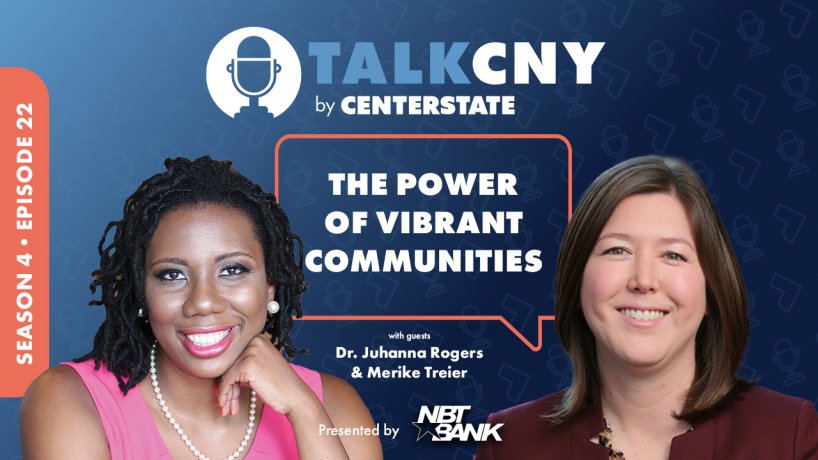
This is Talk CNY, presented by NBT Bank. I'm Katie Zilcosky, Director of Communications at CenterState CEO and your host for Talk CNY. Central New York is changing, and building a vibrant and connected community will be an essential task as we write our next chapter. On this episode of Talk CNY, presented by NBT Bank, we are joined by Executive Director of the Downtown Committee of Syracuse Merike Treier and CenterState CEO's Senior Vice President of Racial Equity and Social Impact, Juhanna Rogers, to talk about placemaking and why it matters to our future.
Merica, Dr. J, thank you both so much for being here today.
Thank you for inviting us to the table.
I'm excited. Yeah, I'm excited for our conversation too. We're talking today about placemaking, which is a big broad term that means different things to different people depending on what you're doing in your job day-to-day. So I want to start the conversation by just asking what that term kind of means to you and how you are seeing it play out in your roles. Merike, we'll start with you.
Sure. So at Downtown Committee of Syracuse, we focus specifically on the Central Business District of Syracuse, New York. So we have for this area, the urban dense spaces. And placemaking for us is how do we create spaces that are attractive, and welcoming and enjoyable and attract people into our center city? So we're looking at not only the experiences that you can have here, but opportunities to activate public spaces and, again, create that vibrancy in all the spaces around us.
So in my work, a lot of what I'm thinking about is how to help business and business leaders think about our story and utilize it as a tool to recruit, retain, and engage the talent that they have here and those that may want to return home and work here or are moving here for the first time. How do we talk about beyond downtown, how do we talk about this being a region where people could see themselves returning to or coming to live their lives in a way that helps businesses thrive? It's what placemaking from a CenterState perspective is framing.
And I think what's really interesting just about placemaking in general is everybody in our community plays a different role. And so it takes all of us to create this vibrant place that will attract the businesses, attract the residents, attracts visitors to come here to experience all of our seasons, for example, or the theater or the arts and culture. So it's your building owners first, we'll start there. They have the opportunity to activate their ground floor spaces with businesses that are going to attract visitors or meet needs of our local residents or business owners. You have the office employers who are looking for that vibrant location to locate their company, to not only retain the employees that they have, but also to attract new employees. And so it takes that commitment from our office employers who are choosing an active place and choosing to commit their resources and their energy to building up the spaces around us.
We have partners, not only the downtown community with our team, Visit Syracuse is our tourism bureau, the City of Syracuse, Onondaga County. All these different partners play a different role in this space. And so it's so important that we're all pulling together so that were each doing our part to create that vibrancy.
And I think part of what's really magical about this time and this opportunity is how we get to bring so many stakeholders. We're not going to be able to talk about placemaking with just one group. At least we shouldn't be. We should be thinking about when we were leading conversations with board members about should this be one of our priorities? They were talking about the streetscape and what it means to walk downtown or what it may mean to walk in a neighborhood that doesn't currently have sidewalks. How do we connect community in ways that build something that maybe we haven't seen before? And I think that's where I get a little starry-eyed because it's this really unique opportunity where the conversation isn't just about the business impact. We really are having a conversation about what shapes community and what shapes community are all the things outside of your office when you leave for the day. What shows do you want to see?
Are you taking your kids to the museum this weekend? Where are the parks you want to visit? And I think we have so many of those elements here. Now it's like, okay, well how do we equip more businesses, more business leaders, more HR folks, the folks that are going to go out there and talk about the opportunities that are here and forthcoming and have people think about Syracuse in a way that wants to make them stay and build their lives here.
I mean, we are having this conversation during a time where our region is seeing some historic investment and with that comes change naturally. So why is placemaking something that we should really be focusing on and investing in the same way that we're doing so with workforce and with infrastructure and a number of other really important parts of our region as a whole?
Sometimes I think that it's important to acknowledge the moment that we're in. And I think everybody in this community is a part of this moment and it's a moment where we get to say in 50 years we would want Central New York to feel like we would want people to experience. And I don't know how many other places in the world that get to do that in their lifetime. And I think this is something that not just business leaders, but our youth can lean into. The college students that are across the region could sit down and say, "Hey, if I chose to stay here, I would want to see." And I think that is something as a member of this community, as someone that resides in this region, that if there was an opportunity to roll your sleeves up, we would come to the table and offer that in a way that could be more inclusive also than we may have seen historically.
And that's what really makes me excited, the possibility of what could be for a diverse group of people.
And I think the placemaking component of why is it so important? It is that piece that ties everything together. And so you have a lot of these individual activities or spaces where things are happening with inside buildings or inside public spaces, but what is your experience from going from place to place? As soon as you walk out of your front door, what is your sidewalk experience? What is your sidewalk experience as you're going out to grab lunch or going to dinner or if you're coming to a show, what is the experience from your parking lot or garage as you're headed to the theater? So that placemaking component is certainly that physical streetscape piece of what you are experiencing from that pedestrian level, but also it helps to, as we move along, helps us to develop what our brand is and what our feel is and what is our area known for.
Whenever I think of Syracuse, I am so thankful that our historic preservation has saved all of these beautiful historic buildings because when you go to other cities, when you travel to Philadelphia, if you travel to Chicago, you notice that great architecture, you notice that sense of place and history and culture, which is so authentic, which is not something that can be easily duplicated. So again, whenever I think of downtown, so fortunate that we have a lot of these historic structures and then it's figuring out how do we keep focusing on Downtown Syracuse's growth? We have so many opportunities ahead of us. What are those next steps?
What's really exciting about that is that we know that Syracuse is going to be a center because it has a lot of the things that communities across the country thrive on. There are how many theaters within blocks? There's a couple of museums. How do we activate those spaces? And I think this is really what makes me excited about this work because the elements are here, but it's about activating and bringing diverse stakeholders to the table to think through some of those solutions. It's going to be an interesting process, but I think it's going to be a really important one as we think about, hey, we want the businesses that are going to be stationed here to feel like the employees that come with them can see themselves here. And the people that are already here are a part of shaping what they want to see and see where that converges.
What I always say is that if you got on 81 or the Thruway, Syracuse is the center of New York State. It's, in my opinion, the heart of it. And there's culture and there's diversity and there's richness here. There's the region characteristics from lakes to hikes to waterfalls to art.
It's walkable in 20 minutes. You can be anywhere you want.
You can be anywhere you want. So how do we bring that alive? I know that because I travel back and forth a lot, but how do we help other people see that and not just see it, but also feel it and also are a part of it?
Yeah. And I know you both are engaged right now in some really intentional work around that. I mean, Merike, we'll start with you. Right now, the Downtown Committee is leading an effort around a vision plan. I just want to kind of catch up with you on that. I mean, I know you're getting ready for final documents. We're close. We're close.
Yes.
Yeah, I know. It felt probably just like that it's been a long way coming, but can you tell me a little bit about what your goals were for that, what you've been hearing and kind of where you're at in the process?
For so many years we have focused on some strategies for Downtown Syracuse, obviously the clean and safe basics, but residential development was a major strategy. So looking at spaces in downtown that are either vacant or underutilized and filling those spaces with residential. And I think for a lot of cities that Syracuse was at the forefront of that in terms of how do we use some of our existing real estate. And so we are, as Juhanna mentioned, certainly the center for residential, for dining, for culture. And those are all very sound strategies, but we are at such a moment right now within our community, we wanted to be able to better understand and take advantage of what does Downtown Syracuse need for its continued growth? We have a lot of activity coming up on our Inner Harbor area, just the north of Downtown Syracuse, certainly Interstate 81 with the removal of the viaduct offers a better connection to University Hill.
So our whole center city is going to be changing, but specific to Downtown Syracuse, helping us understand we're now in a different environment where hybrid work environments have become much more the norm. Everybody doesn't necessarily need to come into Downtown Syracuse to work anymore. So what does downtown's next chapter look like? Where should we be focusing some of our efforts? Where can we be better partners to help advise on potential types of office tenants or different ways for us to think about activating the available retail spaces? So this effort was something that was really exciting for all of us because it offers us an opportunity to get our entire community engaged in helping us develop a vision for what do we collectively want Downtown Syracuse to be. And then if this is our vision, the strategic action plan component is if this is our vision, then how do we organize ourselves, whether it's a Downtown Committee or other partners to be able to then execute upon that vision?
So the intent is really for this to be a culmination of our community's priorities and vision for Downtown Syracuse. And then this is also happening in partnership with the City of Syracuse's update to their comprehensive plan, which outlines their priorities. So this will be part of the city's comprehensive plan, which will then be adopted by the Syracuse Common Council in summer 2027 and then be used as a guide moving forward.
I know that community engagement has been a really big part of this process. So when you're talking with folks at the open houses or engaging other stakeholders, what are you hearing from them? What are the ideas that are really coming to the forefront in the early parts of this process?
Well, it's been fantastic to see just the level of interest that people have in Downtown Syracuse. Again, more minds around this are going to create a really cool space. We've had a couple of different open houses and have had great turnout there. And it's great to just engage in conversations with individuals about what have been their experiences downtown, what are some other communities that they have traveled to that they think are models for how they would want their spaces to be experienced, to be felt. There's a lot of focus, I would say, from our feedback about retail spaces. If you were to walk around Downtown Syracuse, we have 82 blocks, and we've got the Armory Square neighborhood. We have the Hanover Square area. We have certainly the area around Salt City Market. We have all of these little nodes of activity, but they're not yet connected.
So how do we try to create multiple activities for people to do and experience when they come into Downtown Syracuse and have them be in close proximity? So it's forcing us to rethink a bit, how do we prioritize efforts to try to create that density in specific neighborhoods? And if we can create that density in specific neighborhoods, and how do we start to emulate from there?
Yeah. Dr. J., I definitely want to chat with you a little bit about some of the regional lens that you've been doing your work through, but first we are going to take a quick break for a word from our presenting sponsor, NBT Bank.
I would recommend NBT Bank to any business. My name is Chris Polimino, and I'm the president of Atlas Fence. Chris had decided to purchase Atlas Fence from the previous owner. He had previous connections at NBT Bank. NBT Bank provided me equipment financing, doubling our entire production workforce. It's important to me as a business owner that the decisions of our banking relationship are made locally.
This is Talk CNY, presented by NBT Bank. I'm Katie Zilcosky, Director of Communications at CenterState CEO and your host for Talk CNY. I'm joined on this episode by Merike Treier and Dr. Juhanna Rogers. Thank you both for being here today.
Thank you for having us.
Before the break, we were chatting a little bit about the downtown vision plan and some of the work that's gone into that and its upcoming results that we're also looking forward to. But we are a region as a whole. We are Central New York. Downtown Syracuse is a great center for us, but we have lots of folks who live outside of the city center that engage with it in multitudes of ways. And I know Dr. J., that's been a conversation that you've been having with a lot of our greater CenterState Network, especially at our recent board retreat that placemaking was a topic that we engaged a lot of our board members on. So I want to hear from you a little bit. What did you hear from those in the room at the board retreat around placemaking and sharing the story of Central New York as a whole?
That was such a wonderful experience. We weren't sure what folks were going to come up and say, because that's what we talked about here, placemaking can mean so many different things to different people, but we had a full table, and Brittni Smallwood and I co-chaired that group.
Our wonderful producer.
Your wonderful producer, absolutely. And what came out of that conversation? Wow. We went from talking about how we do have so much to offer. There is so much happening here. How do we equip business leaders and the teams that are going out to work on redevelopment projects to recruit talent? How do we equip them with language and a story that they could share with communities and stakeholders that they're engaged with? We talked about how much planning is happening across many different communities and the way that folks are coming around the table to think about what their community could look like, and how do we convene those individuals? How do we bring those different groups to a table to just talk about that so we have some type of comprehensive understanding of what people are thinking about? The other, I think, piece that was really interesting, we talked about what the community could look like if we had different connected points for people to consider.
Some of that rubs up against what Merike's team is doing downtown, but that Syracuse and the outsetting regions, there are personalities to them. There are little unique quirks that different communities have, and how do we braid that together, create, I'm thinking about quilt making, taking different pieces of what makes a place unique and weaving that together in a way that's authentic and honest and community-centered because they think that is where there could be real, I think magic, but also power in articulating who we are. And so it felt really good to sit around a table with this group of leaders and not think about necessarily as in depth the numbers or the outputs, but really what creation and creativity and arts and culture, what that meant and how it helps a community thrive, which was what we were hoping for and actually transpired in those sessions.
Yeah. And we've been talking a lot about the engagement that you've been doing with members of our community, but you two are both experts in the field as well. You've been doing this work for many years. So I want to hear from you guys, what are some of the strategies that you're excited about that you would like to see implemented in Syracuse, whether it's a strategy that we've already kind of been working on as a region or in a city or one that you've seen in another place that you think would work really well here?
Okay. I think about walkability, and I came to Syracuse from Indianapolis, Indiana, who went through a huge transformation in the time that I spent there. When I spent time in Syracuse, I think back to the time in which this huge turnover and transformation happened. When I think about what possibilities could exist here, I think about specifically North Salina Street and what that could look like if it was turned into this walkable streetscape with cafes and restaurants or shops and things that people actually fought for parking to get to. And you could spend a whole afternoon scrolling back and forth, meeting friends, catching an event or happening. And I think because the element of that is there, the element of that for sure is there and there's staples in there. It's just like what needs to happen? And I don't know all the dynamics of it, but what needs to happen to have that be a place where on a Friday night or Saturday night that families or friends or students are gathering in a way that extends the Salina Street experience in some way.
For me, that would be wonderful, especially for the 25 to 45 age group. I think there is definitely a gap in where they can spend time in the community. And so if it was like, Juhanna, you get to pick a placemaking project and here's -
Dr. J's first decree.
Here are a jillion dollars to do it. That would be where I would put this one.
We'll take you up on that and put it to good use. I think what you're talking about is that density and that variety of activities for people to do. And so it's like, what are 10 things that someone could do when they come to this area? Some of it may be free, some of it may be paid, but how can people of all different backgrounds spend their time? That's something when we travel to other cities, you feel it. You know it when you're there. And what's so neat is each of these different communities has such a different culture. And so I think about, we went to a soccer tournament down in Lancaster early this year, and what a cute town. Went to the central market, but it had such a cute commercial district, which reminded me so much of Syracuse, but you can tell there was an intentional effort to prioritize the density of those different businesses within a specific area.
So when you're coming to this area, you have more than one thing to do in such a walkable area. Syracuse, I think overall is exceptionally walkable, but it's then focusing on that placemaking piece of what are we doing or what can we do, what's within our various controls to make that walk interesting, enjoyable, make people curious about what's on that next block. And so if you're walking around Downtown Syracuse, for example, you may have noticed a lot of the street tree lights, and that was an effort to help better connect different neighborhoods. There's been the utility box art program popping up again to try to make something interesting and keep that walk very enjoyable as you're in that public space.
The interesting thing, like you said, is there's enough here. The challenge is how to coordinate it and how to bring it to fruition in a way that makes sense. You talked about we have beautiful buildings and if you go into some of the smaller, the villages and towns that are expansions of Syracuse, they have such personality. There's a charm there. How do we organize a campaign that helps us think about that in an intentional way, in an intentional way that also celebrates the diversity of who we are? Because I think we got to move people across neighborhoods. And I think coming in and knowing this region can be a little parochial. I'm an East Sider or a West Sider and that's the type of thing that makes, I think, a community lively. It gets really exciting, and Salt City Market is an example of that, of how do you own that, but think strategically about allowing people to co-create with that energy in mind.
And I think that's where we have to get to in some ways, shape or form.
I think that's probably what is so exciting about working with this community because you see that opportunity and you can experience it, so you know the potential that exists. Syracuse is a small enough community where you know most of the folks that are working in this space.
So being able to work collaboratively and intentionally about how to we work together, and all pull in the same direction, I think is what keeps a lot of us working here for so long.
I want to end our discussion today by kind of handing it over to the two of you to inform anyone listening who wants to be involved in some of these efforts on the best way to do so. How can someone who wants to make our community more connected, more vibrant, get involved in these efforts?
So for us, we have coming up on December 8th, we have our final open house around the downtown vision and strategic action plan. So that'll be taking place at the Atrium building from 5:00 to 7:00 PM. It's an open house, people can drop in whenever, provide their comments on the priorities and strategies outlined in the plan. And then also I would recommend following the downtown committee on social media. So it's, Downtown Syracuse is the handle for all of our different platforms. We also send out a weekly newsletter. We use that as a communications tool to help inform people all the exciting things that are happening within the downtown area and what they can take advantage of.
For me, please reach out. I think we are still forming how we are going to go about convening different stakeholders and groups going into 2027, and for a period of time, right? This isn't going to be a priority for one year, and then it goes away. I feel like it's going to be something that builds momentum, and we're going to build and figure out together, and it's going to continue to evolve because we have things that are happening for the next 10 years coming. And so I think if you're interested in being a part of those conversations, if you're interested in hosting a convening or being a part of one of the convenings, reach out to us here at CenterState or me directly, and we'll start collecting names so that as we start to lay out this plan and groundwork, we can help people come to the table and be a part of that process.
Dr. J., Merike, thank you both so much for being here. It was such a fun conversation.
Thank you.
Thank you. Thank you. Here's to making places.
Talk CNY, presented by NBT Bank, is recorded in the production studio at CenterState's INSPYRE Innovation Hub. Talk CNY is available on all major podcast platforms or centerstateceo.com. Additional content and clips can be seen across CenterState CEO's social media channels. For new episode reminders, be sure to subscribe in your favorite podcast listening app and don't forget to leave a quick review or five-star rating. Thanks for listening to Talk CNY, presented by NBT Bank.
Other
Talk CNY Main Series Transcripts
| S4,E21 - NY SMART I-Corridor | November 11, 2026 | |
| S4,E20 - Cainaan Webb | October 8, 2026 | |
| S4,E18 - Craig Marcinkowski | September 23, 2026 | |
| S4,E17 - Nora Spillane, Craig Witmer | September 9, 2026 | |
| S4,E16 - Joan Royle, Emilija Postolovska | August 26, 2026 | |
| S4,E15 - Dave Kavney | August 12, 2026 | |
| S4,E14 - Carrie Large | July 29, 2026 | |
| S4,E13 - Corporate Leadership Team | July 15, 2026 | |
| S4,E12 - Dr. Carlene Lacey | June 24, 2026 | |
| S4,E11 - Jared Shepard and Jess Abbott | June 10, 2026 | |
| S4,E10 - Sara Nozkova | May 20, 2026 | |
| S4,E9 - Kara Jones and Brad Banikowski | May 6, 2026 | |
| S4,E8 - Joe Nehme | April 22, 2026 | |
| S4,E7 - Rob Simpson, Ben Sio | April 8, 2026 | |
| S4,E6 - Lindsay Mastrogiovanni, Kathleen Avery Connell, Jim Connell | March 25, 2026 | |
| S4,E5 - Jess Abbott & Honora Spillane | March 10, 2026 | |
| S4,E4 - Sara Broadwell | February 25, 2026 | |
| S4,E3 - Brandon Mastrangelo | February 11, 2026 | |
| S4,E2 - Ryan McMahon and Rob Simpson | January 28, 2026 | |
| S4,E1 - Rob Simpson | January 14, 2026 |