

Leadership Lessons S4E7 - Tricia MatthewsPosted on November 29, 2026 |
Image
|
W
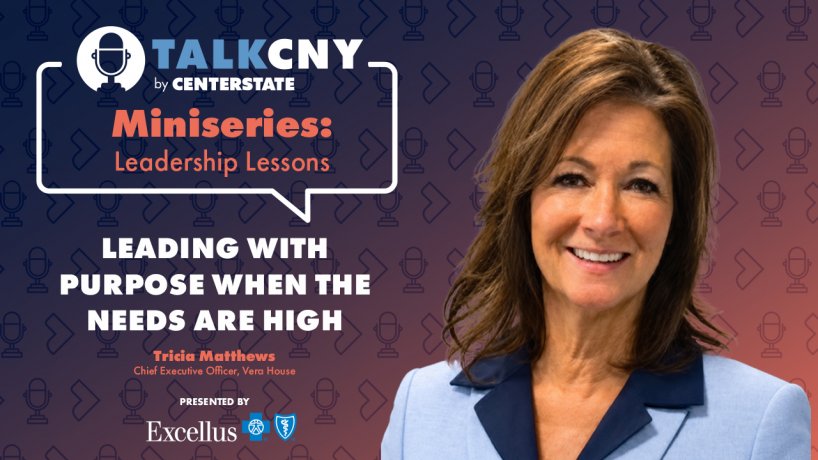
Welcome to the Talk CNY miniseries, Leadership Lessons, presented by Excellus BlueCross BlueShield. CenterState CEO's podcast is being recorded in the production studio at CenterState's INSPYRE Innovation Hub. Today's guest is Tricia Matthews, the Chief Executive Officer of Vera House, an organization committed to ending domestic violence and sexual abuse.
Tricia, welcome. Thank you so much for joining us today.
Thank you for having me.
Oh, it is such a pleasure. So last year, Vera House officially responded to 5,500 crisis calls, not only in the City of Syracuse, but really throughout Central New York.
Sure.
Can you describe to us what is it like operationally to respond to more than 5,500 crisis calls?
Yeah. Well, first of all, it takes an amazing team, which we have. It takes commitment and compassion for me to support that work, to be able to provide what looks like self-care for them, because days are heavy. I think a lot about when people walk into our main office and it's real and in their face and you can see the look of emotion come over them that they think about, think of the stories that this place has heard and the visions of what they've seen. I will say to you that the team, the advocates, the therapists that are responding to all of this, you would never know that their work is heavy, the way they carry themselves. It's remarkable to watch. And they navigate together around a table about difficult cases to say what's in the best interest of our client, and how do we keep them safe?
And they work tirelessly. So very, very proud of that team. Very proud.
They do a wonderful job.
They do, really do.
You truly do have a wonderful team, and crisis intervention isn't really the only thing that Vera House does. You do so much everything from preventative education to therapy to housing accountability program, as well as long-term recovery. Can you describe for me really how does all of this contribute to the mission of Vera House?
Sure. So we like to say that we're like the before, the beginning, the middle, the after, because it's the prevention education piece, getting in the schools and getting upstream to educate young children, young individuals. And then after it's happened, we have two shelters, and then we have a therapy team. We have a team of advocates. We have an abuse-in-later-life program because that's something that's really on the rise. We have a SANE program, sexual assault nurse exam. So anyone that has been sexually assaulted that ends up in the emergency room, we have a team of nurses that go out and take over, and they do the kit, and we send an advocate with them. Roughly there's around 300 of those a year, just to put it in perspective for people. And then it's the after phase too, and then it's the, if we're going to reduce it, it's the people who are causing harm, who many of them are victims themselves, really putting some energy and effort behind that work as well.
So we have the accountability program, and there's a STRIVE grant now within the community. I cannot say enough about it. It's through DCJS, and we work closely with law enforcement in the DA's office and we have a DVHRT, which is a group of people that they review the cases, and we try to figure out the barriers in the system so that we can reduce this moving forward. And so it brings all of this stuff to light. So our volume right now through STRIVE is we're expanding at the seams.
Really, your organization is doing amazing work, and you have a great team.
We do.
You really do.
We really do. They give me goosebumps.
Oh, I love that.
They're so good. And to watch them, I don't care what department they're in, to watch them all come together, it's miraculous, really.
And they go out each day, and they really help so many people through some of the most difficult and darkest times that they have to go through. How do you work with them to build a culture to help them ensure that they don't lose hope themselves?
So we do a lot of networking internally ourselves. We try to have snack day where we just take a breather, and everybody brings something in, and we sit around. One day we did storyboards together. So we took an afternoon and just kind of pressed pause and sat on the floor and cut out of magazines and put boards together. Some days I ask my husband to bring the grill over, and we cook out, and we just spend time together to take a load off. You got to turn this off because domestic violence and sexual assault doesn't just happen between nine and five. It's twenty-four seven, and it's in everybody's backyard. So it's not uncommon for us to be on the phone at nine o'clock at night because there's a particular case that came in that's difficult. And sometimes you just got to put your heads together to say, what are we going to do?
What are we going to do for safety planning for the next 12 hours? It's that type of stuff, especially if we're full at the shelter. So working on that stuff. So it's heavy, it's a lot, but I think we do a really, really good job at the self-care part.
I love that you not only take care of the community, but you take care of one another as well.
We have to. And that finding what does self-care look like for me because I'm carrying the place with me twenty-four seven. I'm a little better than I was. I'm not where I need to be. So it's definitely something that I have to be purposeful about.
What are some of the common misconceptions that people have about whether it's domestic violence or sexual assault?
That it's over there. That it's in somebody else's backyard. And that's not true. It impacts one in four. So anytime you're in a group of people, look around because it impacts one in four. And it doesn't mean that you've been punched in the face. You don't have to have a black eye to be a victim. It's any kind of control. There are people who, they don't have a credit card in their name, they don't have a car in their name, the house isn't in their name. And so if you're feeling like, God, this isn't working for me, how do I get out? You're coming to us possibly. So that's why we talk as a team. We've got to be equipped with the stuff to make them comfortable, or they're not going to stay. They're going to go back. So those are the things that keep us up at night to say, what do we have to have in place here so that we can help these people?
And I'm going to say Onondaga County is very lucky. We are very, very lucky to have the wraparound services that we have here. There's so much support for people, but you've got to make the phone call. So maybe we're not the answer, but we're going to find you the answer. We're going to find another agency that maybe is going to help you for whatever that is that you need.
It's beautiful that you not only sit down and assess their needs, but you really work with them to create a plan.
There's no two people that come in that are the same. So it's not like we're like, okay, on repeat, you really have to take the person and, first of all, what is it that they're going through and then what is it they need to stay safe moving forward and then get them on their feet so that they can stay safe. So coming out of our shelter, that's a 90-day stay. We do get extensions. If it's not a safe discharge. We're not just putting people out on the street. And then what does that look like moving forward for them when they get in their apartment, following through with them and having a case manager that's working with them to make certain that they have everything they need. Someday we can do a session on the staff at the shelter because that's a whole other, give you goosebumps.
That team over there is so compassionate and so dedicated and so loyal and they take great pride in that work. It gets very sad for them when the people move out because when they're there with their kids, and the whole team's helping to take care of the kids so that the mom can take a breather and to watch them. And then when they move out, the staff, they cry because they're like, "Oh, I was helping little Johnny with his homework and we were baking muffins and all of the things." And it's beautiful to watch. It really is. So someday we'll go over, and I'll give you a tour.
I love it. Well, it's just beautiful to listen to as well.
Yeah, it's great.
You have a wonderful team.
Again, we're lucky to have that access to that for people who need it. Some of the weight that I carry is what if all this went away someday, and what would the community do without Vera House? It's bigger than me, and it's bigger than the team. It's that the community really needs to wrap around it because we got to keep it here because it's needed. We serve, and we interact with over 10,000 people a year between all our programs. So got to keep it here.
Now you're really touching on the next topic because you keep really describing how demand for your services really is continuing to grow. So as the CEO, how are you thinking about growth, but also measuring impact currently?
Growth, definitely. Our volume is increasing, numbers are going up, which it's, I mean, I hate that it's that way, but it is right now. And so we have to be ready for that. And the county's been really great working with Vera House. We're talking about expanding. We're working on an expansion application right now with the state. We currently are licensed for 36 beds, but we're full every day. So we've done a walkthrough of our current shelter, and we can add 12 more beds. So we're going to get licensed for 12 more beds.
That's great.
And then theoretically, I'm working with the board of directors and the team. I would like a new shelter that has more beds because with the phenomenal growth with Micron coming, when we talk about 40,000 jobs, that's 40,000 families, which means that's more volume for me and Vera House. And so I have to be prepared for that. So the expansion and the new shelter really will be something that will help support that.
So you kind of touched on it, but as you look out five to 10 years, if Vera House has the resources that it needs, what does that mean not only for your organization, the people you serve, but also the Central New York community?
Sure. So we have to do more for the kids, right? So moms come in and they have their children. And if you've got a mom that has four children, that's five of the beds. So we have to be prepared for more families. And then my vision really is like a sanctuary type of a place where we have a wing where we can support the kids because they're victims themselves. We're not doing enough there. We already recognize that, that we could have a wing of educating them and supporting them and helping them as they're growing and to help educate them what a healthy relationship is, because let's face it, nobody's taught us that. We learned the hard way. And so to be able to support in that way, I could see a whole wing where we do self-care for the survivors, really getting them in a healthy place so that when they leave us or when they go out into the world and get into a safe place for themselves, that they have all the tools in their toolkit to select differently so that they're not ending up in the same situation, the same abusive situation just with somebody else, having a wing where we're educating them in that space and really getting them to start that healing journey. If you're not going to do that work, you're not going to get out of that cycle. And it is a cycle, like I was talking about the people that are causing the harm are sometimes victims themselves. And so getting them healthy as well would be a great thing for the community.
I see your vision. I'm excited for you.
It's a big one. It's a big one.
It's a great one. Well, coming up next, what we do is, it's called a rapid fire section.
Okay. Rapid fire. I like it.
We're going to have fun. So during this part, I will ask you a question, you'll get 30 minutes to answer it, and then we will move on to the next question.
Great.
All right. So my first question for you is, if you had to describe your leadership style, what would it be?
So probably driven. I'd say ambitious, compassionate, strategic. I'm pretty goal-driven. I'm big on numbers and dashboards. The team laughs at me. They're like, "Here she goes again." But I think the numbers tell you something, right? Yeah, I think those things. I think the team would say that. I like to be fair across the board, manage expectations so everybody knows what's coming and what to expect. And I hold myself accountable.
What book, podcast or person has had the biggest influence on the way you lead?
I would say the biggest impact was a very, very bad boss that I had at one point in my career that I actually thought through, I know what I'm never going to do because I know what it feels like to just have that bad boss. So I then became purposeful as I grew up and learned to be a leader that those were the things I was not going to do. I was going to do just the opposite and learning to listen because I don't have all the answers. The team does, so build a good team. And then a very good boss that I had that's been a very good mentor to me throughout my career. We talk often, and I talk through some of the challenges and just talking about approach and those things. And he's been really, really very impactful for me throughout my career.
That's beautiful.
I give him accolades for it though. He knows.
What is a quality that you would say when you look at leaders today, it's something that you really value, but perhaps when you started your career, you didn't think it was necessarily valuable?
Sure. I'd say accountability. And if you don't have a culture of accountability, you're not winning the game. As a leader, my job isn't to be everybody's friend, but I am compassionate, and I want everybody to be okay, but I want them to grow too. And they know that. I say all the time, if you're comfortable, you're not growing. So get comfortable being uncomfortable because as we elevate the work, we've got to elevate what we do individually as leaders and managing the team. So definitely accountability. It's so important.
Well said. When you leave work after a really heavy day, what do you do to recharge and reset?
I have a little bit of a commute. So for me, I take that time. I try to take that time to just listen to some soft music and really kind of let it all out of the brain. I do try to let it all go, even though I'm still getting calls in the evening, which is fine, it's part of the role, because I then am available to be able to answer those questions in a calm way versus all the hype of the day and now you've called me at nine, and I'm not in a good mental space. So I do try to do that.
All right. So fill in the blank for this one. My job is blank, but reality. In reality, it is blank.
I think that people probably would say that my job is very difficult, but in reality it's very rewarding because we get to help people, and we get to create what that looks like and our impact. And the place sucks you in, I'm just going to tell you, we're like a family and coming into those walls, most people are like, "I'm stuck now. I got to stay here because we got to leave it better than we found it." So that's what we're working on.
Well, as we prepare to close our podcast, what would you say to the listener who is a leader and they're trying to ensure that they tackle their short-term goals while trying to set, rather, their long-term strategy?
I would say don't take no for an answer, right? So I can think of multiple times being the CEO here of where I didn't take no for an answer and pushed forward. Keep going because if you're believing in the mission of what you're doing, it's going to take you to put your foot on the gas and push forward or you're not going to survive. So don't take no for an answer. Keep going.
Thank you.
Thank you.
Thank you so much for joining us today.
Thank you for having me.
Oh, it was a pleasure. It was a pleasure.
Well, if you would like additional responses from Tricia, they will be available across CenterState CEO's social media channels. Talk CNY, the miniseries Leadership Lessons, is presented by Excellus BlueCross BlueShield. CenterState CEO's podcast is being recorded in the production studio at CenterState's INSPYRE Innovation Hub. Thanks for listening. Have a great day, everyone.
It's why I love my job. It's literally the best benefit that Excellus has to offer where you can actually sit and talk to someone face to face. I've been studying this for two weeks now. I solved my problem in 10 minutes. I try to make it as simple as possible. I look at each member as if they were my family, and I would want someone to take the necessary steps to reassure them and not take up too much of their time. Come see us if you have a problem, and we will help you. And if we don't have the answer, we'll find the answer together.