

Leadership Lessons S4E4 - Dimitar KaraivanovPosted on July 24, 2026 |
Image
|
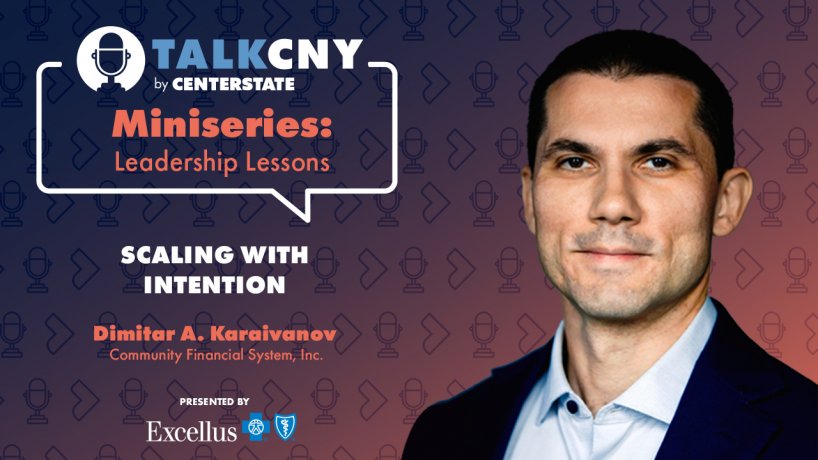
Welcome to the Talk CNY miniseries Leadership Lessons presented by Excellus BlueCross BlueShield. CenterState's podcast is being recorded in the production studio at CenterState's INSPYRE Innovation Hub. Community Financial System was named by Forbes as one of America's best banks, and it won CenterState CEO's Business of the Year Award for businesses with more than 50 employees. Community Financial System has grown exponentially over the years and today has four key business units. Well, today's guest is Dimitar Karaivanov, the president and CEO of Community Financial System. And today we're going to discuss leading and scaling with intention. Dimitar, welcome.
Thank you, Brittni. Very excited to be here.
Oh, it is such a pleasure. I'm really excited to get into this conversation. So Community Financial System today has four business units, but when you began more than a hundred years ago, it was a traditional banking system. So can you describe to us the four business units, and how you've scaled intentionally?
That's right. That's right. So we actually started 160 years ago in Canton, New York. So we've been around for a while now, and we're now the largest financial services company headquartered in Central New York, so right here in Syracuse. We're running right over $800 million in revenue, and we've got 3,000 people in 30 states. So to your point, where we started and where we are today is a little bit different. We have four wonderful, wonderful businesses. One of them is Community Bank, where we started 160 years ago. The bank now operates in New York, Pennsylvania, Vermont, New Hampshire and Massachusetts.
Just to give you a sense of scale, there's 4,000 banks in the country, and we're roughly 75th in terms of size, with about $17 and a half billion in assets. So pretty sizable for what we can do for our customers. Then we have an employee benefits business called BPAS, and that business administers all kinds of benefit plans nationwide. So that's where a lot of our offices come. They have 18 offices across the country. That business is now one of the top 15 record keepers in the country and also has about $16 billion of assets of retirement assets they administer for folks with almost a million participants across the country. Wow. And then we have OneGroup right here in Syracuse as well, which is now the 68th largest insurance agency and risk management company in the country. By the way, there's 40,000 of those around.
So pretty meaningful size and scale as well at OneGroup. Our fourth business is Nottingham Financial Group, which is our wealth and asset management business, which now has also just about as much assets as the bank, $17 and a half billion with customers in every state across the United States. So really, really excited to be where we are today. And that's been a path of evolution and development and growth along the way that we now get to accelerate on our own.
You really have. I mean, when you describe all of those numbers, you can truly tell that you have scaled strategically really in each line of business. So can you describe for us what practices or principles did you cling to and move you along as you scaled?
Yeah, great question, Brittni. It's been intentional, and it's been deliberate. And what we focus on really at the end of the day is our core values and our strategic plan. So if you look at our strategic plan, it actually doesn't say anything about size or revenue or anything like that. We talk about the kind of company we want to be, the kind of talent we need to grow and to acquire, the kind of culture we want to have and the kind of values we have. And all of that then builds on the success. So everything follows from it. So it's very intentional and deliberate.
I'm glad you mentioned company culture. You've described that maintaining trust, keeping people at the center of the business is really paramount. So can you describe what metrics you use to really kind of help you see that you're carrying that forward as the company grows?
Yeah, it's really important. So if you think about our business in financial services, our currency is trust. And one of our core values is integrity. It's the same thing. That is really the currency that we operate with. And then people do business with people. We trust each other by our interactions. So the quality of talent is really paramount, and that's what we focus on is the trust and the talent are really the key ingredients to all of this.
That is beautiful. And I know one of the other things for your organization is excellence. That is truly a key tenet. So as you look at the four components of the one organization now, how do you ensure that excellence carries through as each of the business units really tries to meet their profitability goals?
Great question. We're a little bit obsessed about benchmarking and KPIs. So every quarter, each one of our businesses gets basically compared to its peers. And a lot of folks would then think about, okay, well, what are the peers doing? What is the average? Average is irrelevant. None of us wakes up in the morning and says, "What a beautiful day today to be average." So we want to be top. We want to be top quartile at the very least in each one of those businesses. So we benchmark. We understand what's happening. We understand the places where we need to be better, the places where others are better. And that's how we do it. So it's consistent. It is the pursuit of excellence that really drives us.
Was there a specific moment within your stage of growth where you noticed perhaps that you needed to change up perhaps the communication styles or different structures or systems within the organization to ensure that you scaled effectively?
Yeah, really interesting. This happened actually at the time of my predecessor, Mark Tryniski, probably about five to seven years ago. And all of our businesses kind of hit this next stage of their capabilities and their presence and their ability to acquire talent and to grow. And so as a result of that, we really had to go back and take a step back and make sure we've got the right systems, we have the right incentives, we have the right products, we have the right people, we have the right brand, the reputation, the expectations around how we do and what we expect to do, who do we expect to do business with? How are we going to be best in class? So all of that had to be put in place because for us, growth, if you look at in the history of the company, growth has not been really linear.
It's been a step function. And we kind of hit that next step in our growth and that's kind of where we are in the trajectory. And then we're going to hit our next step, and we're going to have to reevaluate again; do we have everything ready for that moment in time?
What I also hear you saying is that having a strong foundation was really important. And then anything as you were growing, you continued to kind of adjust to make sure that everything was in place as you kept going. Wow, you guys have done a great job.
Thank you.
Appreciate it.
Can you describe what was the impetus behind becoming a diversified financial system?
Sure. So if you think about what our function is, it's not to be a widget maker. It is to be a partner to our customers. So if you are a business, you need capital to grow your business. So that would be the bank. You need safety of the money, so that would be the bank. However, you also have employees. You want to grow your talent. So now you need help with, okay, well, I want to provide those employees with the right retirement plans and with the right benefits along the way, and I want to make the best choice for their health insurance from the company's perspective. You also need to insure your business. If you don't have insurance, your business can go poof right away. So that's pretty critical. And it's not just insurance, it's about risk management of the whole operation.
Now you're making money. Now you're becoming wealthy. Hopefully everybody is. So now you have needs as it relates to wealth. Now your employees have needs because they've grown with the company. So really finding a partner that can help you along the way as opposed to just, I think I need a new bank because I'm unhappy. Or I think I need a new bank because they won't give me a loan or my HR director is unhappy with this horrible retirement services provider that we use. Or my people are unhappy because there's nobody to talk to about their financial planning. That's the problem, but that is not the partner. That's not the solution. So we focus on how can we cross-service clients and provide them a real solution in one place in a world-class way because all of our businesses are at that point in their life where they have world-class capabilities.
I love that you really thought about the customer journey for the individual who begins at banking and then as they grow themselves, they can really grow with your organization. Can you describe for me as a leader, what is it like for you to have a vision, to be able to see that this is not just your traditional banking system? This is now what you've created into a diversified banking system?
Yeah. It goes back to just understanding what problem are we solving for. And oftentimes we always go into, if you go to the doctor, you have a preconceived notion of what's happening with your hand hurts or your foot hurts. That may be totally not what you think it is. At least in my cases, I guess I'm a hypochondriac. It's not what I think it is, which is good, I guess. But we have this preconceived notion of what the problem is, but it may not be that. It might be, but it may not be that. And there's a lot more that we don't know than we know.
So then as you continue to look forward to the future, what is your vision for the organization?
Better, higher, being the best bank in our markets, being the best insurance company in our markets and in our niches, being the best wealth manager in our markets and in our niches, being the best employee administration business in the country. So that's our vision. We expect excellence. Again, we go back to our core values, which are humility, integrity, teamwork, and excellence, HITE, which will take us to new heights, pun intended. And that's really the foundation of what we build on every day and what's going to propel us forward.
All right. So within this series, we like to do something fun. It's called our rapid fire section. So I'm going to ask you a series of questions. Our goal is for you to answer it in 30 seconds and then we'll move on to the next one.
All right.
Okay. So the first question for you is what is the best piece of advice anyone has ever given you?
Do the right thing. So it's kind of simple, right? It's true, it's powerful. Just do the right thing.
I like that. What's a habit or routine that helps keep you grounded when business gets especially busy or complex?
I like to go back to first principles and kind of step back and think about, okay, why are we doing the things that we're doing? What are we here for? What does this mean for our customers? What does it mean for our colleagues? What does it mean for our communities? So just stepping back and eliminating the noise. We need to cut the noise out and focus on what's really important, first principles.
I like that. So you take a moment to really reflect on the why. Why is all of this important? That is phenomenal. What moments in your career have brought you the most joy?
Honestly, Brittni, it's seeing our people succeed, seeing them grow, seeing them develop.
What books would you recommend to fellow business owners or leaders?
So what I have found is that there's really no manual to leadership or being in this position. It's a little bit like parenting. Use your best judgment and use the frameworks you've built over time. With that said, when I was elected in my position by the board, they very thoughtfully assigned me a coach for a few months before I stepped into the position. And that coach recommended a book called CEO Excellence, which I truly found to be very, very helpful and very, very inspirational. And I've given it actually to all of my direct reports as well.
That's beautiful. What strengths do you rely on most as a leader?
Transparency to the point of sometimes uncomfortable transparency. I think that builds trust and integrity. I think if you get trust and transparency in an organization, if people know what to expect and what the rules of the road are and what the consequences are, I think it goes a very, very long way.
I agree. One thing I've been itching to ask you, I love that you say that when you have stress, it is a privilege. Can you describe why?
Yeah, it is. So I mean, if I think about the things that I feel most privileged about in my life, which are being a father, being a husband, leading a great organization, all of those come with a fair amount of stress. So the privilege and the stress are interconnected. And if you think about the reason why we feel stress, why we feel pressure, why we're nervous, it's because we're doing something important. And I think it's a privilege to do important things.
Well said. Thank you so much.
You're very welcome.
Well, that ends our Rapid Fire Section. So the last question I want to ask you before we close is for any leader who is listening to this, and they're thinking they would like to scale their organization or company, what advice would you give them?
I would say don't compromise on talent. That really is the key ingredient, and aim for the best, expect the best, ask for the best that drives it forward.
Thank you, Dimitar, for joining us today. If you'd like to catch additional clips from Dimitar, his responses will be available across CenterState's CEO's social media channels. Talk CNY, the miniseries, is presented by Excellus BlueCross BlueShield. CenterState's podcast is recorded in the production studio at Center State's INSPYRE Innovation Hub.
It's why I love my job. It's literally the best benefit that Excellus has to offer, where you can actually sit and talk to someone face to face. I've been studying this for two weeks now. I solved my problem in 10 minutes. I try to make it as simple as possible. I look at each member as if they were my family and I would want someone to take the necessary steps to reassure them and not take up too much of their time.
Come
See us if
You have a problem and we will help you.
And if we
Don't have
The answer, we'll find the answer
Together.